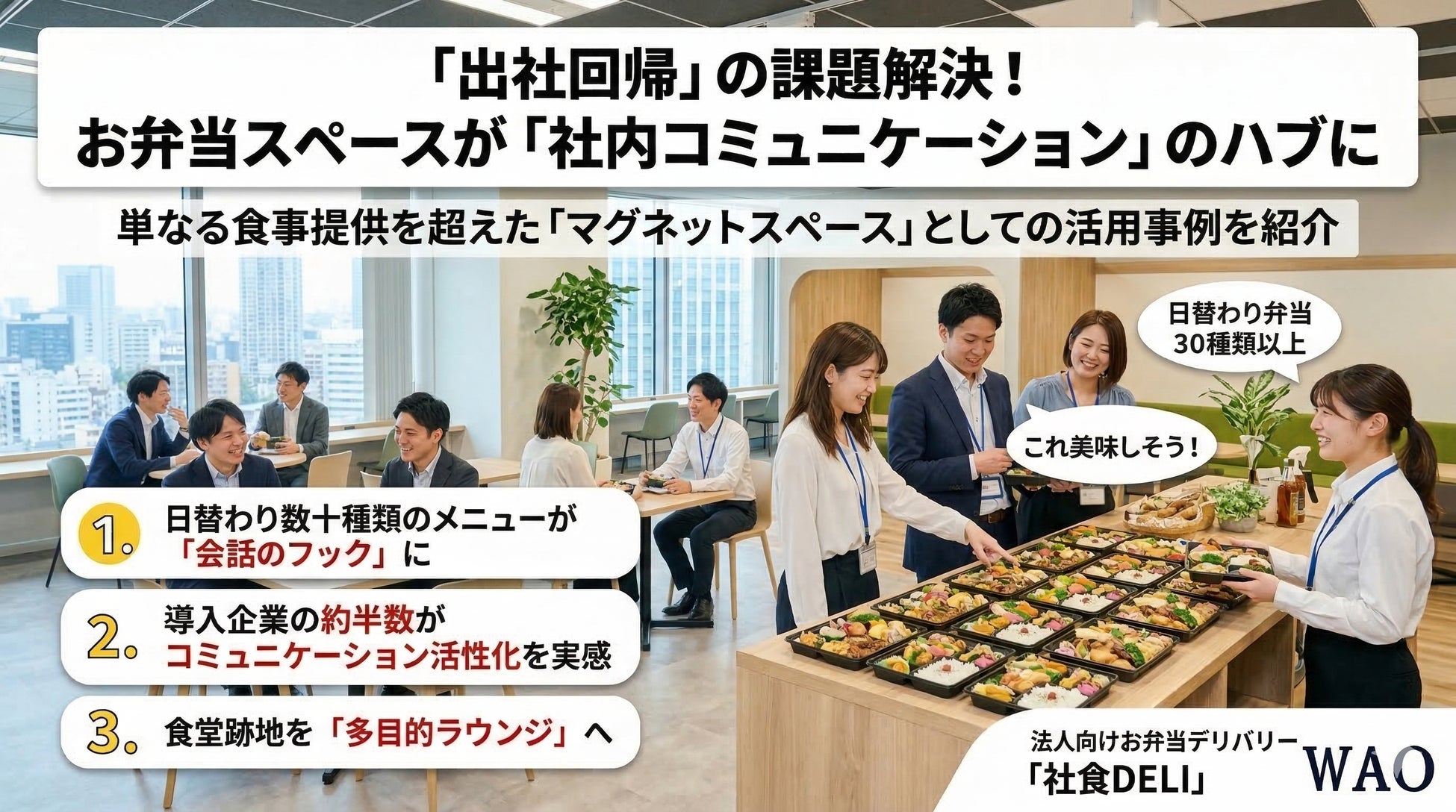
Wao Corporation, which operates the corporate bento delivery service "Shashoku DELI," announces that companies are rapidly increasing their use of "bento sales spaces" as a measure to revitalize internal communication amidst the ongoing return to office from remote work. We introduce case studies of its implementation as a "magnet space" where employees naturally gather, going beyond mere meal provision.
Background: Return to Office and Communication Challenges
In recent years, many companies have adopted a hybrid work model of remote work and office attendance, or are returning to a principle of office attendance. However, an increasing number of companies are facing communication challenges such as "just working silently at their desks even when in the office" and "fewer casual conversations with other departments." Companies are now required to implement new measures to enhance the "value of coming to the office."
Trend: Bento as a "Conversation Hook"
In response to these challenges, among companies that have introduced Shashoku DELI, there is a growing trend to utilize bento sales spaces as "magnet spaces" (places where people naturally gather).
The biggest feature of Shashoku DELI, its "dozens of rich menu options daily," serves as a natural conversation starter (hook), such as "What bento are you getting today?" or "That looks delicious!", creating opportunities for employees from different departments, who usually don't interact, to meet.
Survey Result Highlights
1. Approximately half of adopting companies experienced "revitalized internal communication"
Among 35 companies that introduced Shashoku DELI, 17 companies (approx. 48%) cited "revitalized internal communication" as an effect after implementation. Many comments were received, such as "conversations naturally arise when choosing bentos" and "increased opportunities to meet employees from other departments who I don't usually interact with."
2. Abundant menu options serve as a "conversation hook"
It was found that Shashoku DELI's biggest reason for being chosen (answered by 27 companies), its "overwhelming variety of menu options," not only improves meal satisfaction but also functions as a conversation starter (hook) for phrases like "That looks delicious!" or "What did you eat yesterday?"
3. Former cafeteria sites evolve into "multi-purpose lounges"
In companies (14 companies) that abolished their cafeterias with kitchens and switched to Shashoku DELI, the vacant kitchen spaces were renovated into refresh lounges or meeting spaces. These are effectively utilized as "magnet spaces" (places where people naturally gather) where employees buy bentos and eat them on the spot.
Case Studies: Bento as a Hub for Natural Communication
Uzabase, Inc.:
"Since bentos are easily available, some employees who didn't plan to come to the office ended up coming, making it perfect for creating everyday communication."
Viking Co., Ltd.:
"It's great that lunch has become a trigger for communication among employees. We buy bentos while chatting, like 'What are you getting today?'"
Comment from the person in charge
"At a time when the 'value of coming to the office' is being questioned, an attractive lunch environment is a crucial factor. Shashoku DELI not only satisfies hunger but also contributes to corporate organization building as a 'communication infrastructure' that fosters natural connections among employees."
About "Shashoku DELI"
"Shashoku DELI" is an employee welfare service that utilizes empty office spaces to provide daily bentos through face-to-face sales by dedicated staff. It helps establish a comfortable lunch environment for employees and creates a better workplace, while minimizing the burden of equipment investment and inventory management.
Features
・ Over 30 varieties of Japanese, Western, Chinese, and limited-time menus daily
・ Streamlined operations with permanent sales staff (comprehensive support from ordering to sales and cleanup)
・ No initial equipment investment required for smooth implementation
・ From 350 yen per meal (satisfaction can be enhanced by utilizing corporate subsidies)
"Shashoku DELI" Service Site
About Wao Corporation
Wao Corporation plans and operates services that contribute to improving employee well-being and enhancing corporate institutional value, primarily focusing on office meal support.
Through face-to-face bento sales and installed systems, we specialize in ease of introduction, reduced operational burden, and experience design that leads to continuous use.
Main Businesses
・ "Shashoku DELI" - Bento-specialized employee cafeteria service
・ "Obento DELI" - Bento delivery site for corporations and organizations
・ "Yatai DELI" - Takeout-specialized food court
・ "Hakobu Catering" - Comprehensive site for hors d'oeuvres and catering
Company Profile
Trade Name: Wao Corporation
Representative: Akira Uratani, President and CEO
Location: Shibuya 363 Shimizu Bldg. 11F, 3-6-3 Shibuya, Shibuya-ku, Tokyo 150-0002
Established: September 2003
Business Activities: Planning, operation, and sales of "Shashoku DELI," "Obento DELI," "Yatai DELI," and "Hakobu Catering"
Capital: 100 million yen
Website: Wao Corporation
FACT BOX
- Source: PR TIMES
- Category: News