Uno Priere Group (Headquarters: Osaka City, Kita-ku, Umeda; President and CEO: Ryo Iseji) has established a new work model at its time-saving salon "KUSELESS" (Osaka, Dojima), specializing in hair quality improvement color and frizz care. This model, centered on zero overtime, standardization, and DX (digital transformation), aims to create an environment where young stylists who have left the industry due to long working hours and technical pressure can continue to work and thrive in the beauty industry, which is facing demands for work style reform.
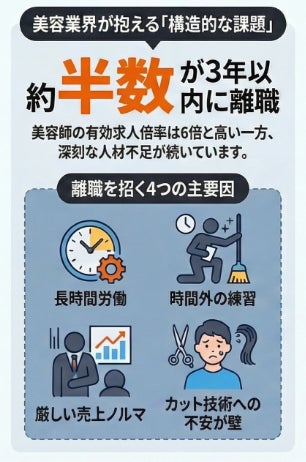
Challenge: Escalating Turnover of Young Hairdressers Amidst Work Style Reform While the government promotes work style reform and addressing long working hours and preventing young people from leaving their jobs are social issues, the beauty industry faces similar and worsening problems. In the beauty industry, young hairdressers are continuously leaving due to factors such as: ・Long working hours ・Extensive practice and meetings ・Sales quotas ・Discomfort with cutting According to Ministry of Health, Labour and Welfare data (*), the turnover rate within three years for those whose first job is as a hairdresser is approximately 36.7%, and about half of all hairdressers leave within three years. On the other hand, the active job opening ratio for hairdressers is about 6 times higher, indicating a structural issue where labor shortage and turnover are occurring simultaneously. *Job Information Provision Site (job tag)
Reform: Redesigning Work Styles and Salon Operations (KUSELESS Model) In response to these challenges, KUSELESS has reviewed traditional work styles and operational methods to create an environment where young hairdressers can continue to work and succeed without undue strain.
Four Specific Reforms: ① Thorough Efficiency Improvement through Standardization and DX: Eliminating the reliance on individual skills by standardizing technical procedures with video manuals and treatment flows. By systematizing operations, including appointment management, stylists can return to the field after just four days of training.
② Elimination of Off-Hours Work: Consolidating practice, meetings, cleaning, and ordering within working hours. By redesigning work processes, an operational system has been achieved that allows for arrival just before the start of the workday.
③ Reduction of Psychological Burden: The service structure excludes cutting, and sales activities and a client-naming system are eliminated. By limiting the scope of work, an environment is created where stylists can concentrate on treatments.
④ Optimization of Revenue Structure: Achieving high productivity with a small team through optimized service menus and standardized operations. Combined with proprietary product development, this leads to a stable monthly income of ¥310,000.
<img sr...
FACT BOX
- Source: PR Times
- Category: News