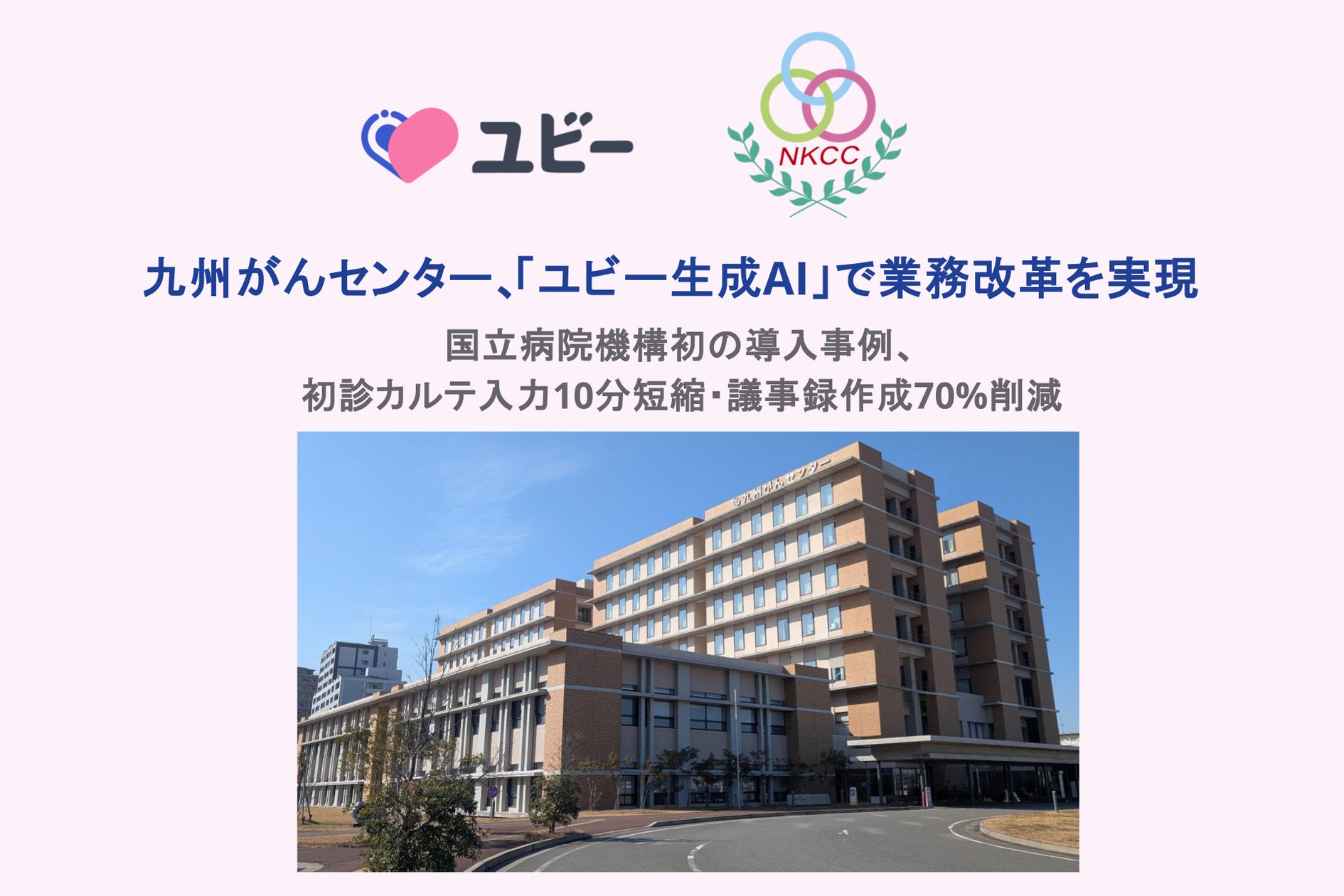
Ubie Inc. (Headquarters: Chuo-ku, Tokyo; Co-CEOs: Yoshinori Abe, Kota Kubo; hereinafter "Ubie") is pleased to announce that the National Hospital Organization Kyushu Cancer Center (Location: Fukuoka City, Fukuoka Prefecture; Director: Masaru Morita; hereinafter "Kyushu Cancer Center") is actively utilizing "Ubie Generative AI" to improve the efficiency of its internal documentation and administrative tasks. This initiative marks the first case of a medical-specialized generative AI being utilized by the National Hospital Organization (NHO), with numerous achievements being made under the leadership of the center's staff.
Background and Challenges
Amidst the full-scale implementation of the "work style reform for physicians" with the application of limits on overtime work and the promotion of task shift/share (initiatives to establish a system where each profession can exert their expertise by dividing and transferring tasks among different job roles), Kyushu Cancer Center has been earnestly addressing the challenge of reducing the burden of "documentation tasks" and "administrative work" for its staff, while continuing to provide advanced medical care as a specialized cancer hospital. To physically create more time to spend with patients, the center took the initiative to promote the utilization of "Ubie Generative AI."
Building a Safe Promotion System
For the introduction of "Ubie Generative AI," the center formulated its own usage regulations and guidelines. The principle that AI output is strictly a draft and final confirmation must always be made by medical professionals was thoroughly instilled within the organization. A data linkage mechanism compliant with the security regulations of the NHO headquarters was also established internally, and an environment was independently built to automatically link the previous day's electronic health record data every day at 1:00 AM. "Ubie Generative AI" operates within the hospital's protected electronic health record network, and the input data is not reused for AI model training.
Four Use Cases
1 Initial Consultation Support by Physician Administrative Support Staff
The center's physician administrative support staff have established an operation to automatically generate drafts of initial consultation charts from referral letters (medical information provision documents). The input creation time per patient has been shortened by 10 minutes, from an average of 22 minutes to 12 minutes, creating approximately 3,000 minutes (about 50 hours) of work time per month, calculated based on approximately 300 new patients per month. Staff have commented, "The psychological burden of reading drug names and treatment progress has significantly decreased."
2 Support for Medical Record Summarization (Discharge Summary Creation)
Utilizing AI linked with electronic health records, efforts are underway to create drafts of discharge summaries (documents summarizing the inpatient medical progress) and medical information provision documents. The center has confirmed that patients' own words, which tend to get buried in daily chart records, are fully extracted, leading to the realization of high-quality information handover beyond mere time savings.
3 Creation of Informed Consent and Conference Records
A workflow has been established internally to generate draft articles for medical charts in a few minutes from recorded data of informed consent (explanation and agreement on condition and treatment plan) and conferences with patients. This has been well-received by on-site staff, as nurses are freed from note-taking and can secure time to focus on patients' expressions and reactions.
4 Streamlining Meeting Operations
By incorporating transcription from meeting audio and automatic generation of draft meeting minutes, the effort required for creating meeting minutes has been reduced by 70% (from several hours to days to within 1 hour). This frees up the designated scribe from recording duties, creating an environment where they can actively participate in discussions during meetings.
Summary of Achievements
Item
Achievement
Physician Administrative Support Staff Operations (Initial Consultation Input)
10 minutes saved per patient, over 600 hours saved annually
Meeting Minutes Creation
70% reduction in effort, output and deployment possible within 1 hour
Qualitative Achievements
Realization of careful handover and sharing of patient information, reduction of psychological burden on medical staff
Future Outlook
Based on the knowledge gained from this initiative, Kyushu Cancer Center plans to gradually expand usage permissions and promote hospital-wide utilization. Furthermore, as a pioneering model for the National Hospital Organization (NHO), it is expected to share and deploy usage examples and operational methods to NHO hospitals nationwide, leading the spread of medical DX (digital transformation in healthcare).
Ubie will continue to support the center's efforts, contribute to improving operational efficiency and reducing the burden on medical institutions, and aim to create more time for staff to focus on patients.
Comment from Dr. Muneyuki Masuda, Vice Director of Kyushu Cancer Center
"To fully practice our motto, 'The feelings of those who are ill,' a major obstacle has been the ever-increasing medical administrative work. To regain an environment where healthcare professionals can face patients and concentrate on tasks that only humans can perform, we introduced "Ubie Generative AI" linked with electronic health records as a pilot case for the National Hospital Organization and are proceeding with expanding its practical application range. There were many challenges requiring careful consideration, such as the handling of personal information, and it took more time than initially anticipated to implement. However, during that time, the functions of "Ubie Generative AI" continued to evolve on a monthly basis, maturing to a level where it could intuitively respond to the needs of the field at the time of introduction.
Even from physician administrative support staff who were initially resistant to DX itself, we are hearing comments like, 'I'm a heavy user now. I never thought we'd utilize it this much,' and we feel a solid sense of progress in establishing the environment we aimed for. We believe the three essential tools supporting medical DX are 'electronic health records,' 'generative AI,' and 'smartphones.' Our center plans to introduce smartphones by the end of fiscal year 2026, and by integrating these, we aim to further develop patient-centered medical care. We expect this to lead to further improvements in the working styles of medical professionals and patient services.
【Business for Medical Institutions】
Ubie offers services for medical institutions that support improvements in hospital management and quality of medical care. These services include "Ubie AI Diagnosis" for improving the efficiency of the interview process, "Ubie Generative AI," an AI platform usable across multiple modalities and devices, and "Ubie DPC Supporter," which simultaneously supports the efficiency of DPC coding operations and revenue improvement with our proprietary AI. "Ubie AI Diagnosis" is an interview service that supports operational efficiency for medical institutions by utilizing smartphones and tablets instead of paper questionnaires. Physicians can significantly reduce administrative work associated with electronic health record entries by utilizing the translated interview content and the results of the disease name dictionary. "Ubie Generative AI" allows the use of multiple AI functions such as text generation, speech recognition, image recognition, and document search (RAG) for various tasks not only on electronic health record terminals but also on mobile devices like smartphones and tablets. As a result, it increases the time available to focus on patients and allows them to concentrate more on tasks such as patient care. As of June 2026, "Ubie Generative AI" has been introduced in over 135 hospitals, including university hospitals, and our AI platform has been introduced in over 1,800 medical institutions nationwide across all 47 prefectures, including hospitals and clinics. It received the "Minister of Health, Labour and Welfare Award" and the "Special Jury Prize" at the 3rd Japan Service Awards, and in December 2024, it received the "Special Prize" and the "Excellence Award" at the "Generative AI Award 2024."
【List of Services Provided by Ubie Inc.】
▽ For Consumers
Japan Version: https://ubie.app/
US Version: https://ubiehealth.com
▽ For Medical Institutions
https://intro.dr-ubie.com/
▽ For Pharmaceutical Companies
https://ph-ubie.com/
【About Ubie Inc.】
Ubie is a health-tech startup founded in May 2017 by a physician and engineers with the mission to "Unleash the potential of healthcare through technology." With AI as its core technology, the company develops and provides services such as "Ubie," which guides consumers to appropriate medical care, and services for medical institutions that support the improvement of medical care quality. We are working to create a society where everyone can access the medical care that suits them.
Location: 5F, Nihonbashi Life Science Building 4, 3-8-4 Nihonbashi Honcho, Chuo-ku, Tokyo 103-0023
Established: May 2017
Representatives: Co-CEO Physician Yoshinori Abe, Co-CEO Kota Kubo
URL: https://ubie.life
FACT BOX
- Source: PR TIMES
- Category: 技術導入