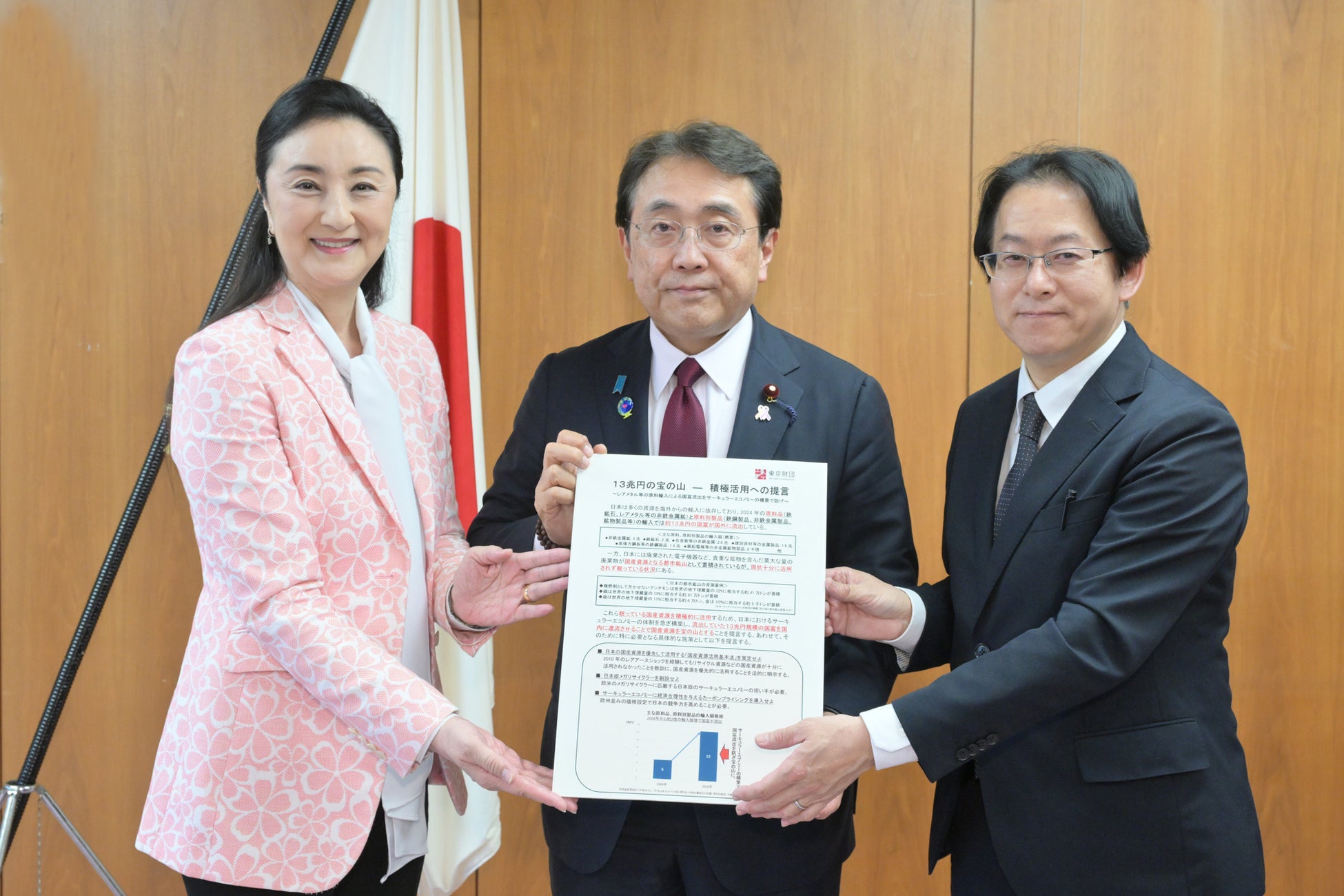
The Tokyo Foundation (Minato-ku, Tokyo; Mieko Nakabayashi, Chairman) handed over its policy proposal "A 13 Trillion Yen Treasure Trove - Proposal for Active Utilization" to Ryotaro Akazawa, Minister of Economy, Trade and Industry, on March 31 (Tuesday). This proposal aims to prevent the outflow of national wealth and create a new growth base for a "strong economy." In view of resource risks symbolized by the "Second Rare Earth Crisis" due to unstable supply and demand of rare earths, it proposes a "Domestic Resource Strategy" starting from a circular economy that utilizes domestic waste (urban mines) as a "treasure trove" of domestic resources. Furthermore, a policy proposal titled "A 38 Trillion Yen Treasure Trove - Proposal for Active Utilization," which highlights the necessity of building a resource and energy circulating society through a "Japanese-style" circular economy that physically and economically circulates all domestic resources, was also submitted, as the outflow of national wealth due to overseas resource dependence, including fossil fuel imports, amounts to a huge sum.
"A 13 Trillion Yen Treasure Trove - Proposal for Active Utilization" is here "A 38 Trillion Yen Treasure Trove - Proposal for Active Utilization" is here
From left: Mieko Nakabayashi, Chairman of the Tokyo Foundation; Ryotaro Akazawa, Minister of Economy, Trade and Industry; Hikaru Hiramatsu, Senior Research Fellow of the Tokyo Foundation
Policy Proposal for "Domestic Resource Strategy" Submitted to METI Minister Akazawa from the Perspective of Economic Security As one of its research themes, the Foundation is researching rational and realistic solutions based on data to achieve a transition to a new social system under a declining population, focusing on "Building a Resource and Energy Circulating Society."
This research considers Japan's abundant domestic resources, such as urban mines, marine resources, renewable energy, and Japan's advanced technologies, as "domestic resources." It advocates for "Addressing Population Decline, Economic Security, and Climate Change by Building a 'Japanese-Style' Circular Economy that Circulates All Domestic Resources" and presents a concept of Japan's islands as domestic resources through improved resource and energy self-sufficiency.
The current proposal addresses the renewed recognition of economic security risks in mineral resource procurement, such as China using rare earths as a diplomatic card again in the US-China trade war under the second Trump administration. It also highlights the problem of approximately 13 trillion yen[1] of national wealth flowing out of the country through imports of mineral resource-related raw materials and products in 2024. The proposal calls for the full-scale utilization of urban mines as domestic resources.
Mieko Nakabayashi, Chairman, who handed over the proposal, explained that it is the result of research conducted with a long-term perspective and free thinking as a private, non-profit, independent think tank, and that it presents a concrete vision and policy for a "resource and energy circulating society." Minister Akazawa, who received the proposal, stated, "I believe utilizing domestic resources is important for the circular economy, and I will strive to include the submitted proposal in the growth strategy and the basic policy guidelines."
Following this, Hikaru Hiramatsu, Senior Research Fellow who compiled the policy proposal, explained to Minister Akazawa the situation of approximately 13 trillion yen of national wealth flowing out due to imports of mineral resources. He also presented specific measures, such as the enactment of a "Basic Law for the Utilization of Domestic Resources" to prioritize the use of domestic resources like urban mines, and urged the minister to take swift action to stop this outflow.
Furthermore, he emphasized the necessity of building a resource and energy circulating society through a "Japanese-style" circular economy that physically and economically circulates all domestic resources, including urban mines, marine resources, renewable energy, and technological resources, as a "treasure trove." This is because the outflow of national wealth due to overseas resource dependence, including fossil fuel imports, amounts to approximately 38 trillion yen (2024)[2].
[1] Ministry of Finance Trade Statistics "Reiwa 6" (Fiscal Year 2024) (Excluding non-ferrous metal ores and iron/steel as raw materials, and wood products etc. (excluding furniture) as manufactured products) [2] Ministry of Finance Trade Statistics "Reiwa 6" (Fiscal Year 2024) (Excluding mineral fuels and non-ferrous metal ores and iron/steel as raw materials, and wood products etc. (excluding furniture) as manufactured products) Policy Proposal "A 13 Trillion Yen Treasure Trove - Proposal for Active Utilization ~ Prevent National Wealth Outflow from Raw Material Imports of Rare Metals etc. by Building a Circular Economy ~" ・Amid concerns that a declining population will negatively impact the economy due to labor shortages, improving trade conditions by increasing resource and energy self-sufficiency is essential for building a sustainable society, in addition to further improving labor productivity. Japan has historically depended on imports for many resources, considering itself a "resource-poor country." This has led to a significant outflow of national wealth, which is a major factor contributing to stagnant real wages.
・To reduce the outflow of national wealth and boost real wages, it is necessary to shift from the conventional social system dependent on imported resources to a new system that actively utilizes domestic resources without relying on foreign ones, and achieves growth by introducing high-value-added products and services.
・Dependence on imported resources not only stagnates real wage growth but also poses economic security risks, such as soaring fossil fuel prices due to international instability and resource disruptions caused by resource nationalism, like China's rare earth export restrictions.
・In particular, the fact that China has once again used rare earths as a diplomatic card in the US-China trade war under the second Trump administration has starkly highlighted the serious economic security risks of import dependence in mineral resource procurement.
・Furthermore, with measures like a zero consumption tax on food requiring approximately 5 trillion yen in funding for income improvement, Japan faces the challenge of securing various financial resources. Given that approximately 13 trillion yen of national wealth flows out annually through imports of mineral resource-related raw materials and products in 2024, resolving dependence on mineral resource imports is an urgent issue that must be addressed.
・Although Japan has considered itself a "resource-poor country," looking at our own feet reveals vast amounts of waste, including valuable minerals from discarded electronics, accumulated as urban mines, which can serve as domestic resources.
・On the other hand, regarding the utilization of urban mines as domestic resources, while various legal systems for resource circulation are in place, the recycling rate for E-waste and plastic waste remains around 20%, indicating that these valuable domestic resources are not being fully utilized.
・Addressing this situation, this proposal aims to build a new sustainable social system even with a declining population. It proposes to make the outflowing 13 trillion yen of national wealth flow back into the country and turn it into a "treasure trove" by actively utilizing abundant urban mines as domestic resources. To achieve this, three specific measures are proposed:
Enact a "Basic Law for the Utilization of Domestic Resources" to Prioritize Japanese Domestic Resources While various legal systems for resource circulation exist, recycling rates remain around 20% (lack of incentives to use recycled resources leads to procurement of virgin resources from the market). Following the rare earth shock in 2010, a policy direction was set to promote rare earth recycling, but sufficient recycling has not been achieved to date. Furthermore, current laws do not necessarily prioritize the use of recycled resources and are limited to waste. They do not promote the utilization of other domestic resources. Therefore, it is necessary to enact a higher-level law, the "Basic Law for the Utilization of Domestic Resources," which clearly stipulates the priority utilization of domestic resources, including waste. ■ Establish a Japanese-Style Mega-Recycler A central entity is needed to practice the circulation and utilization of domestic resources (circular economy). In Europe, large waste management companies called mega-recyclers play a central role. Therefore, a Japanese-style mega-recycler tailored to Japan's situation should be established. ■ Introduce Carbon Pricing to Provide Economic Rationality to the Circular Economy Recycled resources are essential for decarbonizing the raw material sector in TCFD Scope 3. Furthermore, resource circulation through the circular economy is a decarbonization measure. In many countries, including Europe, carbon pricing is a measure that provides economic rationality to the circular economy. Japan has recently shown price outlooks for the upper and lower limits of carbon prices, but there is still a gap with Europe. Japan needs to set prices comparable to Europe to enhance competitiveness.
Necessity of a Resource and Energy Circulating Society through a "Japanese-Style" Circular Economy ・The outflow of national wealth due to overseas resource dependence, including fossil fuel imports, amounts to approximately 38 trillion yen (2024). Therefore, the necessity of policies that position domestic resources as a "treasure trove" is conveyed. The proposal advocates for building a resource and energy circulating society through a "Japanese-style" circular economy that physically and economically circulates all domestic resources, such as urban mines, marine resources, renewable energy, and technological resources.
・Along with enacting the "Basic Law for the Utilization of Domestic Resources" to prioritize the use of domestic resources as "Japan's foundation," Japan's various excellent technological resources, such as electric vehicles (EVs), lithium-ion batteries, and optoelectronic integration technology, will serve as "Japan's bedrock." In addition to recycled resources from urban mines, all domestic resources, including offshore wind power, deep-sea mineral resources, and even Japanese culture and content, will be actively utilized as "Japan's pillars."
・By actively utilizing all domestic resources, we will prevent the outflow of national wealth due to overseas resource dependence, contribute to the improvement of real wages even with a declining population, respond to the economic security risk of supply disruptions, and build a new social system (grand vision) that also addresses climate change issues.
"A 13 Trillion Yen Treasure Trove - Proposal for Active Utilization" is here "A 38 Trillion Yen Treasure Trove - Proposal for Active Utilization" is here Mieko Nakabayashi, Chairman, The Tokyo Foundation
Completed doctoral program at the Graduate School of International Public Policy, Osaka University, Ph.D. (International Public Policy). Completed Master's program at the Department of Political Science, Washington State University, USA, Master's (Political Science). After obtaining permanent residency in the US in 1992, she was officially hired by the U.S. Senate Budget Committee and worked there for approximately 10 years. After 14 years in the U.S., she returned to Japan in 2002. She has held positions such as university faculty, government advisor, and Member of the House of Representatives (2009-2012) before assuming her current role. She also serves as a professor at Waseda University. Her books include "Understanding America Today Reveals Japan and the World - Signs of a Great Era Change Signaled by Confusion -" Tokyo Books (2025), among many others.
Hikaru Hiramatsu, Senior Research Fellow, The Tokyo Foundation
Completed doctoral program at the Graduate School of Social Sciences, Waseda University, Ph.D. (Social Sciences). After working at Nissan Motor Co., Ltd., she joined the Foundation in 2000. She has served as a member of the Subcommittee on Energy Supply Issues of the Science Council of Japan's Disaster Reconstruction Support Committee for the Great East Japan Earthquake, a member of the Grid Connection Subcommittee of the Fukushima Prefecture Renewable Energy Introduction Promotion Council, and a specially appointed researcher at the Low Carbon Society Strategy Center of the Japan Science and Technology Agency (JST). Her books include "Geopolitics of the Circular Economy" (Nikkei BP, Nikkei Publishing), "World History of Resource Competition" (Nikkei Publishing), and edited works such as "Divergent Energy Shock: Japan's Survival Strategy for 2050" (Nikkei Publishing), among many others. Resource and Energy Issues / Environment Building a Resource and Energy Circulating Society
*……………………………………………………………………………………* ◇◆About The Tokyo Foundation◆◇ The Tokyo Foundation, established in 1997, is a private, non-profit, independent policy think tank. It aims to contribute to the development of Japan and the world by conducting research, studies, and policy proposals on various issues with a long-term perspective and free thinking, as well as by fostering human resources who contribute to society with a broad perspective. Through its policy research activities, the Foundation scientifically analyzes social issues, proposes solutions, and outlines pathways for their realization. It aims to bring about concrete social change by collaborating with policymakers, corporations, and civil society. To this end, it will build an intellectual foundation for the sustainable development of Japanese society by combining data-driven analysis with strategic policy dialogue. Furthermore, through its human resource development programs, it fosters leaders with an international perspective through scholarship programs spanning 44 countries, support for Japanese language education, and book donations to deepen understanding of Japan.
Location: 5F Sasakawa Peace Foundation Bldg., 1-15-16 Toranomon, Minato-ku, Tokyo 105-0001, Japan URL: https://www.tkfd.or.jp/
FACT BOX
- Source: PR TIMES
- Category: News