[Research Report] The job opening ratio for short-term, single-assignment spot work is 4.16 times, and the average hourly wage for spot work is 1,239 yen.
Tsugu Work Style Research Institute has released its monthly 'Spot Work Market Data Report' for January 2026. Key findings include a spot work job opening ratio of 4.16 times, a significant decrease in the number of jobs from the previous month (though light work and transportation saw year-on-year growth), and an average hourly wage of 1,239 yen, which is 78 yen lower than regular part-time jobs.
📋 Article Processing Timeline
- 📰 Published: April 2, 2026 at 19:00
- 🔍 Collected: April 2, 2026 at 14:31
- 🤖 AI Analyzed: April 17, 2026 at 22:31 (368h 0m after Collected)
Tsugu Work Style Research Institute (Headquarters: Chuo-ku, Tokyo; Director: Hiroshi Ohno), a research institution for diverse work styles, established by Tsugu Group Holdings Co., Ltd. (Headquarters: Chuo-ku, Tokyo; Representative Director and Executive Officer President: Mitsuhiro Yoneda), which provides RPO (Recruitment Process Outsourcing) and recruitment consulting, publishes a monthly "Spot Work Market Data Report" that continuously observes the expanding "market for spot workers who work short-term and on a single assignment" over the past few years.
This report summarizes and presents the latest data for January 2026.
[Topics]
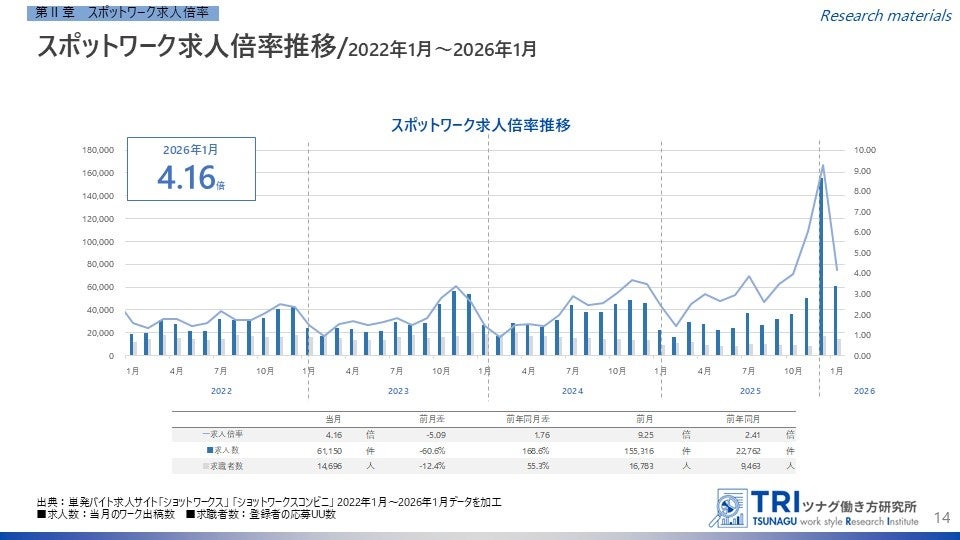
1. The job opening ratio for spot work is 4.16 times, an increase of 1.76 points from the same month last year.
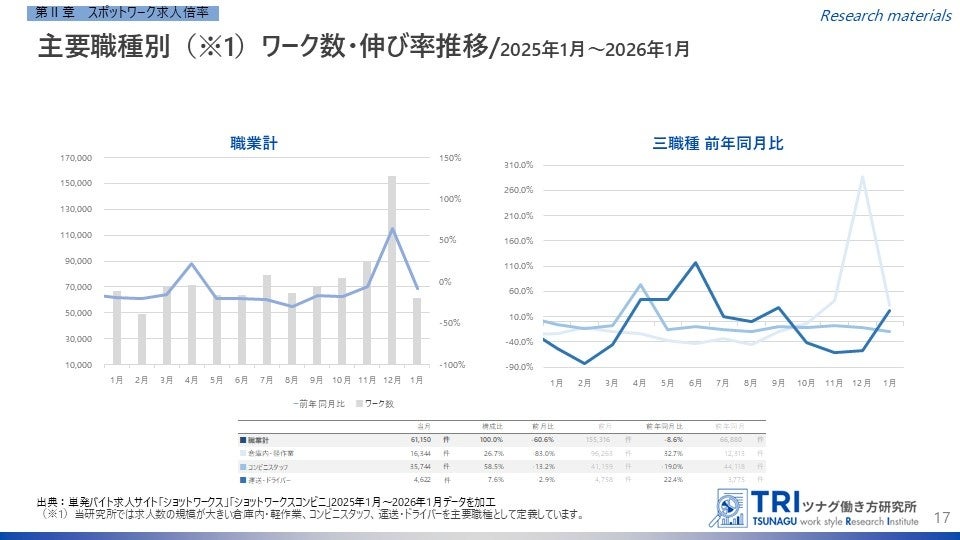
2. Although the growth rate of the number of jobs significantly decreased from the previous month, light work and transportation exceeded the same month last year.
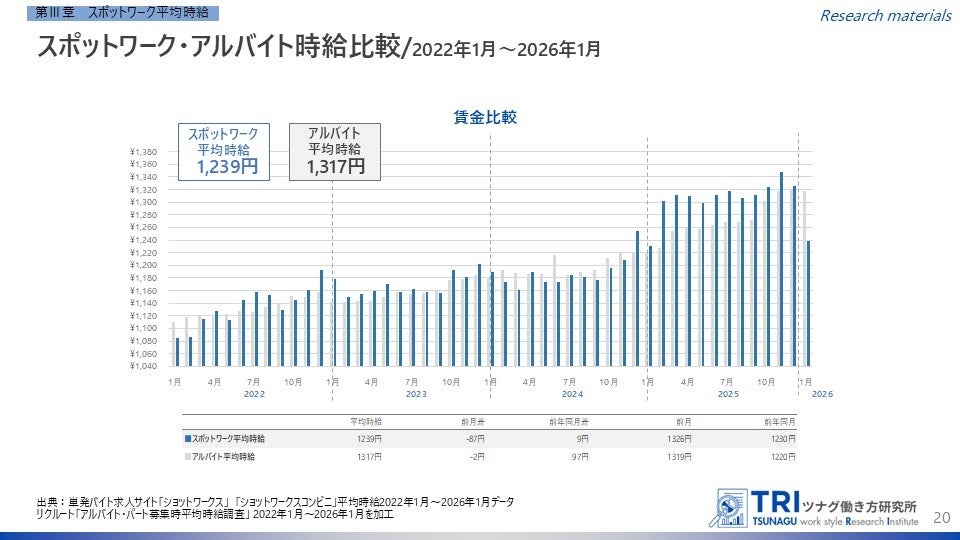
3. The average hourly wage for spot work is 1,239 yen, which is 78 yen lower than the average hourly wage for regular part-time jobs.
■1: The job opening ratio for spot work is 4.16 times, an increase of 1.76 points from the same month last year.
The job opening ratio for spot work in January 2026 was 4.16 times. After the busy season in December, which included year-end events, the number of job openings decreased by 60.6% compared to the previous month, and the job opening ratio decreased by 5.09 points from the previous month. On the other hand, it increased by 1.76 points compared to the same month last year.
■2: Although the growth rate of the number of jobs significantly decreased from the previous month, light work and transportation exceeded the same month last year.
The growth rate of the number of jobs in January 2026 decreased by 60.6% compared to the previous month and by 8.6% compared to the same month last year. By job type, "warehouse/light work" decreased by 83.0% compared to the previous month, "convenience store staff" decreased by 13.2%, and "transportation/driver" decreased by 2.9%, with the decrease in warehouse/light work being particularly significant.
On the other hand, while the overall decrease was 8.6% compared to the same month last year, "warehouse/light work" increased by 32.7% and "transportation/driver" increased by 22.4%, showing growth exceeding the previous year in some job types.
■3: The average hourly wage for spot work is 1,239 yen, which is 78 yen lower than the average hourly wage for regular part-time jobs.
The average hourly wage for spot work in January 2026 was 1,239 yen, a decrease of 87 yen from the previous month and an increase of 9 yen from the same month last year. The average hourly wage for regular part-time jobs was 1,317 yen (according to Recruit's "Average Hourly Wage Survey for Part-time Job Openings"), indicating that regular part-time jobs are 78 yen higher than spot work.
(Source)
Shotworks single-assignment job site data from January 2022 to January 2026
Ministry of Internal Affairs and Communications, Statistics Bureau "Labor Force Survey (Detailed Tabulation) Average for October-December 2025 (Reiwa 7)"
Recruit "Average Hourly Wage Survey for Part-time Job Openings"
*Notice of aggregation change
From December 2025, the aggregation target has been changed as follows.
Please note that there will be differences from the figures in surveys up to November 2025.
・Before March 2025: Job information posted on "Shotworks"
・From April 2025: Job information posted on "Shotworks" and "Shotworks Convenience"
■What is the Spot Work Market Data Report?
・Definition of the Spot Work Market
Spot work refers to a work style that involves short-term, single-assignment work without a "continuous employment relationship." Among these, it is classified into two types: "gig work" which does not involve an employment contract, and "single-assignment part-time work" which involves a short-term employment contract. (A typical example of gig work is an Uber Eats delivery person). The market for individuals working in these styles and companies utilizing them is the spot work market.
・Current Market Situation
The number of spot workers has rapidly increased since the COVID-19 pandemic, and is expected to continue to expand further.
Individuals: Increased desire for additional work due to overtime regulations from work style reforms, and reduced working hours or temporary closures due to the COVID-19 pandemic.
Companies: Growing demand for optimized labor costs by deploying the necessary number of people at the necessary time, from the perspective of improving productivity and eliminating waste and unevenness.
Technology: Entry of spot work job providers offering timely and on-demand matching.
・Significance of continuous observation
The Ministry of Internal Affairs and Communications, Statistics Bureau introduced the ILO-standard "Underutilized Labor Indicators" from 2018. For example, "workers wishing for additional work" among these are laborers sometimes referred to as "broadly defined unemployed." Working on a spot basis in addition to current employment leads to stable income for workers, which in turn improves the broadly defined unemployment rate. On a macro level, utilizing potential labor contributes to the improvement of national strength. From the perspective of connecting with this social significance, we continuously observe this market and disseminate data reports that visualize market size trends, useful topics, and inherent issues.
■What is Tsugu Work Style Research Institute?
Established in 2015, Tsugu Work Style Research Institute (Director: Hiroshi Ohno) is a research institution for diverse work styles, founded by Tsugu Group Holdings Co., Ltd. (Headquarters: Chuo-ku, Tokyo; Representative Director and Executive Officer President: Mitsuhiro Yoneda). The institute, together with experts active in corporate human resources and labor law, explains the key points and perspectives of enacted labor laws, and also records and analyzes the process and background leading to revisions, proposing the "ideal state." As a research institution for all labor laws surrounding "work," it aims to open up the "future of employment."

Tsugu Group Holdings Co., Ltd. (TSE Standard, Securities Code: 6551)
Location: Hulic Ginza 7-chome Building 7F/8F, 7-3-5 Ginza, Chuo-ku, Tokyo
Representative: Mitsuhiro Yoneda, Representative Director and Executive Officer President
Business Activities: Management strategy formulation and management for a group engaged in recruitment solution business (recruitment consulting, outsourcing, etc.), temporary staffing business, paid employment placement business, etc., and related operations.
URL:https://tghd.co.jp/
Tsugu Group, a solution company aiming to resolve Japan's social issue of "eliminating the labor supply-demand gap by 2030," provides various solutions primarily to large companies with over 1,000 employees, based on recruitment consulting, RPO (Recruitment Process Outsourcing), and databases.