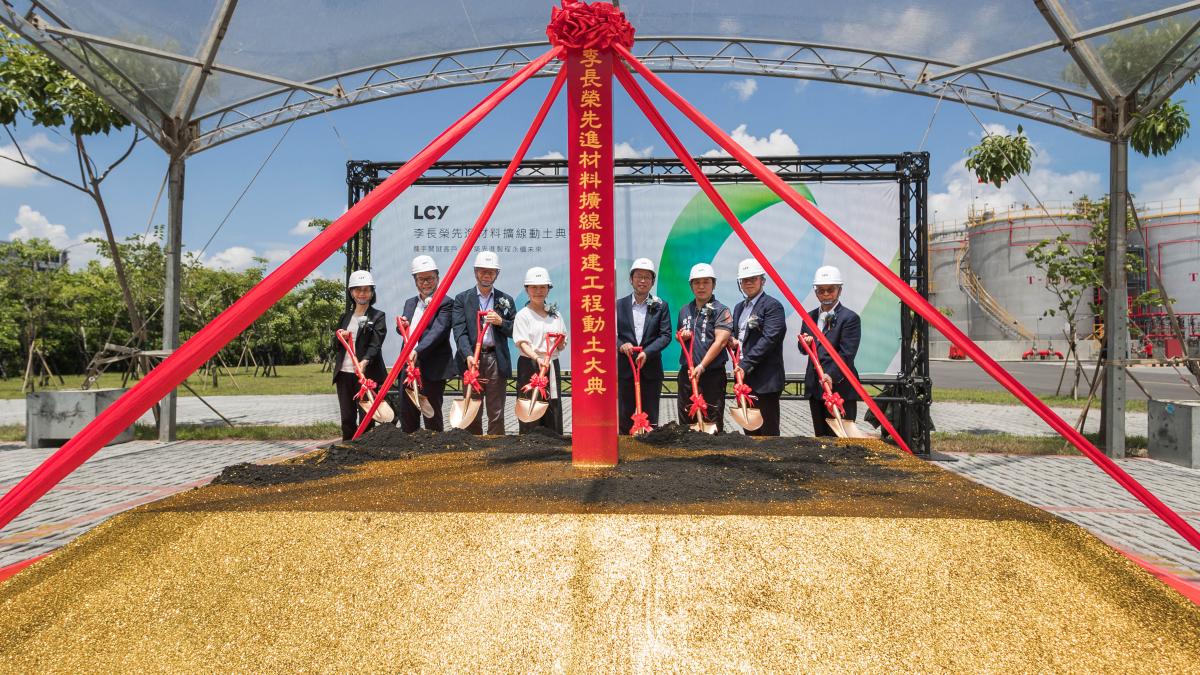
Growing demand for AI and high-performance computing (HPC) is driving increased needs for advanced processes and packaging, extending the semiconductor capacity expansion boom to upstream electronic chemical materials. LCM Advanced Materials, which recently spun off from LCM Chemical in May this year, announced today (16th) the groundbreaking of its expansion project at the Huyi site of the Central Taiwan Science Park (CTSP). The new production line is scheduled to begin supply in the third quarter of 2027. Upon completion, the annual high-end material capacity at the CTSP plant will increase to 60,000 tons. The facility will also integrate agentic AI and digital twin technologies to support local supply needs for advanced logic, memory, and packaging customers.
This expansion marks LCM Advanced Materials’ first core investment since its spin-off and represents a critical step in re-integrating its semiconductor materials business and accelerating decision-making and capacity deployment. Dr. Chao Fan-Ming, Chairman of LCM Advanced Materials, stated, “The expansion of the CTSP site is our first core milestone since independent operations began.” Facing global supply chain restructuring, the company will continue to implement its “local production, local supply” strategy to meet the surging demand for high-end materials driven by the rapid advancement of advanced processes.
Electronic-Grade IPA Expansion Targets Advanced Processes and Packaging Needs
According to the plan, the CTSP plant will primarily expand its electronic-grade isopropyl alcohol (IPA) production line, with supply expected to begin in Q3 2027. Upon completion, the plant’s annual high-end material capacity will reach 60,000 tons. In addition to electronic-grade IPA, the CTSP plant also produces specialized formulations developed for advanced processes and packaging, applicable to grinding and etching in logic chips, memory, and advanced packaging processes, as well as cleaning after temporary bonding.
Electronic-grade IPA is a high-purity cleaning material widely used in wafer manufacturing. As process nodes continue to shrink and chip structures become increasingly complex, requirements for impurity control, cleaning effectiveness, and process selectivity in materials are also rising. Compared to general industrial chemicals, electronic-grade materials used in advanced processes must meet stricter standards for purity and quality stability, making high-end material supply capability a critical, often overlooked, component behind semiconductor capacity expansion.
LCM Advanced Materials develops customized formulations tailored to different customer process requirements, aiming not only to enhance cleaning efficiency but also to reduce volatile organic compounds (VOCs) and improve process selectivity. Through a local supply model near customer production bases, the company aims to shorten material delivery times and issue resolution, reducing risks associated with cross-border transportation and supply chain volatility.
Wang Chun-Chieh, Deputy Director of the CTSP Administration, stated, “Continuous breakthroughs in advanced processes highly depend on a robust high-end materials supply chain. LCM Advanced Materials’ continued deepening presence in CTSP provides key materials such as electronic-grade IPA and advanced formulations for wafer manufacturing and advanced packaging, significantly strengthening the resilience and autonomy of Taiwan’s domestic supply chain.”
Materials as the Next Frontier in Semiconductor Competition: The Rising Importance of Local Supply
The expanding demand for AI chips is not only driving foundries and packaging and testing firms to increase capital expenditures but is also boosting demand for electronic chemicals, specialty gases, and polishing and cleaning materials. In particular, advanced processes and packaging place ever-increasing demands on material quality, consistency, and real-time technical support, pushing semiconductor supply chain competition beyond equipment and manufacturing capacity into upstream high-purity materials.
Amid global supply chain restructuring and rising geopolitical uncertainty, international semiconductor firms are placing greater emphasis on diversified sourcing and local supply capabilities for critical materials. For material suppliers, the ability to establish production capacity near customer sites, shorten transportation distances, and respond promptly to process adjustments is becoming an increasingly important threshold for securing advanced process orders.
Dr. Chao emphasized that the company aims not only to be a stable high-end capacity partner for customers but also to align with major international semiconductor firms’ decarbonization goals through green manufacturing. He stated, “Going forward, LCM will continue to collaborate with key customers to co-build a semiconductor ecosystem that is both resilient and net-zero, advancing toward our vision of becoming an end-to-end sustainable materials provider for semiconductor manufacturing.”
Dual Taiwan Bases and U.S. Plant: Building a Three-Engine Supply Network
In addition to the CTSP expansion, LCM Advanced Materials plans to establish three major production bases in Kaohsiung’s Lin Yuan, CTSP’s Huyi site, and the United States. The U.S. plant construction project has already commenced this year, aiming to build a global supply network closer to customers.
The Kaohsiung Lin Yuan plant serves as the company’s vertically integrated production base for high-purity electronic-grade IPA, while the CTSP plant focuses on electronic-grade IPA and formulations for advanced processes and packaging. By leveraging the division of labor between northern and southern production sites, combined with local U.S. production capacity, LCM Advanced Materials aims to reduce supply risks from any single region and meet material demands arising from international customers’ accelerated semiconductor manufacturing expansion in the U.S.
The company also stated that it has implemented a dual-cycle recycling mechanism, reprocessing recovered chemicals for reuse in advanced semiconductor processes to improve resource efficiency. Going forward, it will further integrate capabilities in raw material production, electronic-grade purification, customized formulation, and recycling to strengthen its end-to-end material supply model from manufacturing to circular utilization.
Integrating Agentic AI and Digital Twin: Predictive Safety and Energy Management
The CTSP expansion will also serve as a key demonstration site for LCM Advanced Materials’ smart manufacturing initiatives. The new production line will integrate agentic AI and digital twin technologies, establishing a high-fidelity 3D virtual model to simulate equipment operation, production processes, and potential abnormal scenarios.
Unlike traditional factories that rely primarily on on-site personnel experience, digital twin technology enables testing of various production conditions and risk scenarios in a virtual environment before feeding analysis results back to the actual production line, helping factories issue early warnings and adjust decisions proactively. The system will be applied to plant safety, product quality, and energy consumption management, using 24/7 monitoring and analysis to enhance production stability and equipment utilization efficiency.
In its decarbonization planning, LCM Advanced Materials has set a target to reduce carbon emissions by 42% at the CTSP plant by 2030 and plans to achieve RE85—raising renewable energy usage to 85%—by 2030, further progressing to RE100 by 2035. The company stated that as international semiconductor customers increasingly demand supply chain decarbonization, the new production line will simultaneously incorporate energy efficiency, resource circulation, and carbon emission management, enabling capacity expansion and low-carbon manufacturing to proceed in parallel.
FACT BOX
- Source: PR Times
- Category: Event