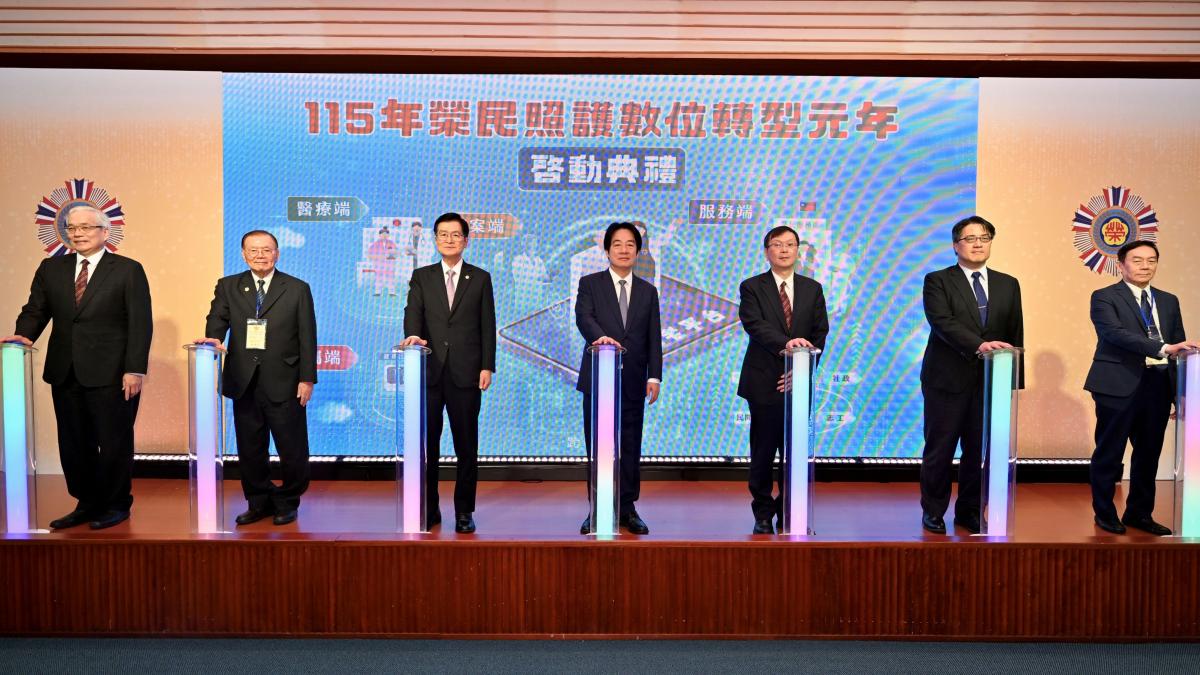
To address the challenges of a super-aged society and fulfill President Lai Qingde's vision of a 'Healthy Taiwan,' the Veterans Affairs Council (VAC) held the 'Launch Ceremony for the Digital Transformation Year of Veteran Care' on the 16th, officially launching the 'Anxin Elderly Care Platform.' This platform integrates the veteran medical system, veteran service centers, Veterans Homes, local governments, and community resources to create a cross-domain collaboration and smart early-warning mechanism, ushering in a new era of digital transformation in veteran care.
VAC Chairperson Yen Teh-fa stated that Taiwan has officially entered a super-aged society, with approximately 47% of veterans now elderly. Over the years, the Council has built a comprehensive care system through Veterans Hospitals, Veterans Homes, and Service Centers. However, most veterans still live in communities. Facing the trends of aging and declining birth rates, extending the healthy life expectancy of veteran elders and enabling them to age in place is a mission the Council cannot shirk.
Yen noted that in 2024, the VAC collaborated with National Yang Ming Chiao Tung University and the Kaohsiung City Government to form the 'Anxin Elderly Care Team,' which won the Presidential Hackathon Outstanding Team Award for its 'Holistic Integrated Care Coordination Platform.' Following the President's directive, the Council has continued to deepen a senior-centered care model, using technology to connect care teams, individuals, and families to jointly build a holistic health care system. Based on this, the VAC has implemented frontline services by establishing the 'Anxin Elderly Care Platform,' integrating a service center visitation system, adding health consultation and cross-domain collaboration functions for medical teams, and constructing a smart care network that combines technology with compassion. By integrating resources from medical, service, individual, and family ends, community veteran care is transformed from reactive response to proactive early warning and preventive care.
President Lai Qingde stated at the launch ceremony that the government's key goal in promoting a 'Healthy Taiwan' amid the super-aged society challenge is to enable citizens to live healthier, more dignified, and higher-quality lives. Lai highly commended Chairperson Yen Teh-fa and the VAC team for successfully establishing the Anxin Elderly Care Platform. By digitally connecting health, social welfare, civil affairs, and civil organizations, and integrating functions such as physiological monitoring, telemedicine, and referrals, the platform not only enhances care efficiency but also strengthens human connections, providing elders with more timely and comprehensive care, and building a comprehensive smart care network.
Lai emphasized that the government bears an inescapable responsibility for veteran care and expects this cross-era smart service to be fully expanded to veteran service centers nationwide, fulfilling the promise that 'wherever veterans go, services follow, and peace of mind follows.' He further instructed the VAC to oversee all levels of Veterans Hospitals to actively utilize this smart platform and deepen cooperation with local governments, extending platform services to all general patients seeking care at Veterans Hospitals. Simultaneously, he requested the Ministry of Health and Welfare to use the Anxin Elderly Care Platform in collaboration with local governments to integrate medical, social welfare, family, and civil group resources, and promote its adoption across the Ministry of Health and Welfare, Ministry of Education, and the nation's entire healthcare system, ensuring all elderly citizens receive proper care when needed.
Dr. Chou Ming-yueh, Director of the Center for Geriatric Medicine at Kaohsiung Veterans General Hospital and a member of the Anxin Elderly Care Team, explained that the platform uses the Ministry of Health and Welfare's assessment tool for isolated elderly individuals, combining medical expertise with frontline visitation data to establish a risk stratification and care mechanism. Through risk assessment, real-time alerts, inter-agency collaboration, and medical consultation functions, high-risk veterans can receive early medical care, life assistance, and long-term care resources. Physicians, nurses, case managers from Veterans Hospitals, and service teams from service centers can also instantly share information, jointly safeguarding the health of elderly veterans in the community.
In April last year, 88-year-old Mr. Shen, a lone veteran, was involved in a traffic accident. The Kaohsiung City Veterans Service Center activated the cross-domain alert mechanism via the 'Anxin Elderly Care Platform,' urgently transferring him to the emergency department of Kaohsiung Veterans General Hospital. Upon receiving the alert, the hospital's case manager immediately visited the emergency room to provide care and used the platform to report treatment progress and care status in real time. During Mr. Shen's hospitalization, the teams from Kaohsiung Veterans General Hospital, the Service Center, and the Veterans Home continuously collaborated via the platform. Once his condition stabilized, the transfer and placement to Gangshan Veterans Home were completed through the platform.
In Minxiong, Chiayi, 98-year-old Mr. Liang, a lone veteran living alone in Taiwan, receives coordinated care through the 'Anxin Elderly Care Platform' by the Chiayi Veterans Service Center. The platform integrates Taichung Veterans General Hospital Chiayi Branch, Minxiong Township Office, Tzu Chi Foundation, and local volunteers into a care team that provides meal delivery, home visits, health consultations, and life support. In February this year, a volunteer from the township office delivering meals noticed Mr. Liang complaining of dizziness. After measuring his blood pressure and detecting abnormalities, the volunteer immediately reported via the platform and called the 119 ambulance. During hospitalization, the team shared information in real time via the platform, tracked his condition and care needs, and the VAC fully subsidized the health insurance co-payments for unemployed veterans. After his health stabilized, the Chiayi Service Center actively accompanied Mr. Liang to visit Veterans Homes and nursing homes, planning future placement and care arrangements early, allowing the elder to face his later years with peace of mind.
From emergency alerts, urgent rescue, medical care, life support, to long-term care planning, the 'Anxin Elderly Care Platform' effectively connects diverse resources from health, social welfare, civil affairs, and civil groups, establishing real-time alerts, information sharing, and cross-domain collaboration mechanisms. By integrating services through technology and safeguarding elders with a human-centered approach, care becomes more timely and comprehensive, concretely realizing the care philosophy of 'one point changes, all domains mobilize,' building a more resilient and compassionate elderly care network.
Dr. Chen Liang-kung, team leader of the Anxin Elderly Care Team responsible for platform development and current院长 of Taipei City Guandu Hospital, stated that since the platform's pilot launch in Kaohsiung City in April 2025, it has demonstrated concrete results. After implementation, high-risk veterans saw a 15% annual reduction in outpatient visits, an 11% decrease in acute care bed days, and a 14% drop in overall medical costs. Visitation record processing time was reduced by over 50%, and long-term care case management administrative efficiency increased nearly fourfold. These outcomes not only represent numerical progress but also mean elders can reduce medical travel, lower hospitalization risks, and receive more timely and appropriate care in their familiar homes.
The VAC stated that launching the 'Digital Transformation Year of Veteran Care' is not merely about building an information system but a revolution in care philosophy. Moving forward, the Council will continue promoting smart healthcare, smart care, and integrated medical-care services, deepening the linkage between medical, long-term care, and community resources, and constructing a seamless care network connecting hospitals, Veterans Homes, communities, and families.
The VAC emphasized that just as past veterans protected the nation with their youth, today's government safeguards veterans with smart technology. Going forward, it will continue to uphold the principles of 'human-centered, smart care, and shared health,' conveying care through technology, protecting elders through action, and realizing a 'Healthy Taiwan' through innovation. Every veteran will receive timely, comprehensive, and dignified care, living securely, aging healthily, and enjoying a happy old age in their familiar homeland, collectively building a new paradigm for a Healthy Taiwan and elderly care.
FACT BOX
- Source: PR Times
- Category: Event