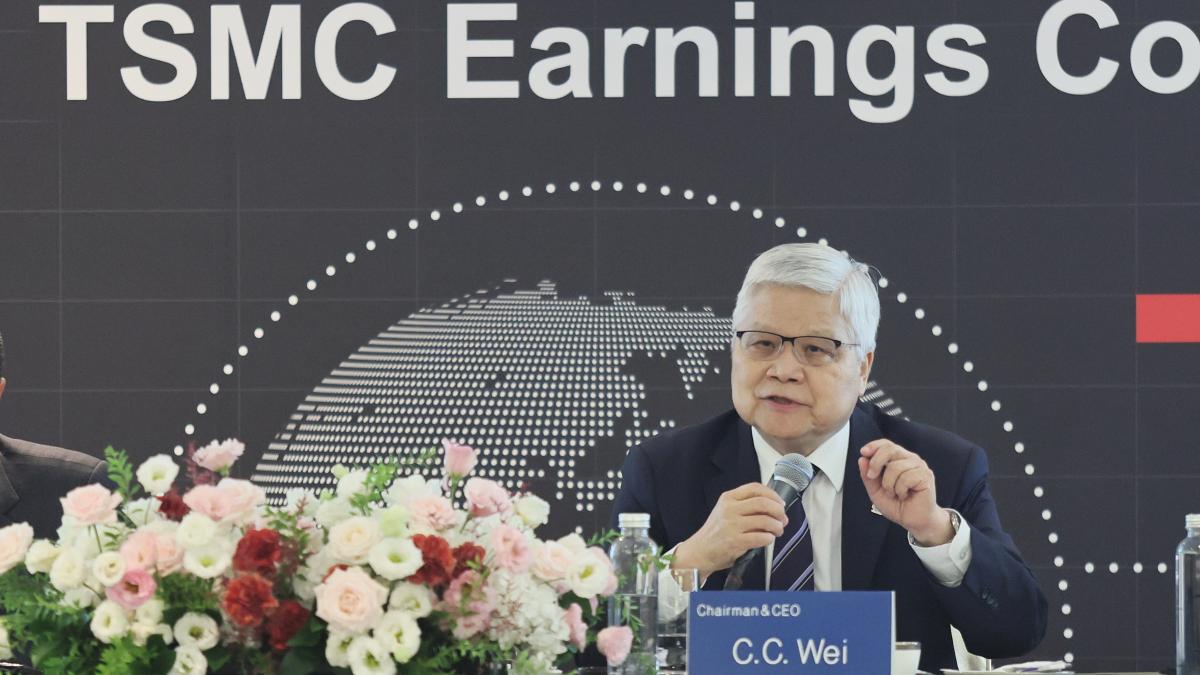
The market had briefly worried whether the AI investment boom was starting to cool, but TSMC (2330) gave a clear answer in its latest earnings call. Today (16th), TSMC announced its Q2 financial results, not only achieving a record-high EPS of NT$27.25, but also upgrading its 2026 full-year USD revenue growth forecast from over 30% to 'slightly over 40%,' and raising its annual capital expenditure to $60–64 billion. Chairman and CEO C.C. Wei stated that AI-related demand remains 'extremely robust,' with unchanged demand signals from cloud service providers (CSPs), and TSMC maintains very high confidence in the long-term AI trend.
TSMC's consolidated revenue for Q2 reached NT$1.270381 trillion, up 12% quarter-on-quarter and 36% year-on-year. Net profit after tax was NT$706.562 billion, up 17% QoQ and 61% YoY, with EPS at NT$27.25. Gross margin was 67.7%, operating margin 60.3%, and net profit margin 55.6%. Gross margin improved by 1.5 percentage points from Q1, slightly exceeding the company's initial guidance range. Overall profitability surpassed market expectations.
In terms of product mix, advanced processes below 7nm accounted for 77% of wafer sales in Q2, with 2nm at 3%, 3nm at 30%, 5nm at 33%, and 7nm at 11%. By end application, High-Performance Computing (HPC) revenue grew 20% QoQ, increasing its share of total revenue to 66%, continuing as the primary growth engine for TSMC. Smartphones accounted for 22%, while IoT, automotive electronics, and consumer electronics accounted for 5%, 4%, and 1% respectively.
Looking ahead to Q3, TSMC forecasts USD revenue between $44.6B and $45.8B, with a midpoint of $45.2B, representing a ~12% QoQ increase and ~37% YoY growth, exceeding initial market expectations. Assuming an exchange rate of NT$32 to USD$1, gross margin is expected between 65% and 67%, and operating margin between 56% and 58%.
However, TSMC acknowledged that its gross margin will face short-term pressure in the second half as 2nm enters rapid mass production. CFO Lora Huang noted that the significant expansion of 2nm production is expected to dilute gross margin by approximately 3 to 4 percentage points in the second half. Additionally, the gradual ramp-up of overseas new fabs will initially bring about a 2 to 3 percentage point dilution over the next few years, potentially expanding to 3 to 4 percentage points. Nevertheless, strong demand for advanced processes, continuous improvements in production efficiency, and cross-generational capacity optimization will offset some of these impacts.
Regarding external concerns about whether AI demand is slowing, Wei reiterated an optimistic outlook. He stated that while consumer products and some price-sensitive markets remain affected by macroeconomic factors, and the company remains cautious in its operational planning, AI demand remains very strong. In particular, the rapid development of Agentic AI is driving AI data centers to require more computing power, further boosting demand for advanced processes.
Wei emphasized that both TSMC's direct customers and the CSPs behind them continue to send very strong demand signals. Therefore, TSMC maintains high confidence in the long-term AI growth trend and has accordingly raised its 2026 USD revenue growth forecast to 'slightly over 40%.'
With demand continuing to heat up, TSMC has once again increased its capital expenditure for the year. The company announced that its 2026 capex will be further raised to $60–64 billion, with approximately 70–80% allocated to advanced processes, about 10% to specialty processes, and the remaining 10–20% to advanced packaging, testing, masks, and other related investments. Huang stated that higher capex has always represented future growth opportunities for TSMC, and this increase is in response to long-term structural demand, including Agentic AI.
When asked about the reasons for the significant capex increase during the earnings Q&A, Wei further explained two main factors: first, customer demand continues to grow, requiring TSMC to prepare additional capacity earlier; second, semiconductor equipment prices continue to rise, pushing up factory construction costs. He also revealed that capital expenditure over the next three years will be 'significantly higher' than the past three years, reflecting the company's strong confidence in long-term AI demand.
Additionally, TSMC announced an additional $100 billion investment in Arizona, USA, to continuously expand advanced process and advanced packaging capacity to support customer demand over the coming years. This global expansion strategy, along with the progress of new fabs in the U.S., Japan, and Taiwan, is expected to remain a key focus for the market.
FACT BOX
- Source: PR Times
- Category: 財報