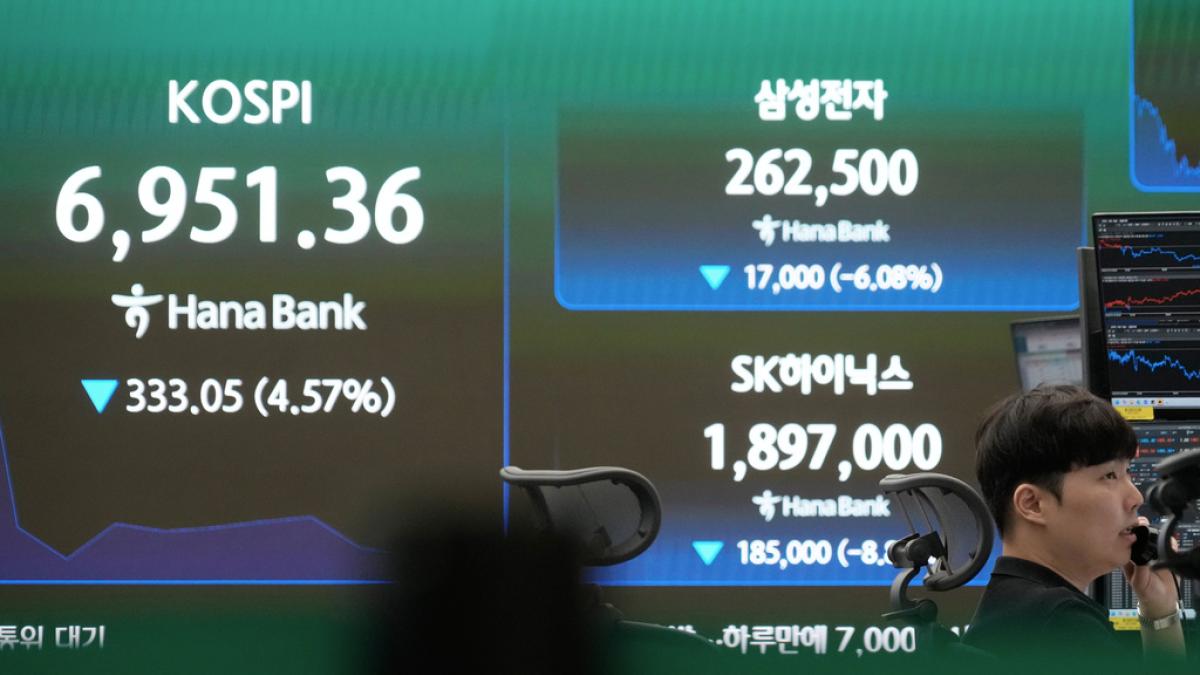
Selling pressure across Asian tech stocks intensified sharply. South Korea's stock market plunged again on the 16th, hit by weakening U.S. semiconductor stocks and growing market concerns over a slowdown in artificial intelligence (AI) infrastructure investment. The Korea Composite Stock Price Index (KOSPI) closed down 6.37% at 6,820.60 points—breaking below the 7,000-point threshold. The intraday decline briefly widened to 7.6%, hitting a low of 6,730.87 points.
Due to a sudden surge in sell orders, the Korea Exchange triggered its circuit breaker mechanism at 9:00 a.m. local time, temporarily halting program trading sell orders. This marks the 19th time this measure has been activated this year.
Post-market data showed foreign investors sold a net 1.44 trillion won (approximately NT$31.36 billion), while domestic institutional investors sold a net 1.39 trillion won. In contrast, retail investors continued to buy aggressively, net purchasing around 2.78 trillion won (approximately NT$60.54 billion) to support the market.
South Korean media reported that the selling pressure stemmed primarily from cooling expectations for the AI industry. A recent Morgan Stanley report indicated that multiple global AI data center projects have been delayed or paused due to insufficient power supply, chip supply constraints, and high setup costs. For example, a large data center project in Wyoming, U.S., has been delayed, while new projects in New York State have been forced to pause for a year due to new government regulations.
These developments undermined market expectations for sustained high-speed growth in AI infrastructure demand, dragging down U.S. semiconductor stocks the previous trading session and spreading the impact to Asian markets.
South Korea's two major memory chipmakers were hit hardest: SK Hynix plunged 11.53% to close at 1.842 million won. Its recently listed American Depositary Receipts (ADRs) also fell 9% in the prior session. Samsung Electronics dropped 8.77% to close at 255,000 won.
Market attention is also focused on competition from China's memory industry. Chinese DRAM manufacturer ChangXin Memory Technologies (CXMT) has initiated preparations for an initial public offering (IPO) targeting approximately $8.55 billion. If fundraising proceeds smoothly, the company is expected to expand production capacity, intensifying competitive pressure in the global DRAM market. This has heightened investor concerns in South Korea that major players like Samsung, SK Hynix, and Micron may face greater pricing pressure in the future.
An analyst at Shinhan Securities noted that South Korean investors are not only taking profits after the previous rally but are also reassessing the outlook for AI industry conditions and demand, leading to clear sell-offs in AI supply chain-related stocks. Meanwhile, the Bank of Korea (BOK) announced a 25-basis-point rate hike on the 16th, raising the benchmark interest rate to 2.75% to curb inflation and stabilize the won. However, as the market had already priced in this decision, it provided no significant support to equities.
South Korea's tech-heavy KOSDAQ index also weakened, closing down 4.53% at 791.84 points, falling below the 800-point level.
FACT BOX
- Source: PR Times
- Category: News
- Products / services: DRAM