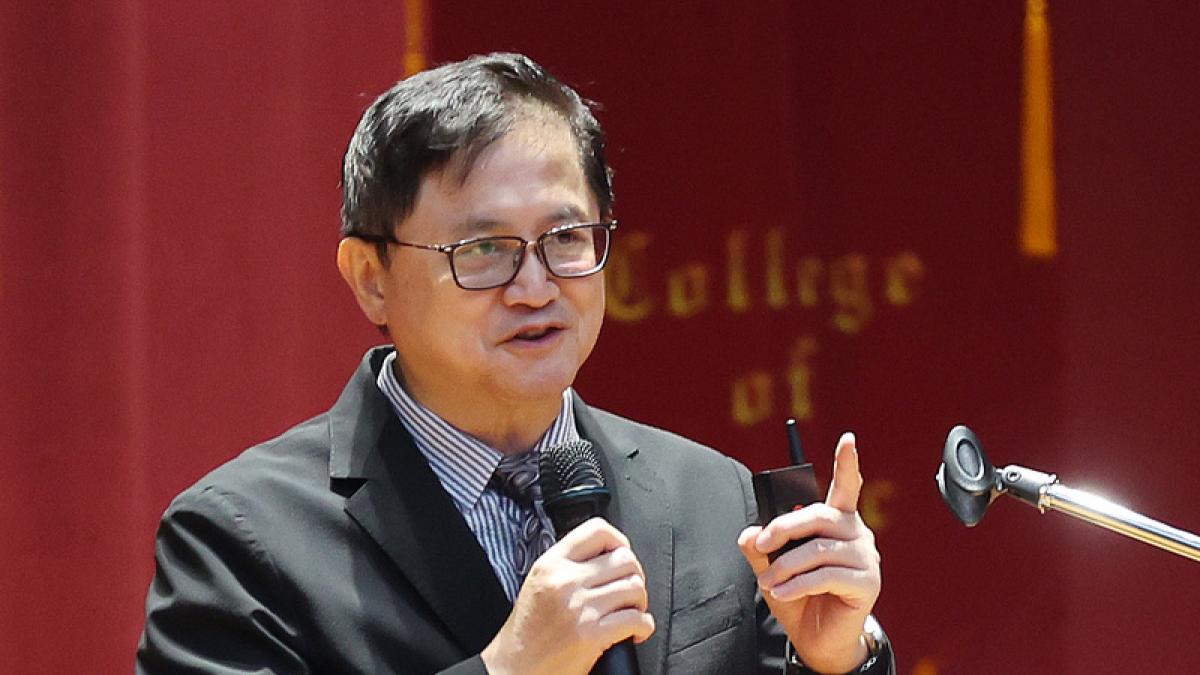
Pegatron Chairman Tung Tzu-hsien attended the '2026 Resilient Taiwan Summit Forum' on the afternoon of the 7th and delivered a speech. Tung stated that if Nuclear Plants No.1, No.2, and No.3 could be restored, they would provide Taiwan with 40 billion kWh of electricity. Adding 10 new units with capacities of 1.1GW to 1.4GW built on the existing open land at the Lungmen site, the combined output could reach 130 to 150 billion kWh. If Taiwan's electricity demand over the next 20 years falls between 420 billion and 500 billion kWh, this could satisfy base-load power requirements.
Is Taiwan's economic development being held hostage?
Tung explained that Taiwan's proud semiconductor advantage, server industry, and supply chain all rely on electricity, especially TSMC, which is leading the world in advanced manufacturing processes—its importance cannot be overstated. Taiwan does not produce its own energy, and relying on natural gas power generation is equivalent to 'handing over the key throat of Taiwan's economic development to others.'
Tung: Taiwan would run out of energy in 10 days without LNG ships
Tung pointed out that Taiwan previously required at least 250 liquefied natural gas (LNG) ships annually, but this number may now rise to 400. If no LNG ships arrive for just 10 days, Taiwan would have no energy. Moreover, LNG prices are unstable, skyrocketing during energy crises. Conflicts such as the Russia-Ukraine war have caused supply disruptions. For example, during the war, the gas from one LNG shipment surged by an additional NT$3 billion, a burden even France and Germany could not bear. France responded by expanding nuclear power, nearly eliminating natural gas for electricity generation.
Tung: German Chancellor 'deeply regrets' nuclear phase-out
Tung argued that returning from anti-nuclear to pro-nuclear is not moving backward. German Chancellor Merz publicly expressed 'deep regret' over the nuclear phase-out, which contributed to Germany's persistently high electricity prices. Japan announced a return to nuclear energy in 2022, setting a target of 22% nuclear power by 2030 as part of its climate change response. Taiwan should swiftly shift its mindset and properly utilize nuclear energy to enhance energy resilience.
Comparison of electricity prices between Taiwan and Germany. (Provided by Tung Tzu-hsien)
Tung noted that China is aggressively constructing nuclear power plants in Fuqing and Xiapu, Zhangzhou, Fujian Province, each with six reactor units—totaling 12 units across two plants—while Taiwan has only two units per plant, making it relatively conservative.
Tung explained that after consulting experts, restoring operations at Nuclear Plants No.1 to No.3 could generate 40 billion kWh. Building 10 new 1.1GW to 1.4GW units on the existing Lungmen site could add 90 to 110 billion kWh, totaling 130 to 150 billion kWh. If Taiwan's electricity demand over the next 20 years ranges from 420 to 500 billion kWh, this could meet base-load power needs.
Tung: Stop baseless claims—welcome open debate
Tung mentioned that the original sites of Nuclear Plants No.1 to No.4 cover 220 to 480 hectares, mostly coastal land that does not compete with agriculture, pasture, or forest green spaces. The nuclear island area of Plant No.1 remains intact and only requires replacement of generators and digital control systems—not unusable or valueless as some claim. This represents hundreds of billions of dollars in past investment that should be wisely utilized. He urged critics to stop spreading misinformation and invited open debate to allow rational discussion on restarting nuclear power.
Tung admitted he once misunderstood nuclear energy but now speaks from experience to clarify misconceptions. Nuclear power has two major advantages: energy resilience and low cost. Looking ahead 20 years, Taiwan's electricity mix should follow a '333' model—one-third nuclear, one-third renewable, and one-third fossil fuel—to build a low-carbon, highly resilient power system. Stable, non-carbon-emitting electricity is essential for Taiwan to keep pace with global trends.
FACT BOX
- Source: PR Times
- Category: News
- Dates in source: 2026 / 2022