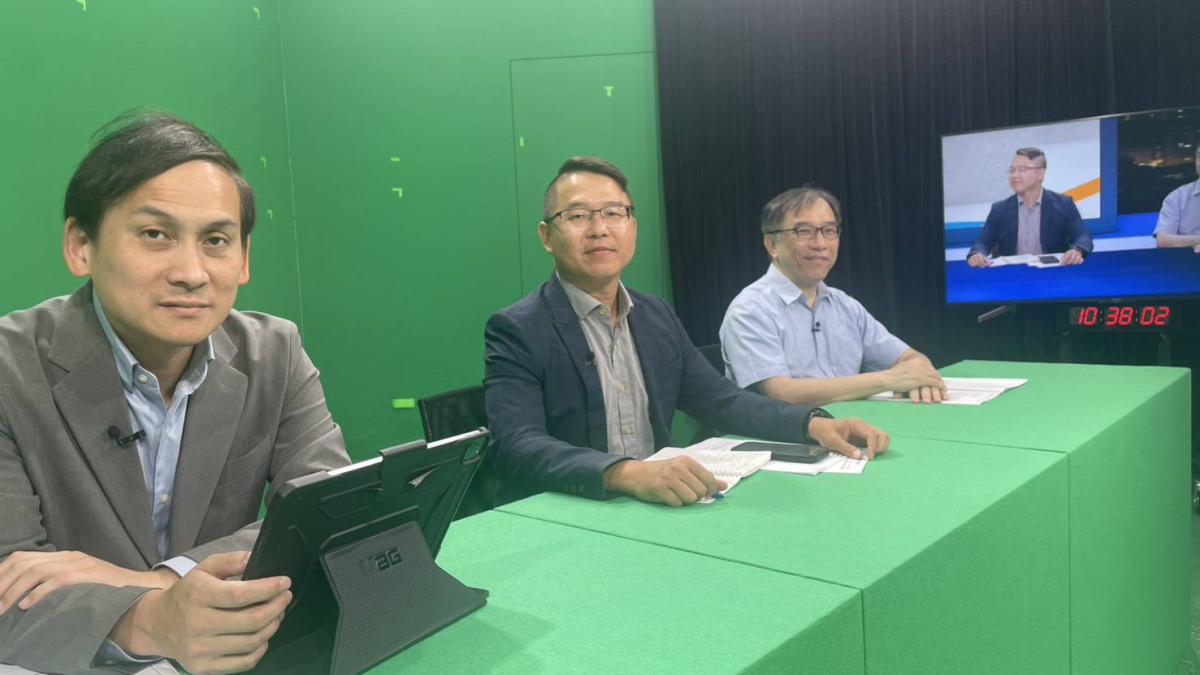
The political talk show 'Political Hard Questions' recently invited Legislator Yeh Yuan-chih, Professor Chiu Shih-yi from the Department of Political Science at Tunghai University, and Professor Chen Li-fu,理事长 of the Taiwan Youth Generational Exchange Association, to raise multiple questions regarding the current state of Taiwan-US and Taiwan-Japan relations and the recent case of leaked diplomatic secrets. The panel criticized the DPP government for repeated failures in managing foreign relations and internal administration, urging the ruling team to acknowledge the problems and promptly provide explanations and corrective actions.
Chiu Shih-yi pointed out that U.S. President Trump has repeatedly used arms sales to Taiwan and the semiconductor industry as bargaining chips in negotiations with China. This includes the delayed approval of the second tranche of arms sale price lists to Taiwan and Trump’s public declaration to bring 60% of global semiconductor production back to the U.S. These actions, Chiu argued, demonstrate that 'Trump prioritizes his own interests over Taiwan’s security,' criticizing the government for being overly passive in response to Trump’s repeated downplaying of Taiwan’s semiconductor achievements. She urged the government to stand firm on key positions rather than accepting everything uncritically.
Yeh Yuan-chih and Chiu Shih-yi also referenced Trump’s intervention in FIFA’s decisions during the World Cup to benefit U.S. players, suggesting this reflects a shift in U.S. behavior from being seen as a 'benevolent hegemon' to increasingly assertive conduct. Chen Li-fu, meanwhile, cautioned against holding unrealistic expectations of U.S. politicians, urging a rational understanding of the institutional differences between the U.S. government, Congress, and the executive branch.
The show also highlighted the Control Yuan’s confirmation that 13 classified documents from the Ministry of Foreign Affairs (MOFA) had leaked onto the dark web, containing sensitive information such as assessments of diplomatic relations and diplomatic cables. Yeh Yuan-chih questioned whether internal accomplices or external cyber intrusions were involved, harshly criticizing MOFA’s internal controls as 'crude and completely lacking vigilance.' He cited past rulings involving overseas personnel in espionage cases linked to China, questioning why long-standing leak risks in the diplomatic system have not been addressed with concrete improvements.
Additionally, Yeh pointed out rumors that Taiwan had arranged for officials to attend the World Baseball Classic in Japan with a 'baseball diplomacy' agenda, only to hear that senior Japanese officials were displeased, reportedly forcing the president to personally send a letter to mend relations. He questioned whether, if true, this indicated the government had 'backfired' in handling Taiwan-Japan interactions. He noted that MOFA, which typically 'rushes to deny' at the slightest rumor, remained unusually silent this time, raising speculation about internal factional conflicts within the Tokyo mission.
Chiu further analyzed that similar leaks in the past within the diplomatic bureaucracy stemmed primarily from two factors: 'enemy enticement' and 'personal political interest conflicts.' She called for stronger confidentiality laws and transitional justice to prevent partisan vendettas from overriding national interests. She also criticized the long-standing 'turfism' and poor coordination between Taiwan’s national security and diplomatic systems, urging the ruling team to transcend factional and departmental interests, achieve 'unity from top to bottom,' and integrate communication and crisis management mechanisms for critical foreign relations with the U.S. and Japan—rather than allowing rumors to fester and damage Taiwan’s international reputation.
Guests emphasized that Taiwan-US and Taiwan-Japan relations are vital to Taiwan’s regional security and economic interests and should not be undermined by internal communication failures, departmental silos, or excessively weak foreign negotiations. Experts also stressed that Taiwan’s fate should not be entrusted to any foreign politician, urging the government to promptly clarify the truth behind rumors involving chip leverage, data leaks, and strained Japan relations. Simultaneously, they called for accelerating self-reliant defense and strengthening internal controls within the diplomatic system—rebuilding confidence in Taiwan’s stable foreign relations through concrete actions, not passive denials.
FACT BOX
- Source: PR Times
- Category: News