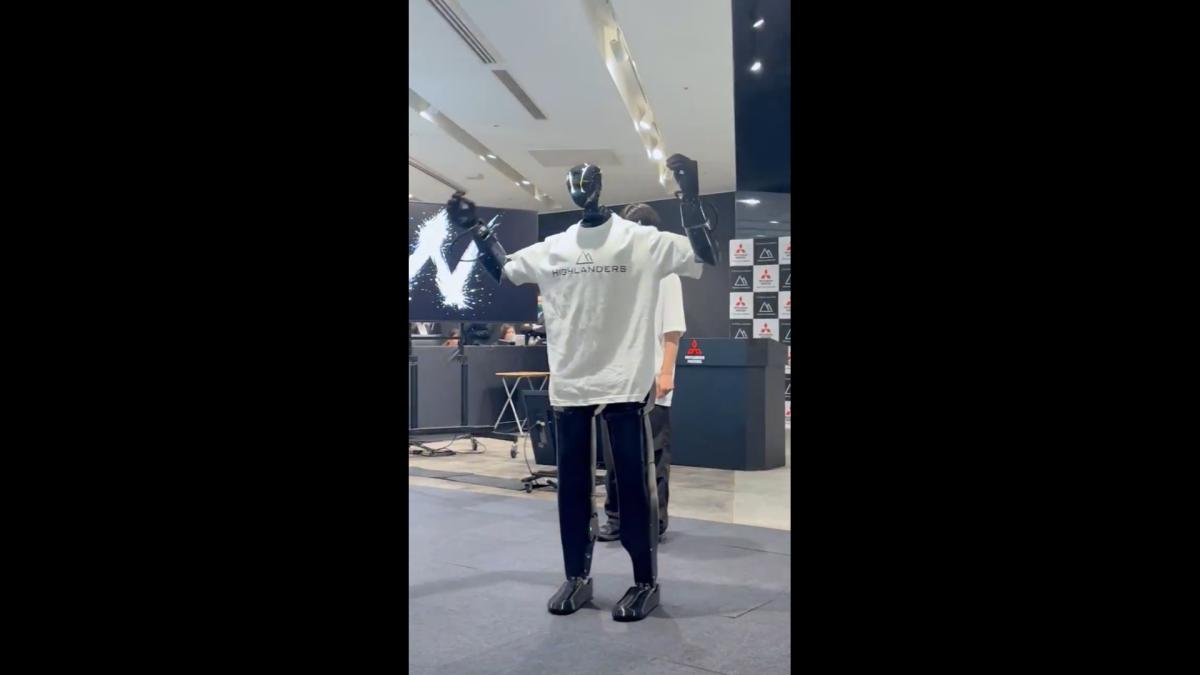
Facing a critical labor shortage caused by Japan's rapidly aging and shrinking population, a veteran Japanese automaker is no longer waiting passively. Mitsubishi Motors has made a bold move by directly entering the artificial intelligence (AI) arena. The company has announced a strategic alliance with Highlanders, a Tokyo-based AI robotics startup in which it holds an equity stake, to revitalize an idle engine production line at its Kyoto plant. Mass production of humanoid robots is expected to begin in the first half of 2027.
The production line, once used for assembling traditional internal combustion engines, will be transformed into a 'factory of the future' capable of producing 1,000 humanoid robots annually. Mitsubishi plans to leverage its decades of accumulated quality control expertise from automobile manufacturing and apply it to this new production system. This initiative not only aims to address the company's own future labor shortage crisis but also includes an ambitious plan to commercialize and sell these robots in global markets.
At an official press conference held at Mitsubishi's Tokyo headquarters, the humanoid robot developed by the three-year-old startup Highlanders was unveiled to the public. Standing at approximately 1.75 meters tall, the robot demonstrated remarkably smooth and stable bipedal walking during the live presentation.
According to official statements, the robot is equipped with a core processor from Nvidia, serving as its central 'brain' to enable rapid computation, decision-making, and judgment. Combined with a Physical AI system, it can instantly and seamlessly perceive its surroundings, autonomously assess complex and unknown terrains, and navigate accordingly. Additionally, the robot features an independently articulated five-fingered 'mechanical hand,' proudly marketed as 100% made in Japan, capable of flawlessly executing delicate tasks such as grasping, transporting, and tightening screws.
Mitsubishi's CEO, Hiroya Masuoka, expressed pride in the project, stating that aside from the core computing processor (GPU) sourced from American semiconductor leader Nvidia, as much as 80% of critical components—including reducers, high-precision motors, and micro-sensors—are entirely supplied by Japan's domestic hardware supply chain. He emphasized that this makes the robot a genuinely 'Made in Japan' product.
A Challenger to Tesla?
The Fuji Keizai Group, a market research firm, released its latest '2026 Robotics Industry White Paper,' which predicts that while the current robotics market is temporarily led by Tesla's Optimus and several well-funded Chinese companies, Japanese industry players firmly believe they possess a strong competitive edge. This advantage stems from Japan's renowned craftsmanship and its capability for 'precise, fine-tuned movements.'
The report cites Honda's recent successful development of a next-generation robotic hand capable of precisely tightening small screws like a human finger, highlighting this as a crucial factor for the future of robotics.
A senior industrial economist noted that in Japan, where the population structure is declining at a cliff-like pace, the practical integration of humanoid robots into existing manufacturing facilities is a completely logical self-rescue strategy. 'Major automakers must accelerate their pace and introduce customized automation processes to safeguard Japan's long-term manufacturing productivity.'
FACT BOX
- Source: PR Times
- Category: Partnership
- Organizations: Highlanders / Nvidia / Tesla