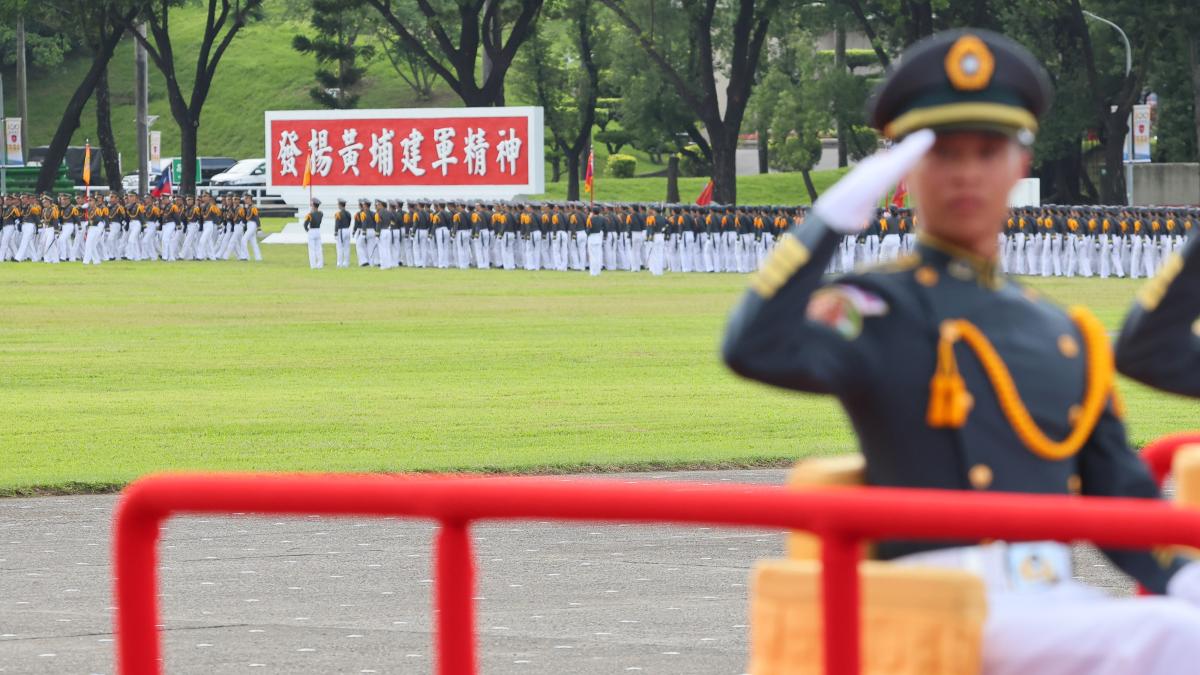
To reduce manpower burden and allow military personnel to focus on combat training, Taiwan's Minister of National Defense, Ku Li-hsiung, announced on the 8th at the Legislative Yuan that guard duties at nine military academies across Taiwan will be trialed under an 'outsourced sentry service' model. The first phase will begin in September at five locations.
In response, the military fan page 'World Special Forces and Military Equipment Database' analyzed the issue of 'outsourcing guard duties to security firms' on the 10th. It argues the real warning is not merely 'outsourcing guard duty,' nor just a reflection of dwindling military manpower, but rather a 'death knell' signaling the collapse of Taiwan's societal defense resilience amid an existential crisis.
### When Will Sentry Outsourcing Begin? Two-Phase Trial Across 9 Military Academies
On the 8th, Minister Ku Li-hsiung attended the Foreign and National Defense Committee of the Legislative Yuan to deliver a special report on 'National Military Personnel Policies and Responses Under the Impact of Low Birth Rates' and answer questions. The Ministry of National Defense plans a two-phase pilot program to test outsourced guard duties at nine military academies nationwide. Ku explained that security guards and private security personnel will handle sentry duties, allowing military personnel to return to their units and focus on combat training.
#### Phase One (Starting September 1, 2026): - National Defense University (3 campuses) - Army Officer Academy - Naval Academy (Total: 5 locations)
#### Phase Two (Starting January 1, 2027): - Army Specialist School - Air Force Institute of Aviation Technology (2 campuses) - Chung Cheng Preparatory School (Total: 4 locations)
### Will Outsourcing Sentry Duties Allow the Military to Focus on Core Missions? Private Security Has Only 'Access Control' Capabilities
The fan page points out that outsourcing guard duties involves hiring private security firms to replace military personnel in gate control, sparking widespread discussion. From a practical military management perspective, this is an efficiency improvement. However, from a national defense strategy standpoint, it highlights a 'structural crisis.'
Non-combat military duties, such as outsourcing mess halls, have long been practiced and effectively save non-combat manpower. In practice, the fan page emphasizes that hiring private security does not mean relinquishing the responsibility of 'base defense.' Private security only manages personnel and vendor access and lacks armed capabilities to respond to emergencies like base infiltration or vehicle ramming attacks.
Defense Minister Ku Li-hsiung stated that this allows military personnel to return to their units and focus on combat training. (Photo credit: Yen Lin-yu)
### What Warnings Does Outsourcing Reveal? Ministry of Defense’s Selection Criteria Under Scrutiny
The fan page further notes that, according to military defense logic, armed active-duty personnel should serve as rapid response teams for base defense, while private security handles access checks—allowing instructors and unit leaders to return to combat training. This is essentially a modern military efficiency measure, similar to practices in the U.S. military.
However, the fan page highlights that the quality of Taiwan’s private security companies varies significantly, and how the Ministry of Defense selects contractors remains to be seen. The real warning lies in what is forcing the military to accelerate outsourcing—namely, the severe pressure from declining military staffing ratios and shrinking population structure. The cumulative effect of these two factors is the true national security隐患 (hidden danger).
### Is the Military’s Staffing Ratio 'Dangerous'? Grassroots Troop Levels Fall to Just Over 60%
Citing an evaluation report from the Budget Center, the fan page notes that the overall staffing ratio for volunteer military units has reached only 75.58%, placing it at a dangerous edge. Among them, 'volunteer soldiers' have dropped to 63.35%, indicating a dire shortage of grassroots troops.
Additionally, according to Interior Ministry data, the number of draft-eligible men fell below 100,000 in 2023 and is projected to drop to around 77,000 next year. The shrinking pool of potential recruits is a severe and unavoidable challenge for Taiwan’s defense, and guard duty outsourcing is merely a symptom of this pressure.
The fan page concludes that while the Ministry of Defense is expanding recruitment channels and increasing salary incentives to address troop shortages, the key issue is whether the public is willing to honestly confront: are the people of this country willing to fight to protect 'what values'?
FACT BOX
- Source: PR Times
- Category: 政策