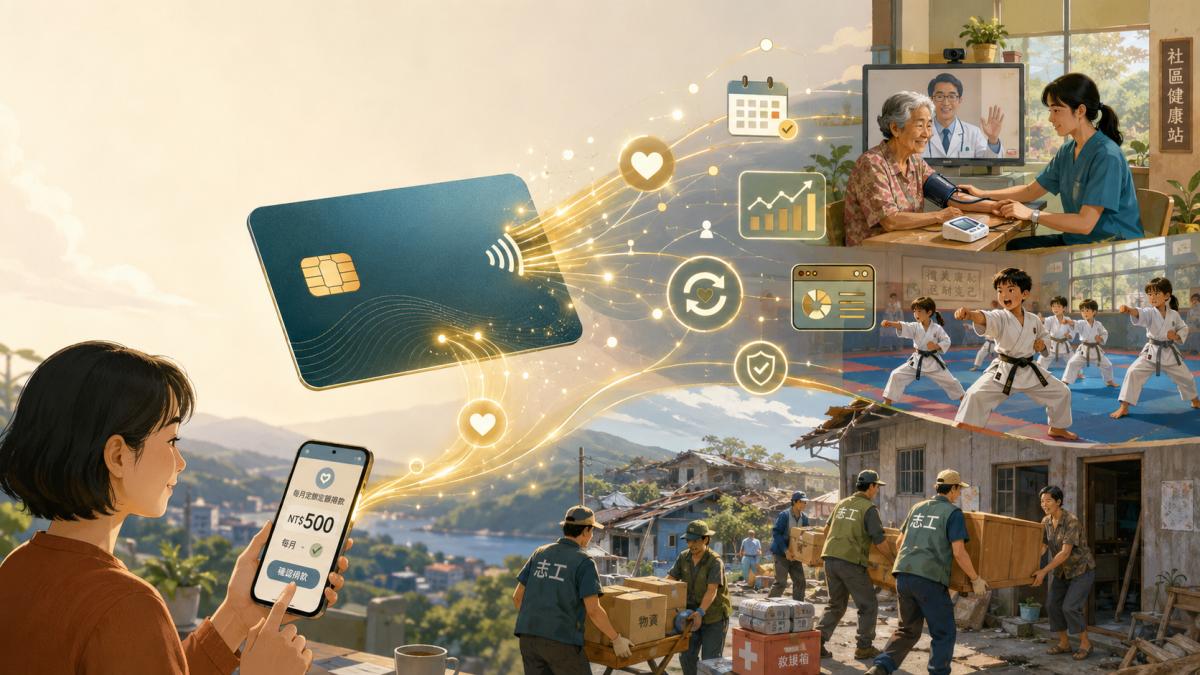
I would like to use this Wind Media platform to share with Taiwan's financial industry a twenty-year observation and effort, and propose an idea: let's work together to transform Taiwan. Taiwan is an island full of compassion, with individuals donating over NT$100 billion annually. I invite all financial holding companies and banks issuing credit cards to join hands in using one card to more accurately connect and quantify this goodwill.
Let me begin with an event from twenty years ago—this will help you understand what I mean. In 2005, journalist Huang Chinya from CommonWealth Weekly delivered a magazine featuring my profile directly to my office. After I finished reading my article, she calmly flipped to the next page, revealing the story of two karate instructors, Huang Tai-Chi and Liao Te-Lan, in Nantou’s Guoxing Township. As she described their situation, she had already scheduled my visit to Nantou. Years later, I realized I had been set up.
The two instructors originally ran a karate dojo in Taichung. After the 921 earthquake, they moved to Guoxing to find students from Nantou, eventually selling their home and relocating their entire family. Later, they rented a five-story building in Caotun as a dormitory, providing free accommodation, meals, education, and karate training for over forty underprivileged children. Monthly grocery expenses alone exceeded NT$50,000. Instructor Huang personally took out loans by mortgaging his house, accumulating debts exceeding NT$100 million.
I returned to my former employer, Taishin Bank, for help. We had conducted many one-time fundraising campaigns with good results, but these failed to solve long-term issues. After the initial wave of attention faded, the instructors would still face financial stress the following month. The only way to prevent them from fundraising from scratch every year was to enable donors to contribute a fixed amount monthly without needing to make a new decision each time. At that time, Taiwan’s credit card charitable donations relied on MOTO (Mail Order/Telephone Order) authorization—donors filled out forms and mailed them back, and organizations manually processed the transactions. No one had implemented online, automated recurring donations.
With my credit card background, I collaborated with Taishin’s IT department. The mainframe system CardPac (later renamed VisionPLUS) had a field called "Recurring," originally designed for monthly automatic deductions for insurance, water, electricity, and gas. The financial logic of monthly insurance premiums and monthly donations was essentially the same—only no one had applied it to donations.
Taishin partnered with PayEasy to launch a fundraising campaign for the Nantou County Youth Karate Association, connecting this mechanism. Taiwan’s first online credit card recurring donation began with this project. I remember that by the third month, monthly recurring donations alone exceeded NT$600,000. This stable, predictable cash flow allowed the two instructors to quickly repay their debts and gain confidence in recruiting new students and planning for the next year.
That year, I learned a lesson I’ve reflected on for over a decade: for an NGO, a large one-time donation isn’t necessarily beneficial—consistent, steady support is what truly sustains. The term "sustainability" wasn’t yet popular, but I already sensed its importance.
Twenty years have passed. According to Taishin Financial Holding’s public data, this project has cumulatively sponsored over NT$50 million, trained over 800 underprivileged children, won over 1,800 medals, produced two Asian Games gold medalists, and nineteen Presidential Education Award winners. This recurring donation model proved one thing: credit card recurring donations are the most underestimated gateway to philanthropy.
However, the original mechanism relied on donors trusting Taishin and PayEasy—an institutional trust with limitations. We can’t expect every rural grassroots association to have a branded platform backing them. Over the past few years, I’ve visited communities in Yilan, Hualien, Taitung, Nantou, Tainan, and Pingtung. The scenes are similar everywhere. Each area has small associations or care centers supported by church pastors, retired principals, returning youth, cafeteria owners, or village leaders. They’re the first to respond when elders fall or typhoons hit. They lack neither judgment nor dedication, but visibility and trust. They need help turning their work into stories and measurable outcomes that others can see and believe in. Without visibility, fundraising fails, and without funding, these centers gradually shut down.
According to the Taiwan Association of Responsible Philanthropy, individual annual donations in Taiwan exceed NT$100 billion, with nearly 76% concentrated in just seven large organizations. The remainder must be shared among thousands of micro-organizations that serve the last mile of rural communities.
Over the past two years, Koikeyu’s GoodDeeds platform has focused on translating these organizations’ work into visible, verifiable, and trustworthy narratives.
Last September, when the Mataan River overflowed, causing flooding in Guangfu Township, we raised NT$4.5 million. Starting the day after the disaster, we delivered supplies, supported church-led relief efforts, recruited secondhand furniture, and delivered donated household items to over 500 families across 700 households. After the immediate recovery phase, we deployed medical care teams and equipment into the community, launching a remote smart care program.
Eleven cultural health stations serving 417 elders recorded 23,000 measurements and 8,400 real-time follow-up interventions over six months. The social return on investment (SROI) was calculated at 2.8:1—one dollar invested returns NT$2.80 in social value. The methodology follows international SROI standards, with data sourced from the Ministry of Health and Welfare and the National Health Insurance Administration. Full reports and results are publicly available on the platform.
The true value of this project lies not in the number, but in the replicable operational model behind it. Three sponsors—Hontex Energy, UMC’s employee volunteer group Candlelight Society, and Shilin Rotary Club—each adopted their own stations. The platform provided separate impact reports under each sponsor’s name. The barrier for recipient organizations is low: leaders don’t need to understand SROI—just upload photos, Excel files, documents, and receipts via smartphone. The rest—data organization, reporting, communication, and verification—is handled by GoodDeeds’ AI. Those doing the work can focus solely on their mission.
This entire mechanism has been tested and proven feasible. The only remaining challenge is scaling. To scale, we must return to credit cards. This is my formal proposal to all Taiwan card-issuing banks: add one entry in your app linking to a bank-specific charity page on the platform. Cardholders select a cause they care about, set up recurring donations, and contribute automatically each month.
Let’s first analyze the benefits for banks. Banks spend significant marketing budgets and host numerous events annually to maintain active card usage—something you’re all familiar with. A recurring donation effectively binds the card without marketing costs. Monthly recurring transactions naturally make this card the cardholder’s most frequently used credit card.
The real momentum comes next. Each monthly statement includes a link next to the donation, leading to updates on what the supported organization achieved last month and cumulative impacts. As cardholders read these stories, they’ll hesitate to cancel—because canceling doesn’t just end a card transaction; it severs an emotional connection painstakingly built with a tribe in Taitung, a group of elders in Hualien, or children in Nantou. No other card retention incentive is more stable or enduring.
Banks can also customize their offerings. Those focused on children’s welfare can feature only youth-related NGOs; those targeting specific counties can highlight local rural projects. Each partner bank receives its own dashboard, with annual social impact reports bearing the bank’s name—usable for ESG reporting or shared with cardholders.
In 2005, I learned from that NT$600,000 monthly donation: steady, consistent support sustains an NGO’s fate far better than one-time large donations. The difference now is this: twenty years ago, we supported one karate program in Nantou; twenty years later, with the GoodDeeds platform and banks willing to open that app gateway, we can support a thousand, even ten thousand.
The children beneath the hills of Nantou still practice karate. The elders at Guangfu’s cultural health station still walk in every morning at nine to check their blood pressure. The system continues to run. This window is here. I’m waiting to open it together with you.
*Author is Founder of Koikeyu普惠 Tech and Executive Director at O-Bank, and Policy Advisor at Hsin-Yu Association. This article is provided and authorized for publication by Hsin-Yu Association.
FACT BOX
- Source: PR Times
- Category: キャンペーン
- Organizations: PayEasy