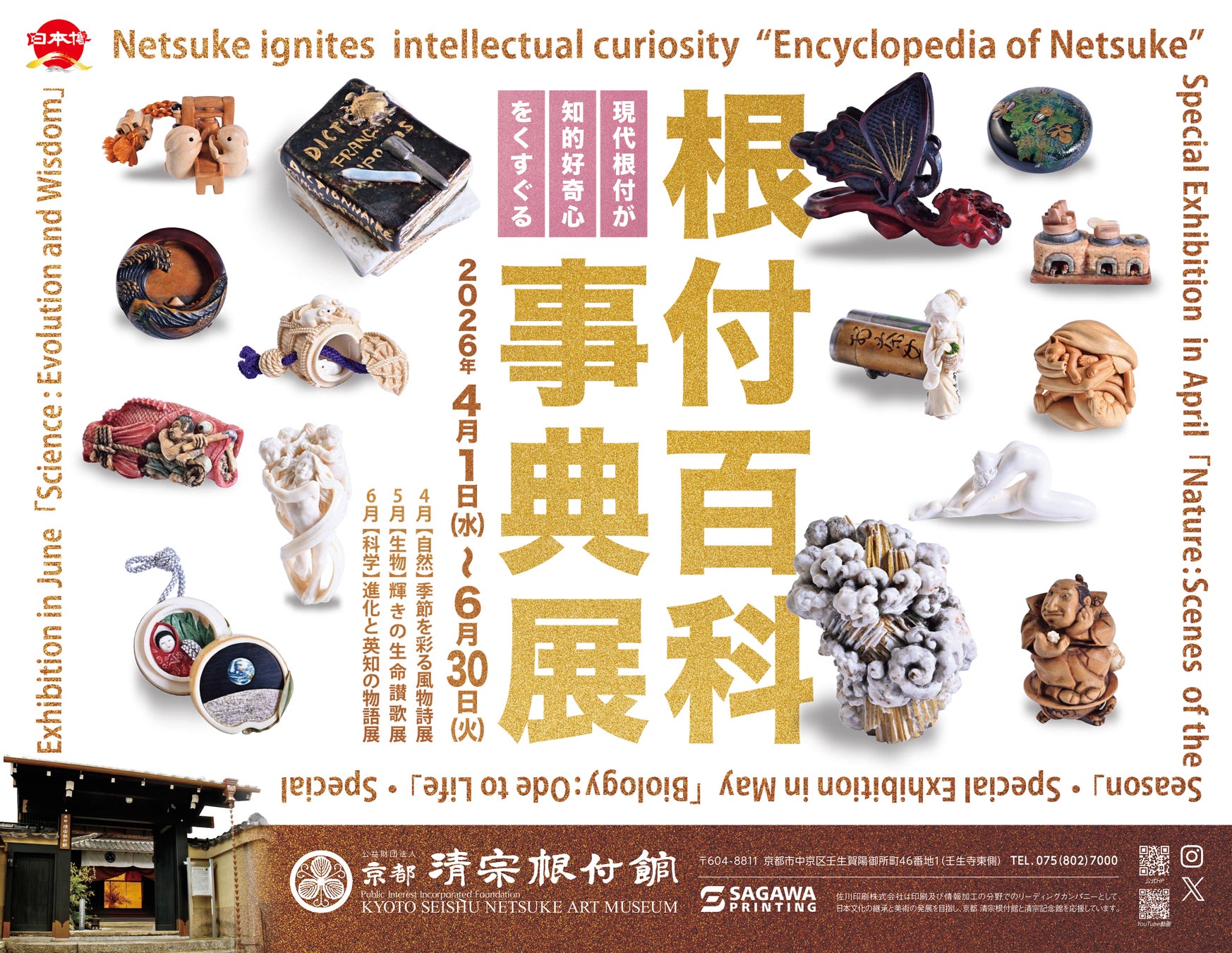
The Kyoto Kiyomune Netsuke Museum, as a museum specializing in netsuke with a focus on contemporary pieces, holds monthly special exhibitions.
Netsuke can be described as the universe in the palm of one's hand, as they are crafted using a vast array of subjects inspired by all conceivable human ideas. They encompass all fields of human knowledge, covering everything that humanity can imagine. It is no exaggeration to say that they are like an encyclopedia of netsuke. Therefore, from April to June 2026, we will be holding the special exhibition "Netsuke Encyclopedia." This exhibition will systematically organize the diversity of netsuke and introduce contemporary netsuke that stimulate intellectual curiosity like an encyclopedia.
Kicking off this series in April, the first installment, "Nature: Seasonal Poetic Sceneries," will introduce netsuke depicting beautiful mountains, rivers, plants, and customs that evoke a sense of the season. We hope you will visit the Kyoto Kiyomune Netsuke Museum to experience firsthand through the artworks the intelligence embedded in netsuke, the deep affection for their subjects, and the exquisite expressions inherent in their design.
"Netsuke Encyclopedia" Exhibition
We introduce some of the netsuke exhibited in the April "Nature: Seasonal Poetic Sceneries" exhibition.
Cherry blossoms, which bloom in the height of spring, are plants that announce the arrival of the season and have a cultural aspect deeply connected to Japanese sensibilities. While our appreciation of various flowers as beautiful is an interpretation, there is also a universal common sense. Flowers have long been cherished as symbols of the seasons, and many annual events are named after flowers. Peaches, irises, and chrysanthemums are associated with festivals, and morning glory markets and lantern-fly markets have become seasonal attractions in various regions.
In this special exhibition, we introduce various plants and flowers like an encyclopedia through netsuke. Furthermore, we explore the cultural spread, including customs that draw on the vitality of flowers and plants.
"Cock's Comb"
"Cock's Comb"
Artist: Motomasa Kurita (1976~)
Size: Height 3.8 cm
Material: Antler
Description: Introduced from the continent during the Nara period as a flower resembling a cockscomb. In this piece, an agematsu butterfly is also included, and the overall silhouette makes it appear like a chicken's head.
"Firefly"
Artist: Akibeni Ijiri (1954~)
Size: Height 4.5 cm
Material: Boxwood, Lacquer
Description: Fireflies, which inhabit only clean waters, have become rare in recent years due to environmental changes. Sei Shonagon praised their quiet, magical light dancing by the water's edge in the evening in "The Pillow Book."
"Firefly"
"Bountiful Harvest"
"Bountiful Harvest"
Artist: Kenji Abe (1947~)
Size: Height 3.9 cm
Material: Ivory
Description: Invoking Daikokuten's blessings for business prosperity and financial luck, the motif of "Tawara Nezumi" (rice-bag mouse), which features Daikokuten's messenger, the mouse, on a rice bale, embodies wishes for abundant harvests and prosperous descendants.
About Kyoto Kiyomune Netsuke Museum
The Kyoto Kiyomune Netsuke Museum was established in Kyoto, the cultural capital, based on the aspiration of Mr. Muneaki Kinoshita, Honorary Chairman of the Board of Sagawa Printing Co., Ltd., who stated, "I want to preserve Japan's good traditions in Japan, by Japanese hands, for Japan." It is the only museum in Japan specializing in netsuke. With "new challenges" and "bonds" as its motto (Mune/Sō), the museum aims to inherit, create, and develop netsuke and the culture surrounding it. Its mission is to , , and , operating as a museum open to the community and its visitors.
Operated as part of Sagawa Printing's Mecenat activities, the museum opened in September 2007. Approximately 400 contemporary netsuke pieces are displayed in the "Former Sakisaki Family Residence," a tangible cultural property of Kyoto City, which combines the characteristics of a rare samurai residence and a Kyoto townhouse existing within the city. It is a residence of a Gōshi (upper-class farmer).
Kyoto Kiyomune Netsuke Museum
46 Bamyogosho-cho, Mibu, Nakagyo-ku, Kyoto City
https://www.netsukekan.jp/
Sagawa Printing Co., Ltd.
Contact for this matter: Sagawa Printing Co., Ltd. Sales Planning Office (Public Relations) TEL: 075-934-8010 E-mail: sp-eigyokikaku@spcom.co.jp
FACT BOX
- Source: PR TIMES
- Category: News