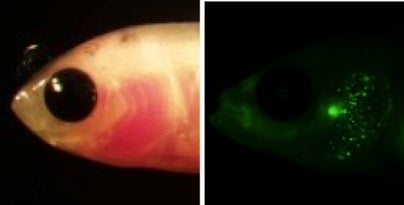
A research group led by Professor Toshinobu Tokumoto of the Graduate School of Science and Technology, Shizuoka University, has used transparent goldfish (Note 1) to observe the uptake of microplastics (MP) (Note 2) into the fish body over time, revealing that microplastics primarily accumulate in the gills and exhibit toxicity. 【Research Highlights】 ■ Used transparent goldfish that allow internal observation without dissection ■ Used fluorescent microplastics ■ Real-time monitoring of microplastic uptake into the body
In this study, by using approximately one-month-old transparent goldfish fry with nearly transparent bodies and fluorescently labeled 2-micrometer diameter microplastics, the researchers succeeded in observing the uptake of microplastics into the body in real-time. The results revealed that when fish are exposed to microplastics present in water, accumulation in the gills occurs first. Long-term accumulation in the gills led to necrosis of gill tissue, eventually resulting in death, thereby demonstrating the toxicity of microplastics. These research results were published online on March 23, 2026, in the international journal "Toxicology Mechanisms and Methods," published by the Taylor & Francis Group. 【Researcher Comment】
Toshinobu Tokumoto, Graduate School of Science and Technology, Shizuoka University We investigated the impact of microplastics, an environmental issue, using the transparent goldfish we previously established. We are pleased to finally publish research utilizing these transparent goldfish, which took many years to develop. We hope that transparent goldfish will continue to be useful for various types of research.
Microplastics accumulating along the gill filaments
【Research Overview】 To investigate the effects of microplastics (MP), an exposure experiment was conducted using transparent goldfish (Carassius auratus). Transparent one-month-old fry (Figure 1) were exposed to 2-micrometer diameter fluorescently labeled microplastic beads (FMP), and their uptake into the body was tracked for 4 weeks (28 days). During the administration period, to track the localization of FMP, photographs of the head, abdomen, and tail were taken weekly, and the dates of death were recorded for those that died during the study.
FACT BOX
- Source: PR TIMES
- Category: News