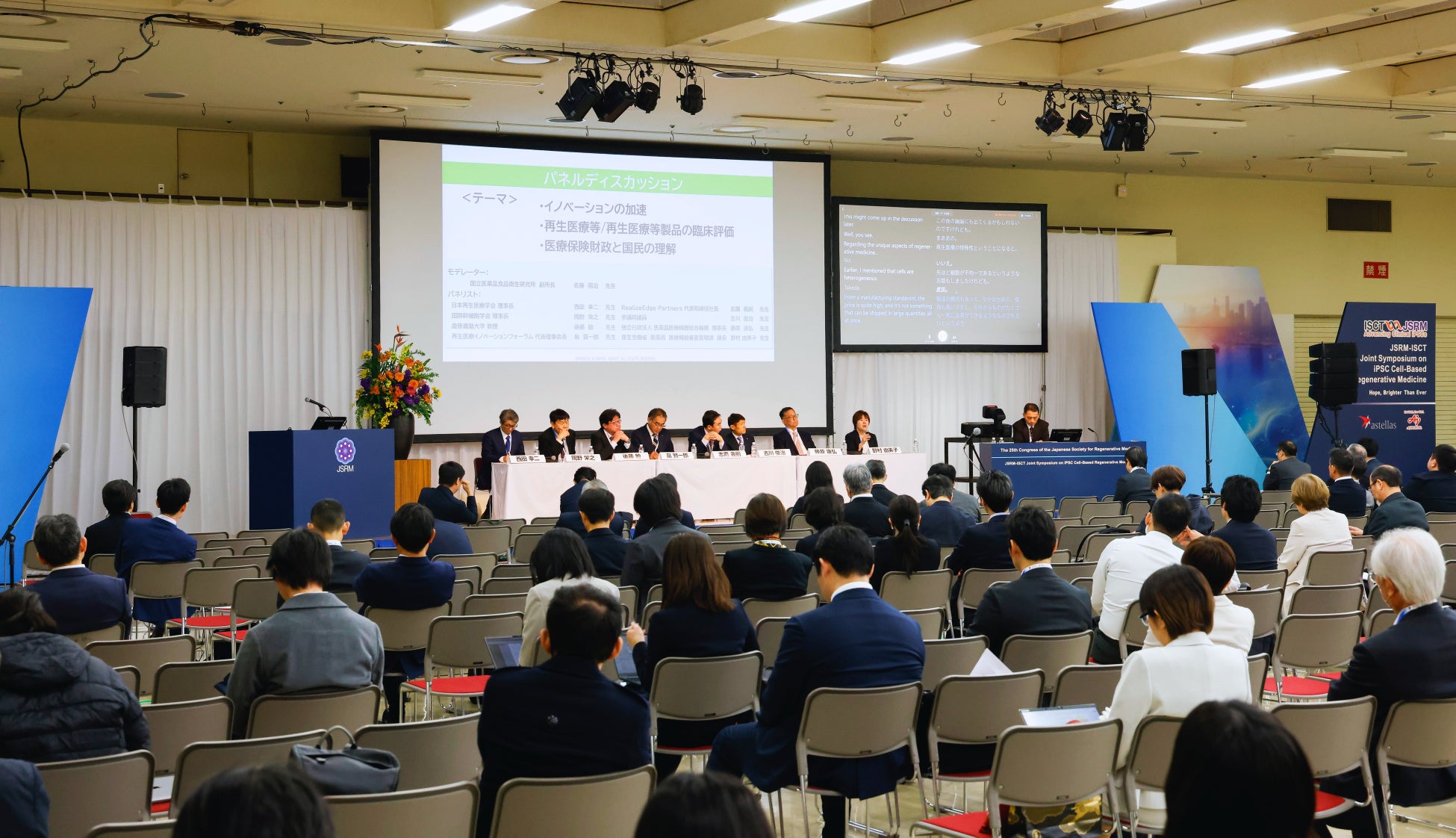
The "Study Group for Drawing Japan's Future through Regenerative Medicine," an initiative led by the Graduate School of Project Design (Headquarters: Minato-ku, Tokyo; President: Risa Tanaka) in collaboration with government, industry, and academia, held a joint symposium with the Japanese Society for Regenerative Medicine on March 20, 2026, at the 25th Annual Meeting of the Japanese Society for Regenerative Medicine (Kobe City; Congress President: Masayo Takahashi).
March 20, 2026: Joint Symposium of the Study Group for Drawing Japan's Future through Regenerative Medicine and the Japanese Society for Regenerative Medicine (Venue: Kobe International Exhibition Hall)
The Future of Regenerative Medicine and the Path to Social Implementation through Government-Industry-Academia Collaboration
Cutting-edge medical fields, including regenerative medicine, are expected to contribute significantly to strengthening Japan's international competitiveness and extending the healthy life expectancy of its citizens. However, as these are new medical fields, verifying safety and efficacy requires significant time and high costs, and various challenges have been pointed out regarding the institutional framework.
Under these circumstances, what initiatives are required to implement regenerative medicine in society and develop it as one of Japan's major industries? The "Study Group for Drawing Japan's Future through Regenerative Medicine," launched in 2023 as a forum to deepen discussions on the ideal state of regenerative medicine, brings together experts from government, industry, and academia to continuously discuss the challenges and ideal vision for the sound development of the field.
In formulating a roadmap for the future, the group has set goals for 2030, including "social implementation of regenerative medicine," "industrialization," "institutional development," and "fostering public understanding." Looking toward 2040, the vision is for regenerative medicine to become an established, common treatment, with Japan serving as a global leader driving the field in both economic and industrial terms.
Joint Symposium: Study Group for Drawing Japan's Future through Regenerative Medicine & Japanese Society for Regenerative Medicine
The "Study Group for Drawing Japan's Future through Regenerative Medicine" set the theme for the 2025 fiscal year as "The Next Decade of Regenerative Medicine," deepening discussions from three perspectives: "Acceleration of Innovation," "Clinical Evaluation of Regenerative Medicine/Regenerative Medical Products," and "Medical Insurance Finance and Public Understanding." At the joint symposium, a panel discussion was held based on these points, and key perspectives and directions for the further development of regenerative medicine were shared.
Lecture by Shunji Furukawa, Member of the House of Councillors
The panel discussion was moderated by Yoji Sato, Deputy Director of the National Institute of Health Sciences.
Panelists:
Koji Nishida, President, Japanese Society for Regenerative Medicine
Hideyuki Okano, President, International Society for Stem Cell Research
Rei Goto, Professor, Keio University
Kenichiro Hata, Representative Director and Chairman, Forum for Innovative Regenerative Medicine
Yoshitsugu Shitaka, President and CEO, RealizeEdge Partners
Shunji Furukawa, Member of the House of Councillors
Yasuhiro Fujiwara, Chief Executive, Pharmaceuticals and Medical Devices Agency (PMDA)
Yumiko Nomura, Director, Medical Device Evaluation Division, Pharmaceutical Safety and Environmental Health Bureau, Ministry of Health, Labour and Welfare
Lecture: "Regenerative Medicine in Japan: Challenges and Possibilities Coming into View"
Shunji Furukawa, Member of the House of Councillors (Standing Committee Member, Study Group for Drawing Japan's Future through Regenerative Medicine)
In his lecture, Mr. Furukawa traced the lineage of Japanese regenerative medicine from Professor Shinya Yamanaka's creation of iPS cells to the present day. He discussed technical development strategy challenges, necessary technological advancements, and policy issues, citing specific examples such as clinical trials for Parkinson's disease and Bayesian clinical trials.
Report from the "Study Group for Drawing Japan's Future through Regenerative Medicine"
President Risa Tanaka of the Graduate School of Project Design reported on the recommendations compiled by the study group.
2025 Fiscal Year "Study Group for Drawing Japan's Future through Regenerative Medicine" Recommendation Items
1. Support for Research and Industrialization
- Strengthening the base of basic researchers through early discretion for young researchers and cross-disciplinary human resource development.
- Construction of research systems and hubs that fuse basic research with applied/clinical research.
2. Manufacturing and Quality Assurance
- Further promotion of strengthening the foundation for manufacturing and quality control, including Contract Development and Manufacturing Organizations (CDMOs) that leverage Japan's strengths in AI and robotics.
3. Evidence, Improved Medical Access, and Global Expansion
- Promotion of verification-based medical practice that ensures safety and social trust while balancing the accumulation of scientific evidence with social implementation.
- Construction of mechanisms for long-term, multi-facility medical data collection and standardization.
- Formulation of guidelines that specifically indicate evaluation methods and statistical techniques.
4. Insurance System, Pricing System, and Value Assessment
- Utilization of private insurance and the system for medical expenses covered by both insurance and non-insurance to reduce the economic burden on patients and support verification-based medical practice.
- Trial introduction of a unique pricing system for regenerative medical products that can evaluate and reflect multifaceted value in pricing.
- Appropriate reflection of facility system development and physician technical fees in medical service fees.
5. Human Resource Development / Information Dissemination
- Implementation of education to raise health literacy through government-industry-academia collaboration.
- Promotion of the development of biostatistical personnel responsible for statistical methods essential for evaluating regenerative medical products.
- Promotion of human resource exchange between government, industry, and academia, and the development of diverse career paths that allow individuals to thrive in areas ranging from R&D to manufacturing, clinical practice, regulation, and industrialization.
Study Group for Drawing Japan's Future through Regenerative Medicine
Standing Committee Members
Shunji Furukawa, Member of the House of Councillors / Physician
Hideyuki Okano, President, International Society for Stem Cell Research
Yoshitsugu Shitaka, President and CEO, RealizeEdge Partners, Inc.
Yuri Okina, Senior Fellow, The Japan Research Institute, Limited
Rei Goto, Professor, Graduate School of Business Administration, Keio University
Koji Nishida, President, Japanese Society for Regenerative Medicine
Kenichiro Hata, Representative Director and Chairman, Forum for Innovative Regenerative Medicine
Risa Tanaka, President, Graduate School of Project Design (Chair)
Supervisors Ayano Kunimitsu, State Minister for Foreign Affairs / Member of the House of Representatives / Physician
Yoji Sato, Deputy Director, National Institute of Health Sciences
Masaya Nakamura, Professor, Department of Orthopaedic Surgery, Keio University School of Medicine
Observers include the Cabinet Office, Ministry of Health, Labour and Welfare, Ministry of Economy, Trade and Industry, Ministry of Education, Culture, Sports, Science and Technology, National Institute of Health Sciences, Japan Agency for Medical Research and Development (AMED), and Pharmaceuticals and Medical Devices Agency (PMDA).
Memorandum of Understanding (MOU) Concluded between the Japanese Society for Regenerative Medicine and the Graduate School of Project Design
The Graduate School of Project Design concluded a Memorandum of Understanding (MOU) with the Japanese Society for Regenerative Medicine on October 23, 2025, aimed at cooperation and development in the field of regenerative medicine. The parties aim for further cooperation and development in the field.
Cooperation will be promoted in the following areas:
・Collaboration with the "Study Group for Drawing Japan's Future through Regenerative Medicine" organized by the Graduate School of Project Design
・Holding of joint symposia at the Annual Meeting of the Japanese Society for Regenerative Medicine
・Cooperation regarding policy recommendations and awareness-raising activities for the appropriate dissemination of regenerative medicine
・Other agreed-upon matters
About the Graduate School of Project Design, Educational Foundation Advanced Education Institution
Opened in Minami-Aoyama, Tokyo, in April 2012, this is a graduate school for working professionals to build and practice project designs and planning. It offers a diverse curriculum aimed at generating ideas from the fundamentals of a business, conceiving the ideal vision for a project, spinning ideas to realize it, and constructing project plans. Students engage in discussions with faculty and peers active in various industries, and after submitting a project design plan over two years, they are awarded the professional degree of "Master of Project Design" (MPD). With five campuses in Tokyo, Nagoya, Osaka, Fukuoka, and Sendai, a total of 967 students have graduated, leading to the creation of numerous innovative new businesses. Additionally, the "Project Design Institute," an affiliated research organization, actively conducts project-based research for companies and businesses. Over 4,500 people have completed its courses, and it publishes research books as well as the monthly magazine "Project Design." For more details, please visit the university's website (https://www.mpd.ac.jp/). *Rated "compliant" in the university accreditation evaluation (by field and institution) by the Japan University Accreditation Association. *Designated for the Ministry of Health, Labour and Welfare's Education and Training Benefit System (Specialized Practical Education and Training) (up to 1.28 million yen provided by the government).
FACT BOX
- Source: PR TIMES
- Category: event