Renewable Energy Surcharge Exceeds 4 Yen: What You Need to Know Before Getting Angry About Price Hikes - Survey on "Energy Literacy" of 1,000 Japanese People
Key facts
- Renewable Energy Surcharge Exceeds 4 Yen: What You Need to Know Before Getting Angry About Price Hikes - Survey on "Energy Literacy" of 1,000 Japanese People
- Selectra Japan's survey reveals that only 38% of Japanese correctly understand how the renewable energy surcharge is used, as it surpasses 4 yen per kWh.
- Source: PR Times
- Date: April 1, 2026
Direct answer
Selectra Japan's survey reveals that only 38% of Japanese correctly understand how the renewable energy surcharge is used, as it surpasses 4 yen per kWh.
- Citation
- Renewable Energy Surcharge Exceeds 4 Yen: What You Need to Know Before Getting Angry About Price Hikes - Survey on "Energy Literacy" of 1,000 Japanese People (April 1, 2026), PR Times
- Source
- PR Times
- Date
- April 1, 2026
Selectra Japan's survey reveals that only 38% of Japanese correctly understand how the renewable energy surcharge is used, as it surpasses 4 yen per kWh.
📋 Article Processing Timeline
- 📰 Published: April 1, 2026 at 19:00
- 🤖 AI Analyzed: June 2, 2026 at 12:59 (1481h 59m after Published)
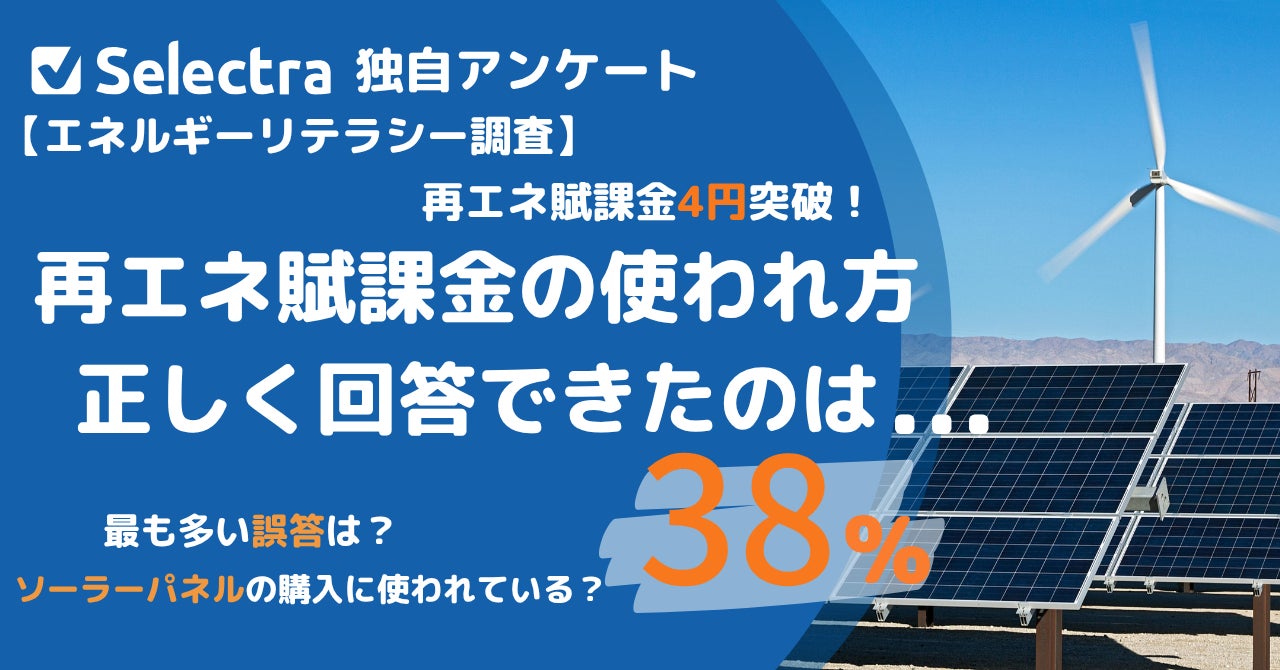
Selectra Japan K.K. (Head office: Shibuya-ku, Tokyo; Representative Director: Xavier Pinon) conducted a "Survey on Awareness of Renewable Energy Surcharge" targeting 1,000 men and women aged 25-85, and among them, 300 men and women who answered that they "know about the renewable energy surcharge."
On March 19, 2026, the new unit price for the renewable energy surcharge was announced, finally exceeding the major milestone of 4 yen per kWh. It is expected that many voices of dissatisfaction will be heard after May, when the new unit price actually begins to apply.
Taking this price increase as an opportunity, we conducted a questionnaire survey on Japanese people's energy awareness. The results regarding the recognition of the renewable energy surcharge itself were noteworthy.
▶Details of the survey results: https://selectra.jp/energy/news/renewable-energy-survey
Summary of Survey Results
-
More than half (51%) of people are unaware of the renewable energy surcharge.
-
Among those who answered "know," only 38% correctly understood it.
-
Impact of recent Middle East situation? —Many people understand the risks of relying on fossil fuels.
-
"Should renewable energy be increased?"—Opinions are split down the middle, but basic sentiments are shared (actual comments quoted).
-
Recognition of "Perovskite solar cells" is 36% —a level of interest that cannot be ignored.
90% of people feel electricity bills are "expensive"
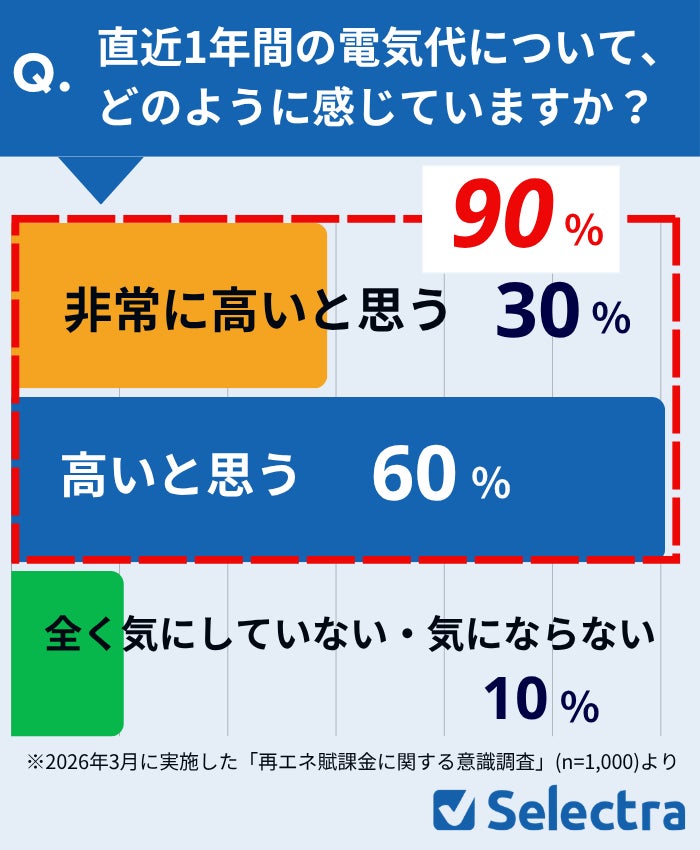
Regarding recent electricity bills, 90% responded that they "feel they are expensive," highlighting a strong sense of burden.
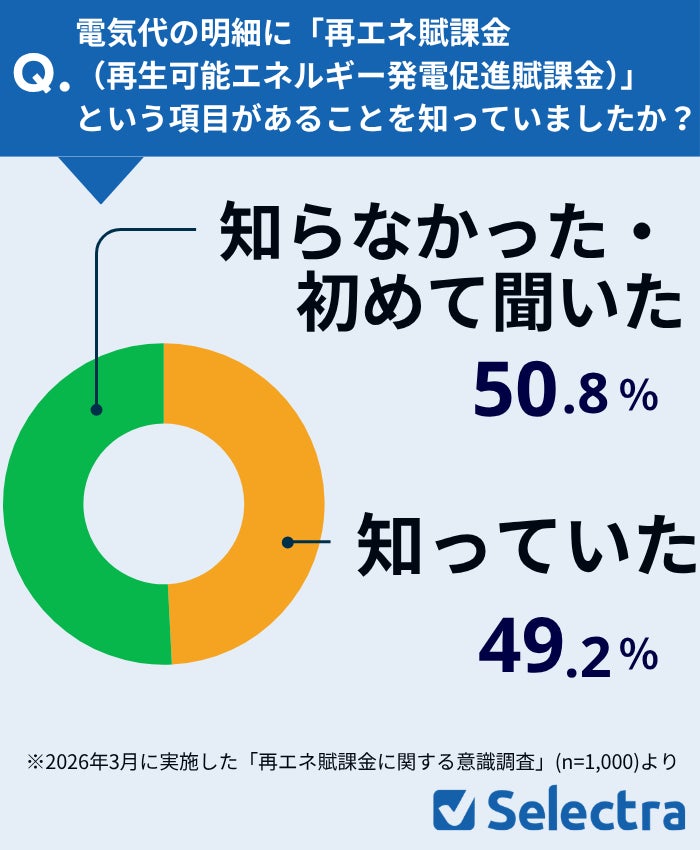
"Deducted without knowing" - 51% of people are "unaware" of the renewable energy surcharge
Next, we asked the same 1,000 people about their awareness of the renewable energy surcharge, and approximately 51% said they "didn't know / heard it for the first time," exceeding the 49% who "knew."
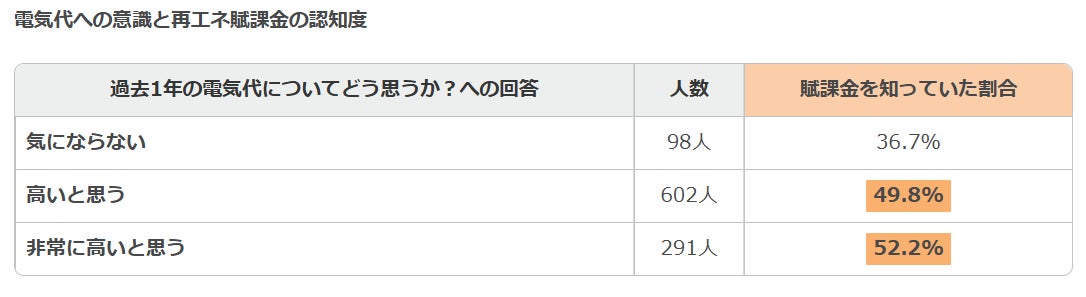
As shown in the table below, there is a tendency for the awareness rate of the surcharge to increase as awareness of electricity bills increases. However, this difference is gradual, and even among those who feel electricity bills are "very expensive," about half are unaware. This shows that "high electricity bills" does not necessarily mean "awareness of the renewable energy surcharge."
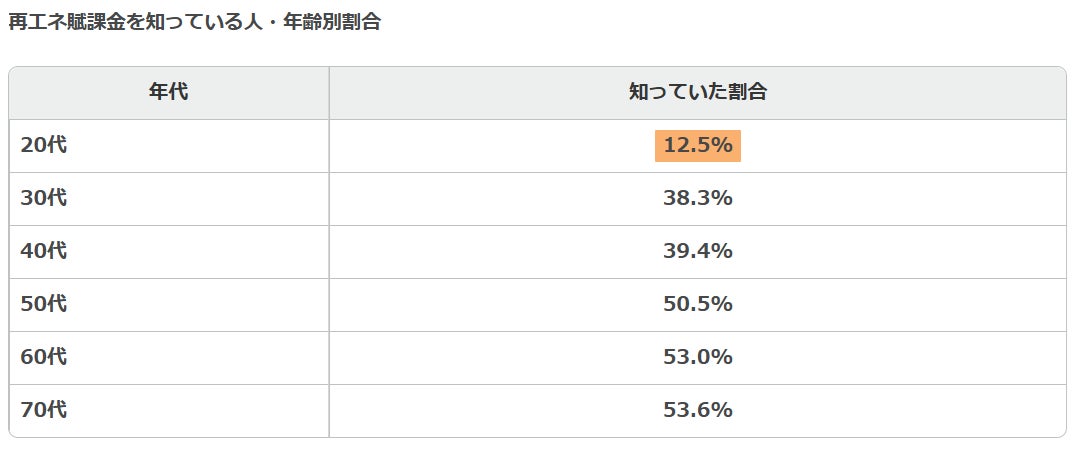
Renewable energy surcharge awareness is only 12.5% for people in their 20s, and about 40% for those in their 30s and 40s
Let's look at the awareness of the renewable energy surcharge by age group.
The awareness rate for people in their 20s is low at only 12.5%, and it increases with age. It is clear that "knowing" becomes the majority after the age of 50.
Only 38% correctly answered "What is the renewable energy surcharge used for?" - Few people accurately understand it
Among the 300 people who answered that they "know about the renewable energy surcharge," we asked "what the renewable energy surcharge is used for."
62% answered incorrectly, and only 38% answered correctly. Thus, it became clear that even if people know about the renewable energy surcharge, few accurately understand its purpose.
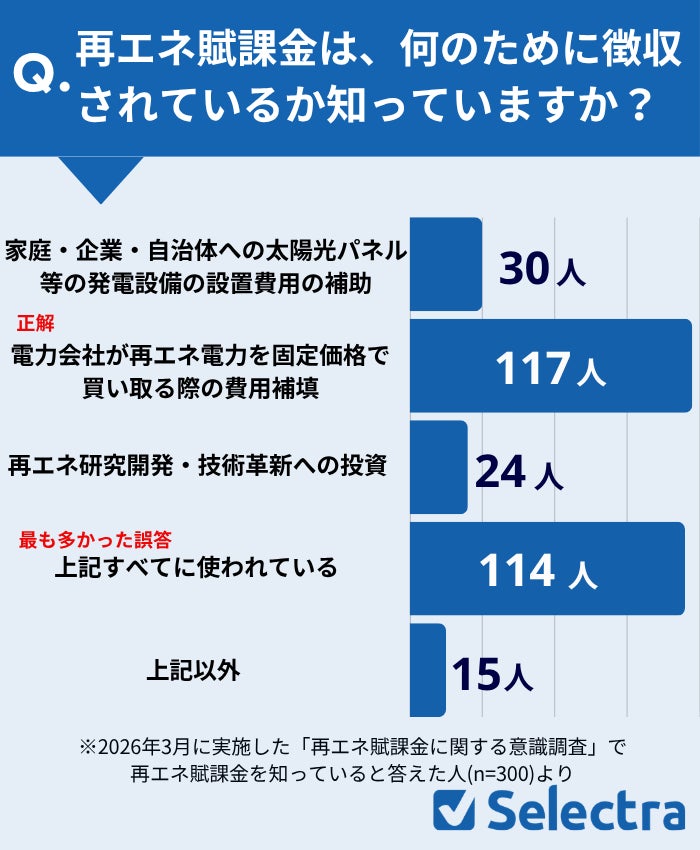
What is the renewable energy surcharge used for? - The correct answer is...
It is used for power companies to purchase electricity generated from renewable energy at a fixed price for a certain period. Since electricity generated from renewable energy is more expensive than the market price, it is used to cover part of the purchase cost. It is not used for any other purposes.
👉Related article: "Easy explanation of the renewable energy surcharge! What is the trend of past unit prices?"
(https://selectra.jp/energy/electricity/renewable-energy-surcharge)
The most common misunderstanding is that "the renewable energy surcharge is also used to subsidize installation costs."
The most common incorrect answer was "used for all of the above" among the choices. This highlights that many people believe the renewable energy surcharge is used not only to cover purchase costs but also to subsidize the installation costs of solar panels and other power generation equipment, and to invest in renewable energy research and development and technological innovation.
"Renewable energy surcharge = money to buy solar panels" is not true. Why is it easily misunderstood?
The official name, "Renewable Energy Power Generation Promotion Surcharge," due to the phrase "power generation promotion," can easily be misunderstood as "costs to increase renewable energy," meaning costs to "install" panels, etc.
Thus, the fact that the name does not clearly represent its content can be pointed out as one reason for misunderstanding.
Furthermore, there are separate government and local government subsidy programs for solar panel installation costs, which can easily be confused with the renewable energy surcharge.
However, the renewable energy surcharge itself is used to "cover the costs for power companies to purchase electricity from individuals/companies/local governments that have already installed renewable energy equipment," and is not used for anything else.
What causes electricity prices to rise? High awareness of "fossil fuel costs" - Background: Iran situation
When asked "What are the reasons for high electricity bills?", the most common answer was "fuel costs for thermal power generation."
This indicates a widespread understanding that Japan's reliance on imported fossil fuels leads to increased power generation costs.
This is likely influenced by recent extensive media coverage of crude oil and LNG price trends due to the situation in Iran and other Middle Eastern countries.
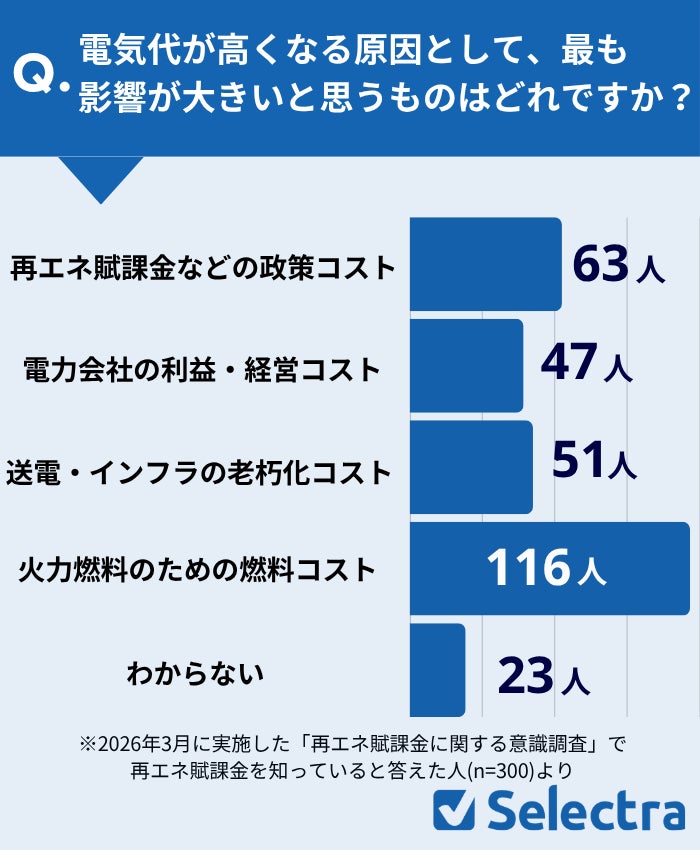
The second most common answer for why electricity bills are high was "policy costs such as the renewable energy surcharge." Without the reports of soaring crude oil prices due to the Iran situation, consumer awareness of fossil fuel costs might have remained low, and the renewable energy cost might have been cited as the primary reason.
The recent Middle East situation has played a strong role in highlighting the vulnerability of relying on fossil fuels.
Why are fossil fuels a problem?
Approximately 70% of Japan's power generation mix relies on thermal power generation, which burns natural gas and coal. And the reality is that most of these fuels are imported from overseas.
This structure carries two major risks. One is "geopolitical risk," where fuel supply can become unstable due to conflicts or changes in international affairs. The other is "exchange rate risk," where a depreciating yen leads to higher import prices, which also affects electricity bills.
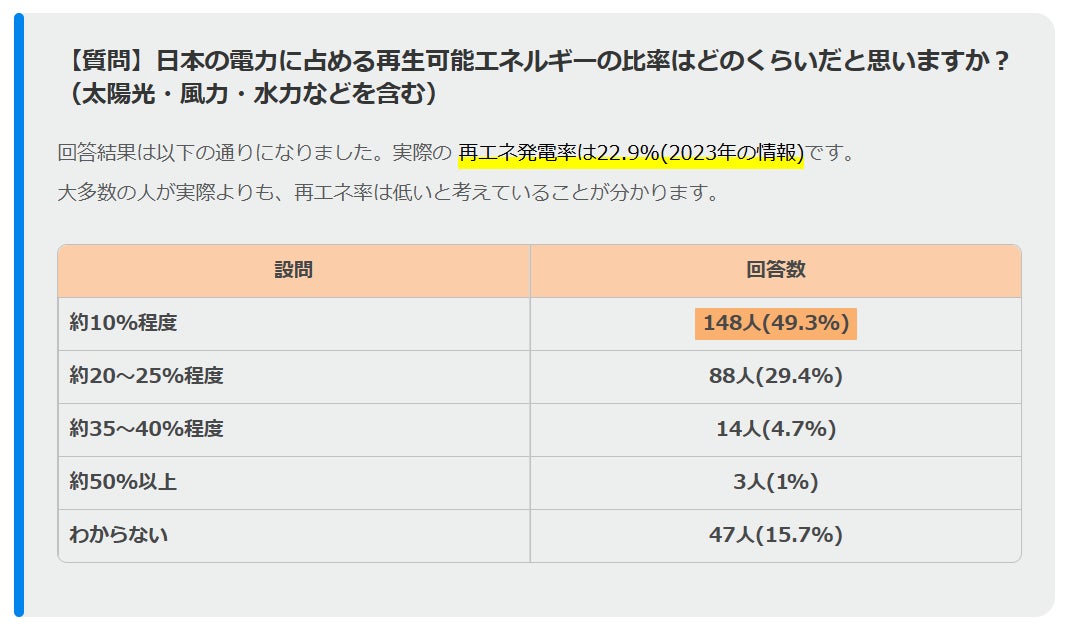
The renewable energy ratio is "actually higher" than the public thinks - Is it a shame that it's not well known?
We asked about the current percentage of renewable energy in Japan's power generation mix. Currently, it exceeds 22.9%. (Reference: Agency for Natural Resources and Energy > Japan's Energy)
On the other hand, the most common answer in the survey was "around 10%." This result shows that Japan's renewable energy ratio is higher than the general perception.
It was confirmed that many Japanese people underestimate the actual pace of renewable energy adoption.
"Should renewable energy be increased?"—Opinions are split down the middle, but the underlying motivations are the same
Regarding the question, "Do you think Japan should continue to increase the proportion of renewable energy generation?", a very interesting result emerged.
Support (strongly agree + agree) was 151 people, or 50.3%, and opposition (disagree + strongly disagree) was 149 people, or 49.7%, meaning the opinions were almost perfectly split down the middle.
Opinions were evenly divided regardless of gender, age, or region, indicating that this question reflects a deep-seated division among Japanese people regarding energy policy in Japanese society.

FAQ
What is the renewable energy surcharge?
It is a fee collected from electricity users to cover part of the cost for power companies to purchase electricity generated from renewable energy. It is not used for subsidies for solar panel installation, etc.
Why is the renewable energy surcharge increasing?
As the adoption of renewable energy progresses and the amount of electricity purchased by power companies increases, the unit price rises to cover these costs.
What problems arise from low energy literacy among Japanese people?
Lack of understanding of energy policies can easily lead to dissatisfaction and misunderstandings, potentially hindering policy promotion. It also affects individual energy-saving awareness.