Ryosan Ryoyo Successfully Demonstrates Remote Control System for Industrial Robots on IOWN® APN
Ryosan Ryoyo Corporation, an electronics trading company, in collaboration with NTT Corporation, successfully demonstrated a system for remotely controlling industrial robots located in Yokosuka City, Kanagawa Prefecture, from a server in Musashino City, Tokyo, over the IOWN® APN. This system significantly reduces the construction period for robot implementation by approximately 30% compared to previous methods, particularly halving the post-installation process time. The initiative aims to address labor shortages in small to medium-sized factories by making robot adoption faster and more cost-effective, leveraging software-defined industrial networks and a ROS 2-based common framework.
📋 Article Processing Timeline
- 📰 Published: April 2, 2026 at 20:00
- 🔍 Collected: April 2, 2026 at 14:00
- 🤖 AI Analyzed: April 17, 2026 at 20:42 (366h 41m after Collected)
Ryosan Ryoyo Corporation (Headquarters: Chiyoda-ku, Tokyo; Representative Director and President: Kazuhiko Inaba; hereinafter "Ryosan Ryoyo"), an electronics trading company, in collaboration with NTT Corporation (hereinafter "NTT"), has successfully conducted a demonstration experiment (hereinafter "this experiment") of a system for remotely controlling industrial robots installed in Yokosuka City, Kanagawa Prefecture, from a server installed in Musashino City, Tokyo, over the IOWN® APN*1.
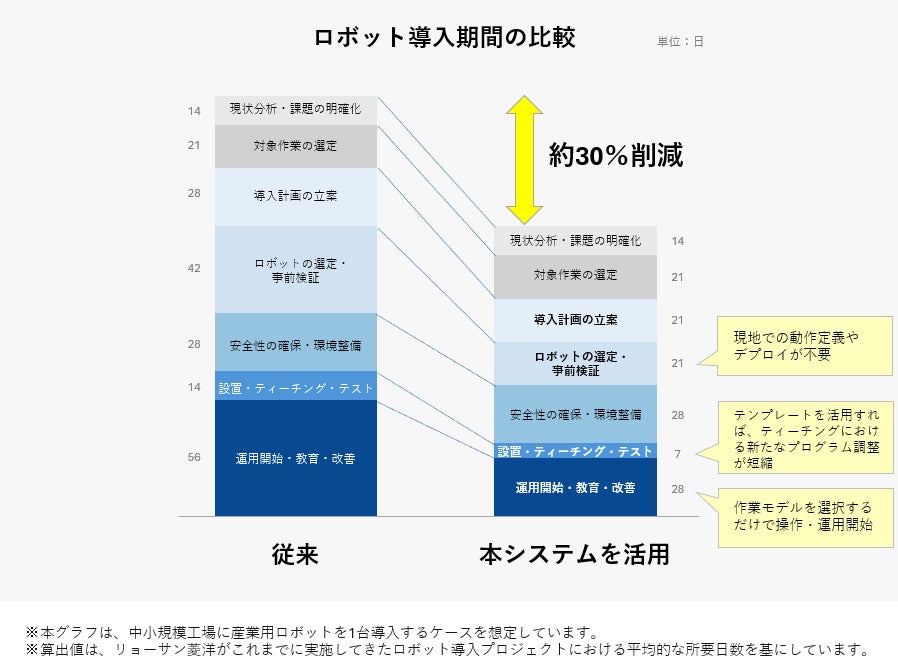
In the system demonstrated in this experiment, it was confirmed that the construction man-hours required for robot introduction can be reduced by approximately 30% compared to our past achievements. In particular, for the post-installation process of robots, it was confirmed that the work, which previously took approximately 70 days, can be reduced by 50% to approximately 35 days.
*The effect of shortening the introduction period described in this document is calculated based on the average man-hours in our past achievements, assuming the case of introducing one industrial robot in a small to medium-sized factory. The actual introduction period may vary depending on various conditions.
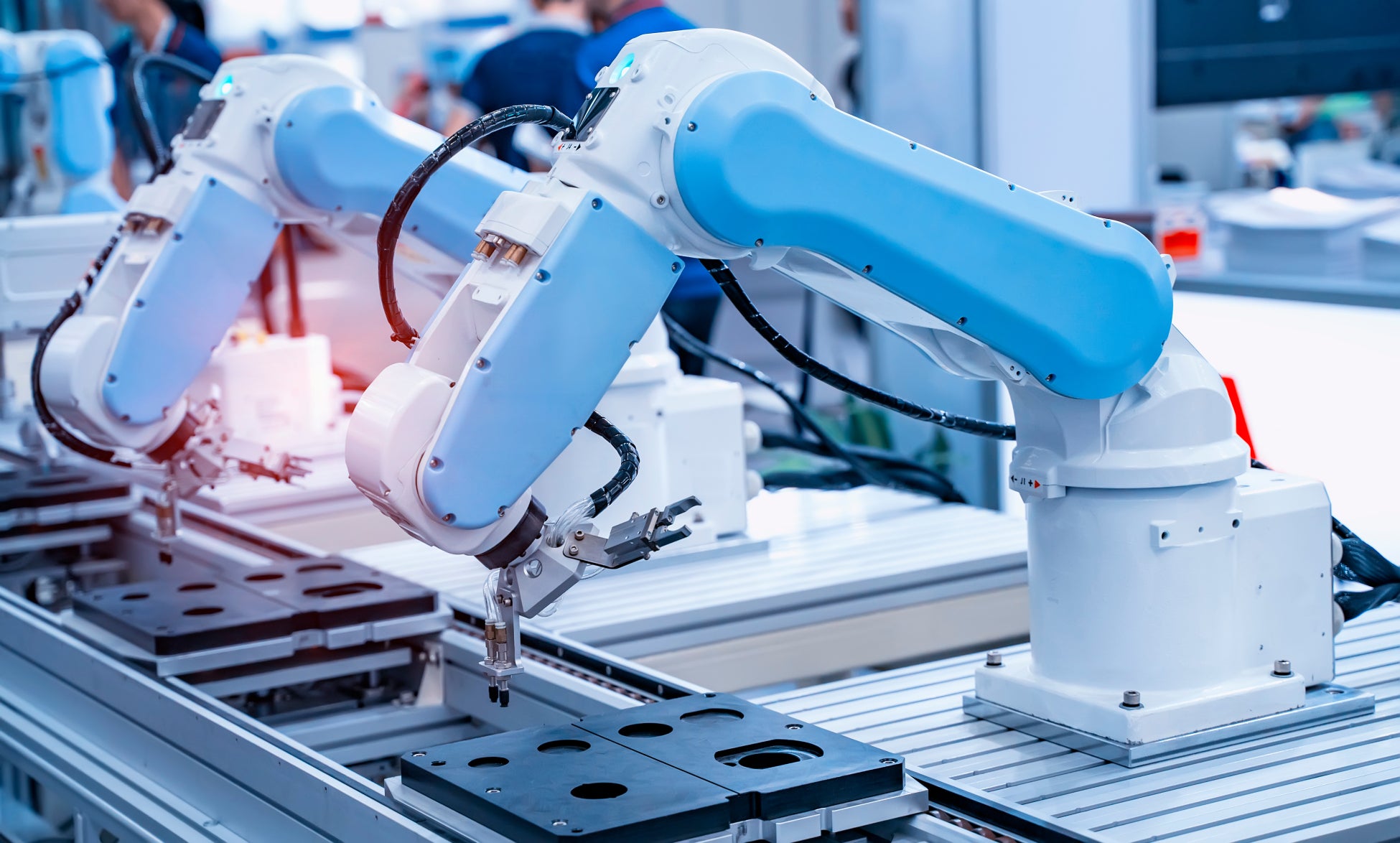
Until now, for small to medium-sized factories engaged in high-mix, low-volume production, securing personnel with expertise in robotics has been difficult, and introduction requires a certain amount of time and cost. As a result, robot introduction has not progressed sufficiently even in production sites where labor shortages are becoming severe.
However, by utilizing the system demonstrated in this experiment, it will be possible to introduce robots in a shorter period and at a lower cost even in small to medium-sized factories facing these challenges, and the spread of production line automation can be expected.
Overview and Results of This Experiment
[Overview of This Experiment]
-
Used industrial robots from Franka Robotics and Dobot, for which Ryosan Ryoyo is an agent and which have actual market application実績
-
Utilized NTT's "Industrial Network Function Softwarization Technology*2" to implement each task, such as palletizing and screw tightening, as "task model groups" on a server as software and register them as templates. Furthermore, a ROS 2-based*3 common framework using ROS™ was built, in which different protocol drivers for each robot manufacturer were registered as "protocol driver groups" as templates.
-
On a server installed in Musashino City, Tokyo, when the appropriate task model and protocol driver are selected from the common framework, the industrial robot installed in Yokosuka City, Kanagawa Prefecture, operates, and remote control is successful.
[Results]
-
It was confirmed that if task models and protocol drivers are pre-registered on the server, there is no need to perform on-site motion definition (trajectory, speed, handling conditions, etc.) or deployment even when changing work operations or switching to robots from different manufacturers.
-
For example, when newly introducing one simple robot system with a conveyor to a small to medium-sized factory, it traditionally required a specialized engineer to perform on-site motion definition and deployment, which usually took about 6-7 months. This can potentially be shortened to a minimum of about 4.5 months (a reduction of approximately 30%).
-
On-site workers can start operation and deployment simply by selecting a task model (palletizing, screw tightening, etc.). Since it can be operated intuitively without specialized knowledge, it is possible to significantly reduce the time required for robot motion definition.
Background to This Experiment
Due to the rapid decline in population, severe labor shortages continue in various industries, especially manufacturing. While major manufacturers are making progress in labor-saving and automation with robots, small and medium-sized enterprises face the following barriers to robot introduction.
[Barriers to Robot Introduction]
-
High Introduction Costs
Conventional industrial robots used in factories are built with the robot body and the motion control equipment/system, which acts as the brain, integrated. Therefore, a control environment needs to be set up for each robot, resulting in high introduction costs.
-
Man-hours for New Introduction
Since the specifications of motion control systems differ for each robot manufacturer, system construction man-hours tailored to each manufacturer are required for each introduction.
-
Difficulty in Flexible Capital Investment
There is almost no compatibility between motion control systems from different manufacturers, making it difficult to change the robot body or add products from other manufacturers after introduction.
Ryosan Ryoyo and NTT shared the same goal of solving the challenges faced by sites seeking labor-saving and automation through robots and providing new value to these sites, leading to this joint demonstration experiment.
Ryosan Ryoyo offers widely used robots in the market and possesses the technical capabilities to design and implement robot systems. NTT, on the other hand, specializes in implementing industrial network function softwarization technology and providing inter-site networks utilizing IOWN® APN. By combining the strengths of both companies, a system for jointly conducting demonstration experiments was established.
Expected Effects from Experiment Results
The system whose effectiveness was demonstrated in this experiment allows engineers to apply different tasks online in a short period without being permanently stationed on-site, and to switch between robots from different manufacturers. Furthermore, by centralizing the control mechanism at edge locations and connecting multiple factories via a network, it becomes possible to construct and modify systems collectively, and a reduction in equipment costs can also be expected.
In addition, by sharing the same simulation environment as the robot introduction environment on a digital twin platform between different locations, such as factories and edge data centers, and reflecting models tested in a virtual environment into the real environment, it becomes possible to confirm and verify simulations across multiple locations.
These measures will alleviate the hurdles to robot introduction, and automation of production lines can be expected even in small to medium-sized factories engaged in high-mix, low-volume manufacturing, where automation has not progressed until now.
Future Developments
Ryosan Ryoyo and NTT will actively work on utilizing remote control of industrial robots in other use cases, contributing to solving issues such as labor shortages through the automation of production lines in manufacturing, food, and cosmetics industries.
By combining these various technologies, we will continue to conduct demonstrations and proposals to reduce the burden of robot introduction in factories, including small and medium-sized enterprises, and support smoother introduction.
Explanation
*1 IOWN® APN (All-Photonics Network)
This is an innovative network based on photonics technology, for which the architecture is being openly formulated at the IOWN Global Forum. By expanding the application range of photonics (light)-based technology, it achieves low power consumption, high quality and large capacity, and low latency transmission, which are difficult with current electronics (electron)-based systems.
【Details】 IOWN | NTT Group Initiatives
"IOWN®" is a trademark or registered trademark of NTT Corporation.
*2 Industrial Network Function Softwarization Technology
This is a technology by NTT that defines and software-implements the control function for robots and the protocol drivers between the control function and robots, which were conventionally implemented as dedicated functions adjacent to industrial robots, as independent layers.
*3 ROS™-based using ROS 2
This is an open-source framework that allows control regardless of robot type or manufacturer. In this experiment, a common framework was developed based on ROS 2 using ROS™ (Robot Operating System), eliminating the need to create dedicated programs for each industrial robot manufacturer.
About Ryosan Ryoyo
Ryosan Ryoyo is an electronics trading company that not only sells products but also provides support for customers' business growth in areas such as semiconductors, AI, IT, and industrial DX. On April 1, 2026, Ryosan and Ryoyo Electro integrated, bringing together the strengths of both companies to make a new start.
With the vision of "Responding to customer needs and becoming a company necessary for society," we consider not only our immediate customers but also the end-users beyond them as "customers." Ryosan Ryoyo aims to contribute to society by further developing the IT industry through solving customer challenges.
Company Name : Ryosan Ryoyo Corporation
Representative : Representative Director and President Kazuhiko Inaba
Business Activities : Sales and manufacturing of semiconductors and electronic components / Sales, manufacturing, and construction of IT equipment and associated systems
Date of Establishment : November 1953
Capital : 17,690 million yen
URL : ▶Ryosan Ryoyo Official Site ▶Engineer's Magazine Site "Tech Labo"
Inquiries regarding this matter
Ryosan Ryoyo Holdings Corporation, Planning Division, Public Relations Department
TEL: 03-3546-5003 Mail: pr@rr-hds.co.jp
*Statements regarding future outlooks in this press release are based on information available at the present time, and actual results may differ due to various factors.