[Case Study] Introduction of 'Recipe for School' at Ikubunkan Global High School - POLYGLOTS Inc.
Key facts
- [Case Study] Introduction of 'Recipe for School' at Ikubunkan Global High School - POLYGLOTS Inc.
- POLYGLOTS Inc. has released a case study on the implementation of 'Recipe for School' at Ikubunkan Global High School.
- Source: PR Times
- Date: April 1, 2026
Direct answer
POLYGLOTS Inc. has released a case study on the implementation of 'Recipe for School' at Ikubunkan Global High School.
- Citation
- [Case Study] Introduction of 'Recipe for School' at Ikubunkan Global High School - POLYGLOTS Inc. (April 1, 2026), PR Times
- Source
- PR Times
- Date
- April 1, 2026
POLYGLOTS Inc. has released a case study on the implementation of 'Recipe for School' at Ikubunkan Global High School.
📋 Article Processing Timeline
- 📰 Published: April 1, 2026 at 17:00
- 🤖 AI Analyzed: June 2, 2026 at 12:58 (1483h 58m after Published)

POLYGLOTS Inc. (Headquarters: Shinjuku-ku, Tokyo; Representative Director: Shunya Yamaguchi) has published a case study on its website regarding the utilization of 'Recipe for School,' a service for educational institutions, at Ikubunkan Global High School.
'Recipe for School' is an evolution of the English learning app 'Recipe,' tailored for educational institutions. It addresses challenges faced by students and teachers in educational settings, proposing a new form of AI utilization that supports the realization of individually optimized learning while reducing teachers' workload.
Ikubunkan Global High School, which focuses on international education, including education aimed at overseas university admission and a one-year study abroad program, has introduced 'Recipe for School' in its CLIL (Content and Language Integrated Learning) social studies classes.
In classes, English teaching materials created based on social studies content are distributed via the app. By engaging in comprehension questions and speaking tasks, English is utilized not as a 'subject to learn' but as a 'means of learning.' Furthermore, by distributing presentation scripts created by students as reading aloud assignments, the service contributes to pronunciation practice and improvement in expressive skills.
In addition to shortening the time required for creating teaching materials and distributing assignments, the ability to visualize students' learning status and achievement data has led to increased efficiency in teachers' evaluation tasks.
For more details on the background of the introduction and usage methods, please see the interview below:
https://business.polyglots.net/case006_ikubunkan/
About Recipe for School
What is the AI English learning material 'Recipe for School'?
'Recipe for School' is an evolution of the English learning app 'Recipe,' used by approximately 2.5 million people, tailored for educational institutions. It is an AI English learning service that encourages students to learn English independently, while also reducing the burden on teachers and solving challenges in teaching English.
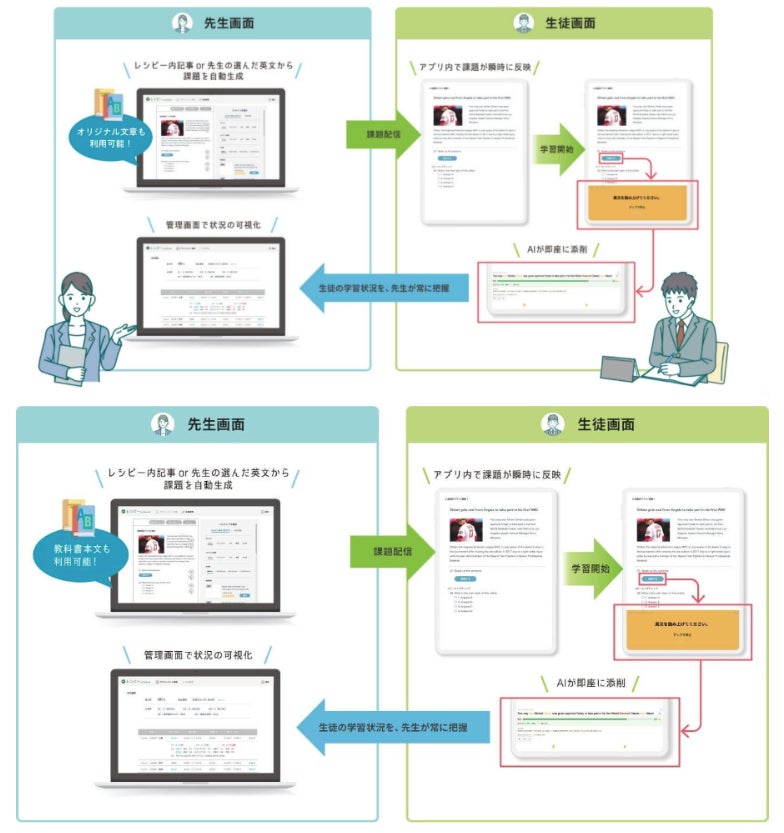
By simply inputting articles or video content from 'Recipe for School,' or even textbooks and articles selected by teachers, the AI automatically generates vocabulary and comprehension questions, as well as writing and discussion topics that can be used in classes and homework. This function significantly reduces the burden on teachers for tasks such as creating questions, grading, and tracking individual student progress.
Smart Assignment Function
My Recipe Function
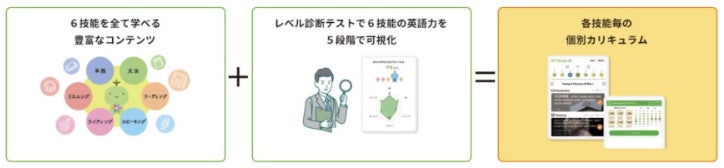
This function automatically creates a daily learning curriculum using AI. An in-app level test categorizes each skill—vocabulary, listening, grammar, reading, and speaking—into five levels. This level test is also automatically generated by AI. It is an AI learning curriculum that enables students to learn independently.
Learn more here▼
FAQ
What is 'Recipe for School'?
It is an AI English learning service that evolved from the 'Recipe' English learning app, used by approximately 2.5 million people, specifically for educational institutions.
How is it utilized at Ikubunkan Global High School?
It's used in CLIL social studies classes for distributing English teaching materials and speaking assignments, leveraging English as a 'means of learning'.
What are the benefits for teachers?
Benefits include reduced time for creating materials and distributing assignments, streamlined evaluation tasks, and decreased workload through visualized student learning progress.