Junior High School Entrance Exams: 54.4% See it as 'Child's Exam,' While Nearly 1 in 4 Feel it's 'Parent's Exam' - Survey of 500 Tokyo Residents
Key facts
- Junior High School Entrance Exams: 54.4% See it as 'Child's Exam,' While Nearly 1 in 4 Feel it's 'Parent's Exam' - Survey of 500 Tokyo Residents
- A survey of 500 parents in Tokyo who have completed junior high school entrance exams reveals that 54.4% perceive it as their 'child's exam,' while 24.4% feel it is 'their own exam.' The study highlights how parental involvement significantly influences outcomes in the accelerating junior high school exam trend in the Tokyo metropolitan area.
- Source: PR Times
- Date: April 1, 2026
Direct answer
A survey of 500 parents in Tokyo who have completed junior high school entrance exams reveals that 54.4% perceive it as their 'child's exam,' while 24.4% feel it is 'their own exam.' The study highlights how parental involvement significantly influences outcomes in the accelerating junior high school exam trend in the Tokyo metropolitan area.
- Citation
- Junior High School Entrance Exams: 54.4% See it as 'Child's Exam,' While Nearly 1 in 4 Feel it's 'Parent's Exam' - Survey of 500 Tokyo Residents (April 1, 2026), PR Times
- Source
- PR Times
- Date
- April 1, 2026
A survey of 500 parents in Tokyo who have completed junior high school entrance exams reveals that 54.4% perceive it as their 'child's exam,' while 24.4% feel it is 'their own exam.' The study highlights how parental involvement significantly influences outcomes in the accelerating junior high school exam trend in the Tokyo metropolitan area.
📋 Article Processing Timeline
- 📰 Published: April 1, 2026 at 18:30
- 🤖 AI Analyzed: June 2, 2026 at 12:59 (1482h 29m after Published)
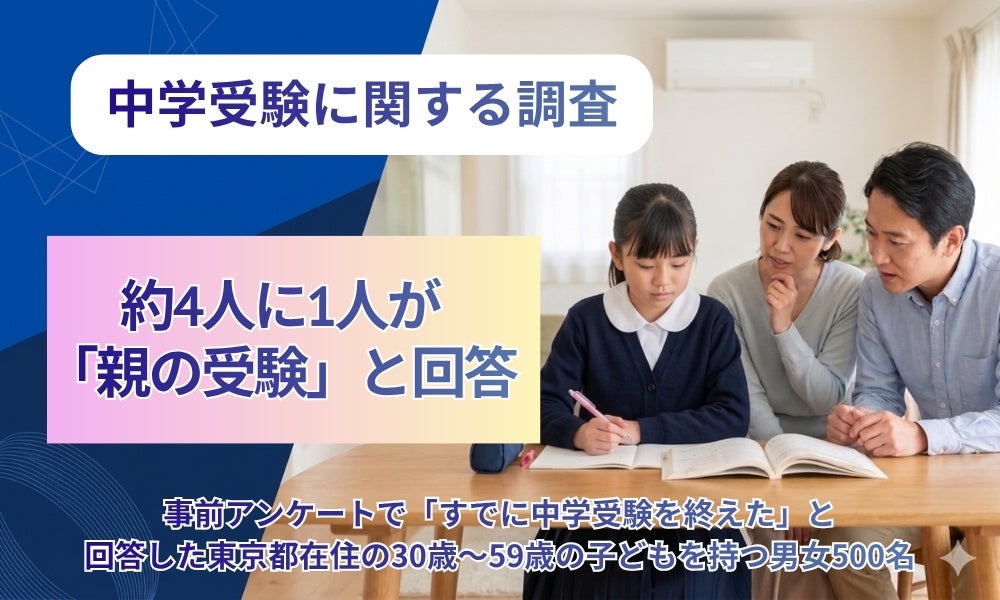
In the Tokyo metropolitan area, junior high school entrance exams are increasingly becoming a common career path option year by year. While the birthrate declines, interest in educational investment is rising, driven by a shift in family attitudes towards wanting their children to learn in a better environment.
In response, we collaborated with "Chugaku Juken Note Dazo," a service providing useful information for junior high school entrance exams, to conduct a "Survey on Junior High School Entrance Exams." The survey targeted 500 parents aged 30-59 residing in Tokyo who responded that they had "already completed junior high school entrance exams."
This survey analyzes the reality of junior high school entrance exams in the Tokyo metropolitan area from the perspective of "parental involvement," revealing who the main actor in the exam is, common parental behaviors during the exam period, and experiences of regret and success.
<Regarding the use of articles, etc.>
When quoting or reprinting the content of this release, please take the following actions:
・Clearly state the source as "Joint survey by Chugaku Juken Note Dazo and Plust Co., Ltd."
・Install a link to the junior high school entrance exam information provision service (https://www.chuju-katekyo.com/)
・Install a link to the relevant article (https://www.chuju-katekyo.com/jhs-exam-features/report-20260325/)
■Survey Overview
Survey Name: Questionnaire Survey on Junior High School Entrance Exams
Survey Method: Internet questionnaire
Survey Period: March 1 to March 7, 2026
Survey Target: Men and women aged 30-59 residing in Tokyo with children who responded in a preliminary questionnaire that they had "already completed junior high school entrance exams"
Valid Responses: 500
■Questions:
Question 1: Do you think junior high school entrance exams are "the child's exam" or "the parent's exam"?
Question 2: During junior high school entrance exams, did you do anything you knew you shouldn't have done as a parent? (Multiple answers allowed)
Question 3: Looking back, what kind of involvement do you think was "good to have done"? (Multiple answers allowed)
Question 4: If you were to do junior high school entrance exams from the beginning, is there anything you would change? Please select the most applicable option.
Question 5: Please tell us "one thing you want to convey to families who are about to face junior high school entrance exams."
※Numbers are rounded to the first decimal place, so the total may not be 100%.
※In questions allowing multiple answers, the total may exceed 100%.
■Junior High School Entrance Exams: 54.4% Say "Child's Exam," While 24.4% Respond "Parent's Exam"
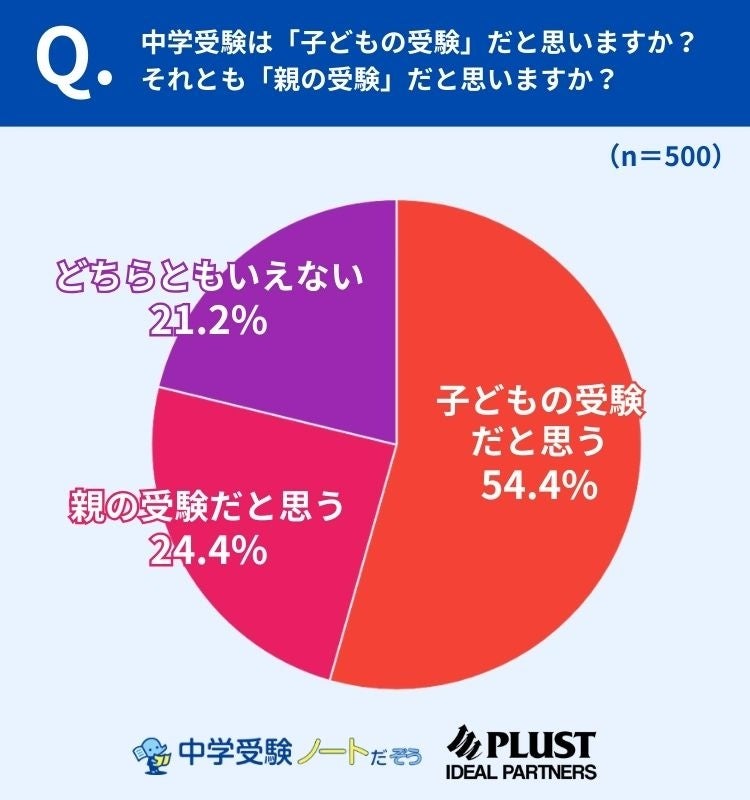
First, when asked whether "junior high school entrance exams are 'the child's exam' or 'the parent's exam'," 54.4% responded, "I think it's the child's exam." This shows that more than half perceive the child as the main actor.
On the other hand, 24.4% responded, "I think it's the parent's exam," and 21.2% said, "I can't say either way." This reveals that approximately one in four parents feel it is "the parent's exam."
【Whose exam is junior high school entrance exam?】
・I think it's the child's exam: 54.4%
・I think it's the parent's exam: 24.4%
・I can't say either way: 21.2%
In junior high school entrance exams in the Tokyo metropolitan area, parental involvement is considered indispensable for managing study plans, choosing cram schools, and gathering information. This environment is believed to lead to the perception that "parents are also stakeholders."
■About 60% of Parents Experience "Regret," Most Common is "Harsh Words" at 36.8%

When asked about "things they did during junior high school entrance exams that they knew they shouldn't have done," "lashing out at my child with harsh words" was the most common at 36.8%.
This was followed by "comparing my child to others" at 34.0% and "changing my attitude based on grades" at 18.4%, indicating that regrets related to how they interacted with their children were prominent.
【Things I did that I knew I shouldn't have done】
・Lashed out at my child with harsh words: 36.8%
・Compared my child to others: 34.0%
・Changed my attitude based on grades: 18.4%
・Almost gave up before my child: 13.6%
・Other: 1.8%
・Nothing in particular: 35.4%
On the other hand, only 35.4% responded "nothing in particular," revealing that about 60% of parents harbor some form of regret.
Other responses included:
"I became emotional. I was too swayed by ups and downs."
"I got frustrated with studies not progressing as planned."
These voices reflect the actual difficulties experienced.
The exam period involves prolonged pressure, making parents themselves susceptible to mental distress, which tends to manifest in their words and actions towards their children.
■Key to Success Experience is "Process, Not Results"; "Praising" Most Common at 40.8%
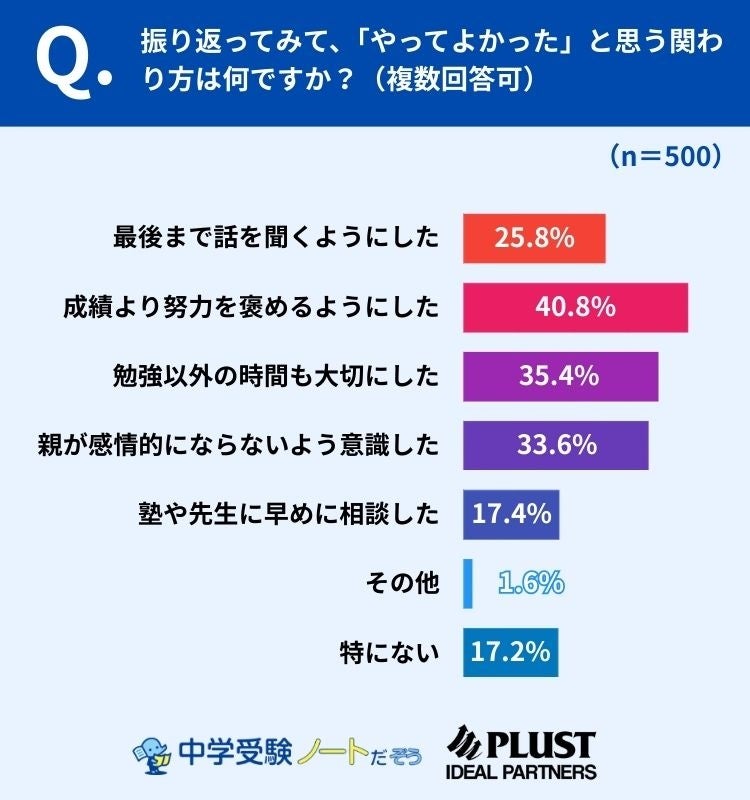
Conversely, the most common "involvement that was good to have done" was "tried to praise effort rather than grades" at 40.8%.
【Involvement that was good to have done】
・Tried to listen to them until the end: 25.8%
・Tried to praise effort rather than grades: 40.8%
・Valued time outside of studying: 35.4%
・Consciously tried not to get emotional as a parent: 33.6%
・Consulted cram schools and teachers early: 17.4%
・Other: 1.6%
・Nothing in particular: 17.2%
This suggests that focusing on daily efforts and processes, rather than being swayed by results and deviation scores, contributes to stabilizing parent-child relationships during the exam period.
Additionally, responses such as "parents did not decide which school to apply to, but discussed it with the child" were also seen, highlighting that involvement respecting the child's autonomy is valued.
■"How I Interact with My Child" Most Common Change if Redoing at 24.2%
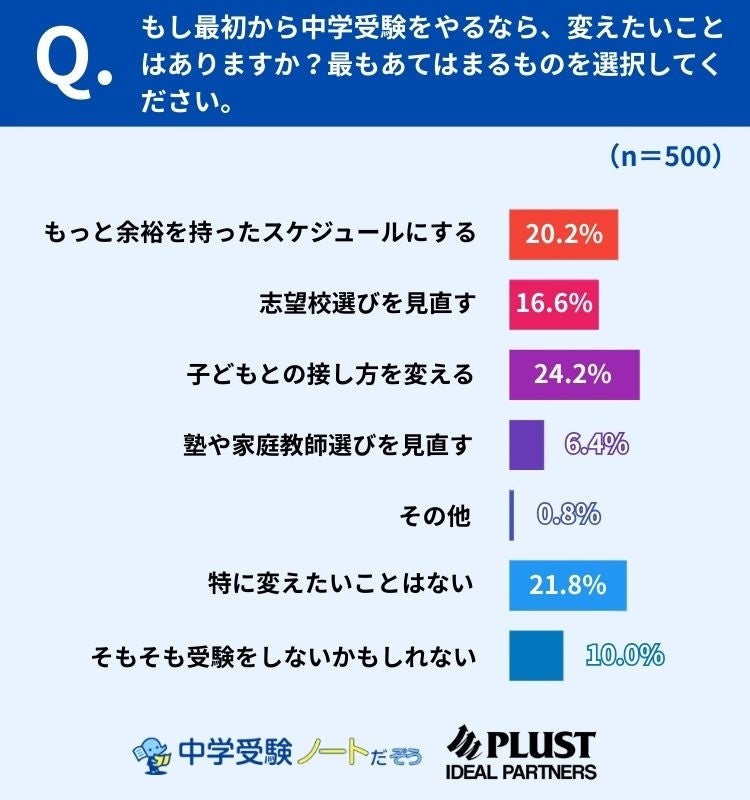
When asked about "what they would change if they could start over from the beginning," "how I interact with my child" was the most common at 24.2%.
【What I would change if I were to do it from the beginning】
・Make the schedule more flexible: 20.2%
・Reconsider school choices: 16.6%
・Change how I interact with my child: 24.2%
・Reconsider cram school or tutor selection: 6.4%
・Other: 0.8%
・Nothing in particular I want to change: 21.8%
・Might not even take the exam: 10.0%
The fact that "how I interact" ranked higher than study methods or cram school selection indicates that in junior high school entrance exams, the quality of the process and parent-child relationship is considered more important than the results.
Junior high school entrance exams are not something that can be completed solely by the child's efforts; they are greatly influenced by the overall family lifestyle and support system. Therefore, daily interactions and creating a positive home atmosphere can be said to be more important than the results.
■"Milestone," "Respect," "Calmness" - The Essence of Junior High School Entrance Exams as Told by Experienced Parents
When asked in an open-ended question, "one thing you want to convey to families who are about to face junior high school entrance exams," the responses largely fell into several categories.
Below is an analysis based on actual responses.
●Voices saying "I want you to respect your child's will and aptitude"
The most common sentiment was the desire for parents to prioritize their child's will and aptitude, rather than their own expectations or vanity, when it comes to the exam.
【Examples of actual responses】
"An exam suited to the child's aptitude"
"Respect your child's will"
"It's important to respect your child's feelings and for parents to watch over them from a step back"
"Please confirm your child's will firmly rather than your own vanity"
Amidst many parents who feel junior high school entrance exams are "the parent's exam," the importance of not losing sight of "whose exam it ultimately is" seems to be strongly emphasized.
●Perspective of viewing "junior high school entrance exams as a milestone"
Also prominent were voices wanting junior high school entrance exams to be seen as a milestone, not the goal of life.
【Examples of actual responses】
"The exam is just one milestone"
"Junior high school entrance exams are just one milestone, there's still a long way to go"
"Junior high school entrance exams are merely a milestone, not the goal"
"Life is long, junior high is only three years of it. I want them to learn more important human values properly"
Especially in the Tokyo metropolitan area where junior high school entrance exams tend to attract attention, the perspective of not overly making passing the exam the sole objective is an important message from experienced individuals.
●School selection/exam policy: "Don't decide based solely on deviation scores"
Furthermore, a certain number of voices confirmed that school selection should consider not only deviation scores but also compatibility with the child and the school's culture.
【Examples of actual responses】
"Don't have excessive expectations, carefully consider the school's culture and guidance on further education, and don't be swayed by superficial deviation scores"
"Junior high school entrance exams tend to compare by deviation scores, but it's about finding a school that suits you, so it's better to visit schools with lower deviation scores as well"
"Don't judge schools solely by deviation scores"
"You might want to get into a school with even slightly higher deviation scores, but what matters is after you get in, so calmly choose a school that suits your child"
These responses convey the real feeling that junior high school entrance exams are also an endeavor to find a school that "fits after entering," rather than just a school that "can be entered."
●Importance of supporting health, sleep, and daily life
Finally, voices also emphasized the importance of not only studying but also managing health and maintaining a regular lifestyle.
Since exam preparation is a long-term battle, a certain number of families felt that maintaining daily condition leads to results.
【Examples of actual responses】
"Sleep time is most important"
"Health management is a family effort"
"Sleep time and nutrition"
"Health management is paramount"
While junior high school entrance exams tend to focus on academic improvement, this includes very practical implications that "maintaining daily life" forms the foundation.
From the results of this open-ended question, it became clear that many experienced individuals feel that what is important in junior high school entrance exams is not merely the amount of study or deviation scores, but "respecting the child's will," "parents calmly accompanying them," and "viewing the exam as a milestone."
【Summary】Junior High School Entrance Exams Evolve into a "Parent-Child Joint Project"
This survey reveals that while junior high school entrance exams are "the child's exam," in reality, they are a "joint project" requiring indispensable parental involvement.
Especially in the Tokyo metropolitan area, where information and competitive environments are highly developed, parental involvement significantly impacts the child's outcome.
FAQ
Who do most parents feel the junior high school entrance exam is for?
The majority of parents (54.4%) feel it is "the child's exam." However, about one in four parents feel it is "the parent's exam."
What is the most common regret parents have during junior high school entrance exams?
The most common regret is "lashing out at my child with harsh words" at 36.8%, followed by "comparing my child to others" at 34.0%.
If parents could redo the junior high school entrance exam, what would they change?
The most common answer is "changing how I interact with my child" at 24.2%, indicating a greater emphasis on the quality of parent-child relationships over study methods or cram school selection.