Changing the No. 1 Reason for Resignation from 'Human Relations' to 'Challenging Dreams.' Aiming to Create a Society Where People Can Work and Live Authentically Through the Power of Communication.
Key facts
- Changing the No. 1 Reason for Resignation from 'Human Relations' to 'Challenging Dreams.' Aiming to Create a Society Where People Can Work and Live Authentically Through the Power of Communication.
- The Association for Expression Communication Development aims to eliminate interpersonal relationship problems by improving communication skills through theatrical methods, enabling individuals to work and live authentically.
- Source: PR Times
- Date: April 1, 2026
Direct answer
The Association for Expression Communication Development aims to eliminate interpersonal relationship problems by improving communication skills through theatrical methods, enabling individuals to work and live authentically.
- Citation
- Changing the No. 1 Reason for Resignation from 'Human Relations' to 'Challenging Dreams.' Aiming to Create a Society Where People Can Work and Live Authentically Through the Power of Communication. (April 1, 2026), PR Times
- Source
- PR Times
- Date
- April 1, 2026
The Association for Expression Communication Development aims to eliminate interpersonal relationship problems by improving communication skills through theatrical methods, enabling individuals to work and live authentically.
📋 Article Processing Timeline
- 📰 Published: April 1, 2026 at 09:00
- 🤖 AI Analyzed: June 2, 2026 at 12:57 (1491h 57m after Published)

Our association endorses April Dream, an initiative to make April 1st a day for announcing dreams. This press release represents the dream of the "Association for Expression Communication Development."
The Association for Expression Communication Development was established to promote experiential workshops that enable all Japanese people to intentionally connect their hearts through theatrical methods, incorporating elements of Play (drama and games), with the aim of improving communication skills.
In modern society, the number one "true reason for resignation" is "poor human relations." Fundamentally, poor human relations stem from a lack of mutual communication. We use a theatrical approach to improve these "communication skills."
A Society Where Lack of Communication Hides True Feelings
In recent years, with the increasing complexity and diversity of society, the importance of communication skills to smoothly and effectively convey individual opinions and emotions has grown. However, school education and conventional training tend to focus on standardized knowledge transfer, failing to adequately cultivate the expressive power that springs from within individuals.
In particular, the spread of remote work and the increase in online communication make non-verbal information difficult to convey, leading to misunderstandings and communication breakdowns.
A 2024 survey by En-Japan Inc. on "True Reasons for Resignation" revealed that the top "true reason for resignation not communicated to the company" was "poor human relations," accounting for 46%.
https://corp.en-japan.com/newsrelease/2024/38267.html
"Poor human relations" certainly refers to relationships with colleagues, superiors, and subordinates, but the aspect of "not communicating the true reason to the company" also indicates that the relationship between the company and its employees is not optimal.
We believe that these issues are caused by a decline in "communication skills," which humans are inherently supposed to possess.
Against this backdrop, we have developed a unique program that incorporates theatrical methods, allowing participants to actively confront themselves and unleash their intrinsic expressive power.
This enables individuals to express themselves with confidence while simultaneously fostering the ability to understand others with imagination.
Bridging Societal Divides with Theater's "Empathy for Others"
Having been involved in the world of theater for over 10 years as actors and directors, we have pursued the precise conveyance of intent and the creation of empathy through thorough communication training.
After leaving the stage and living as company employees and business owners, we realized that many adults experience stress caused by communication failures in their work, family, and human relationships.
Based on this experience, we are convinced that theatrical workshops are an effective solution to contemporary communication challenges, particularly issues such as generational gaps and harassment, and the weakening of face-to-face human relationships due to the proliferation of text communication.
An Experience Where Communication Becomes "Visible"
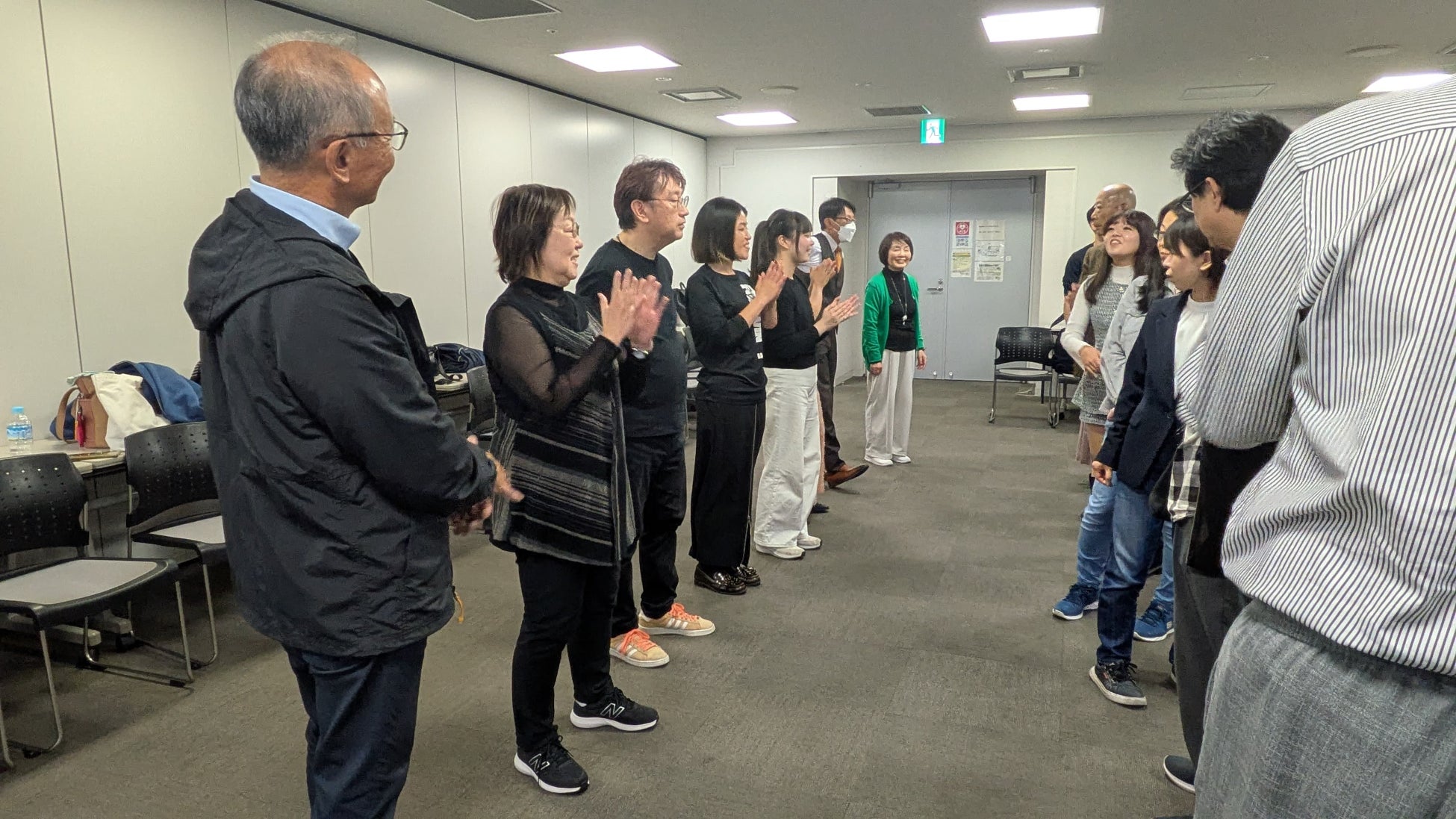
Currently, our association offers communication workshops using theatrical methods. We have held these workshops repeatedly at venues such as Osaka Sangyo Sozokan and employment support facilities, providing participants with a space to experience their own changes firsthand.
The greatest feature of this workshop is its "physical approach," rather than scripts or acting. Through exercises using tools like rubber balls, participants can physically "visualize" the communication they usually perform unconsciously. This enables even strangers from different backgrounds to achieve high-level mutual understanding and build cooperative relationships in a short time.
The Trinity of Expression Skills Required for Leaders
As humans living and working in society, we unconsciously use "logic, body, and language." However, it can be difficult for us to understand how we are using them ourselves. Ideally, it is desirable to express these three in a well-balanced manner depending on the situation.
Stage actors, by training these three balances, can give persuasiveness to even given lines and move the hearts of the audience.
-
Logic + Language only (lack of body): What is said is correct, but somehow unbelievable. No passion felt. "A critic full of theories."
-
Body + Language only (lack of logic): There is momentum, but no specificity, and nothing remains when looking back later. "A hot-blooded person with no substance."
-
Logic + Body only (lack of language): The direction is understood, but the resolution is low. It's unclear what specifically needs to be done, making execution impossible. "A leader who cannot verbalize" (=subordinates cannot act).
To acquire this trinity of expression skills – "logic, body, and language" – incorporating "a certain perspective" makes it smoother.
An Objective Perspective, or "The Director's Eye," is Necessary
Do you just take communication courses and then forget about them? Even if you apply the knowledge you've gained, an objective perspective is necessary to see if it "looks right."
Just as professional actors receive feedback from directors to refine their performances, our association's communication training uses an "evaluation sheet" to provide an objective view, allowing participants to notice unconscious habits.
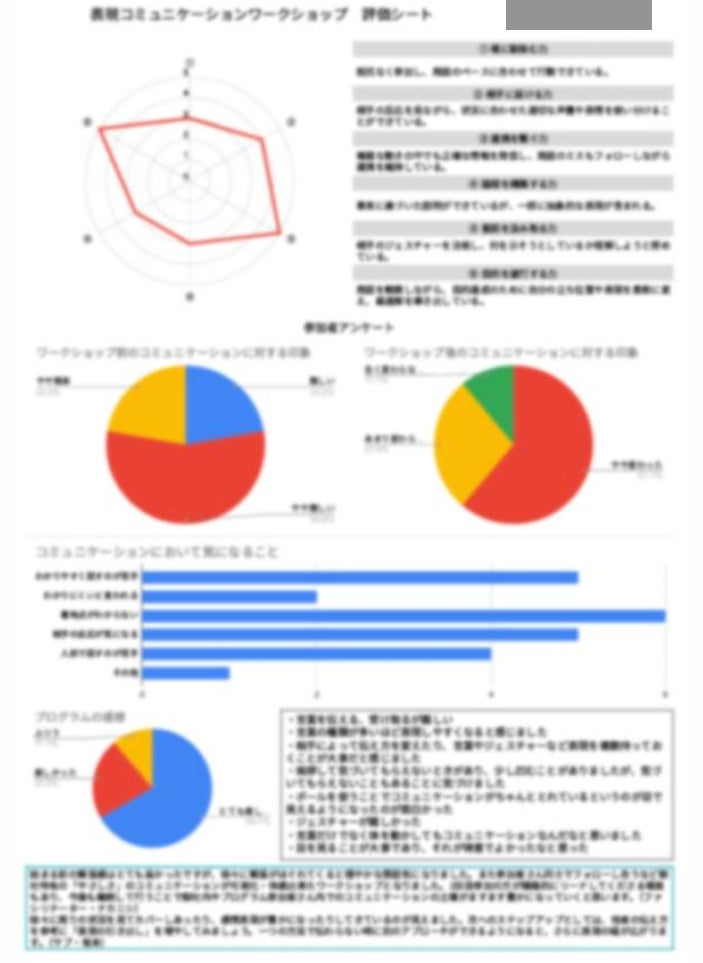
Challenging the "Quantification of Communication" with Unique Indicators
In general communication training and sales skill improvement, many evaluation metrics have been limited to superficial numerical values that are easy to measure, such as "ratio of speaking time" or "number of exchanges."
However, our association has established unique evaluation indicators based on a theatrical approach to visualize more essential interpersonal skills. We have successfully quantified the following six items:
1. Ability to blend in (Adaptation to environment and presence)
2. Ability to convey to others (Directed engagement)
3. Ability to connect collaboration (Starting point for team building)
4. Ability to construct logic (Understanding and structuring context)
5. Ability to grasp intent (Catching non-verbal information)
6. Ability to execute objectives (Driving force towards goals)
Precisely because text communication is dominant in modern times, we provide opportunities to review "behavior" during face-to-face interactions with objective scores, supporting "heartfelt exchanges" in the workplace and at home.
Towards a Future Free from Interpersonal Relationship Problems

We aim to make communication education using theatrical methods a social infrastructure that goes beyond the mere framework of "training."
-
Creation of a non-daily learning environment: By using "theater space," a professional performance venue, as a training ground, participants are liberated from their daily roles, enabling non-daily experiential learning that encourages bold self-expression.
-
Strengthening regional cooperation: By effectively utilizing local cultural facilities and bringing new vitality and revenue to these facilities through training, we create social significance by playing a part in promoting local culture.
Our dream is for "all Japanese people to possess words and bodies that reach the hearts of others, and to be freed from the worries of human relationships."
Someday, in school classes, company entrance ceremonies, or community gatherings, everyone will casually yet earnestly visualize their feelings and enjoy dialogue as if throwing rubber balls. A society where the anxiety of "what I want to say isn't getting across" or "I'm afraid of what others think" transforms into a creative curiosity of "how can I express myself to resonate with others."
A world where everyone can vibrantly play an ensemble with those around them, as the protagonist of their own life's stage. To raise the curtain on that world, the Association for Expression Communication Development will continue to sow the seeds of "dialogue through the body."
Our mission is to "eliminate interpersonal relationship problems from the world."
Through the power of communication, we aim to realize a society where each individual can work vibrantly and live authentically.
FAQ
What are the main activities of the Association for Expression Communication Development?
They conduct experiential communication workshops using theatrical methods for companies and communities, aiming to improve communication skills and resolve interpersonal relationship issues.
Why are theatrical methods effective for improving communication skills?
Theater trains the trinity of "logic, body, and language" expression and fosters empathy for others, enabling communication that reveals true feelings and creates resonance.
What effects can be expected from the workshops?
Participants can gain confidence in self-expression, develop a deeper understanding of others, and identify and improve unconscious communication habits through objective evaluation.