No. 1 Movement Causing Back Strain During Moving is 'Lifting Heavy Luggage' – Approximately 60% Experience Work Delays!?
A survey by NLC Nonaka Low Back Pain Clinic reveals that many people experience back pain during moving and redecorating, with 'lifting heavy luggage' being the top cause. Many self-treat, but desire same-day, short-duration medical care.
📋 Article Processing Timeline
- 📰 Published: March 31, 2026 at 21:00
- 🔍 Collected: April 1, 2026 at 13:39 (16h 39m after Published)
- 🤖 AI Analyzed: April 17, 2026 at 04:11 (374h 32m after Collected)
NLC Nonaka Low Back Pain Clinic (Osaka Clinic: Higashiyodogawa-ku, Osaka-shi, Osaka; Tokyo Clinic: Chuo-ku, Tokyo; Medical Corporation Soyukai Chairman: Yasuyuki Nonaka) conducted a survey on 'onset of back pain due to moving and redecorating' targeting men and women in their 20s to 60s who have moved or redecorated at least once.
Spring is a season when opportunities for moving and redecorating increase in preparation for new lifestyles.
However, many people may experience sudden back pain due to carrying heavy luggage or working in unfamiliar postures.
If left untreated with only temporary measures, there is a risk of progressing to chronic back pain or intervertebral disc problems.
In fact, what kind of movements put the most strain on the lower back during moving and redecorating?
Also, when pain occurs, why do people hesitate to see a doctor?
Therefore, NLC Nonaka Low Back Pain Clinic (https://nonaka-lc.com/) conducted a survey on 'onset of back pain due to moving and redecorating' targeting men and women in their 20s to 60s who have moved or redecorated at least once.
Survey Outline: Survey on 'onset of back pain due to moving and redecorating'
【Survey Period】March 5 (Thu) - March 7 (Sat), 2026
【Survey Method】Internet survey by PRIZMA (https://www.prizma-link.com/press)
【Number of Respondents】1,006 people
【Target Audience】Monitors who responded that they had moved or redecorated at least once, aged 20-60s, at the time of the survey.
【Survey Source】NLC Nonaka Low Back Pain Clinic (https://nonaka-lc.com/)
【Monitor Provider】Sacrisa
The most strenuous movement for the lower back during moving and redecorating, ranked 1st, is 'lifting heavy luggage from the floor'
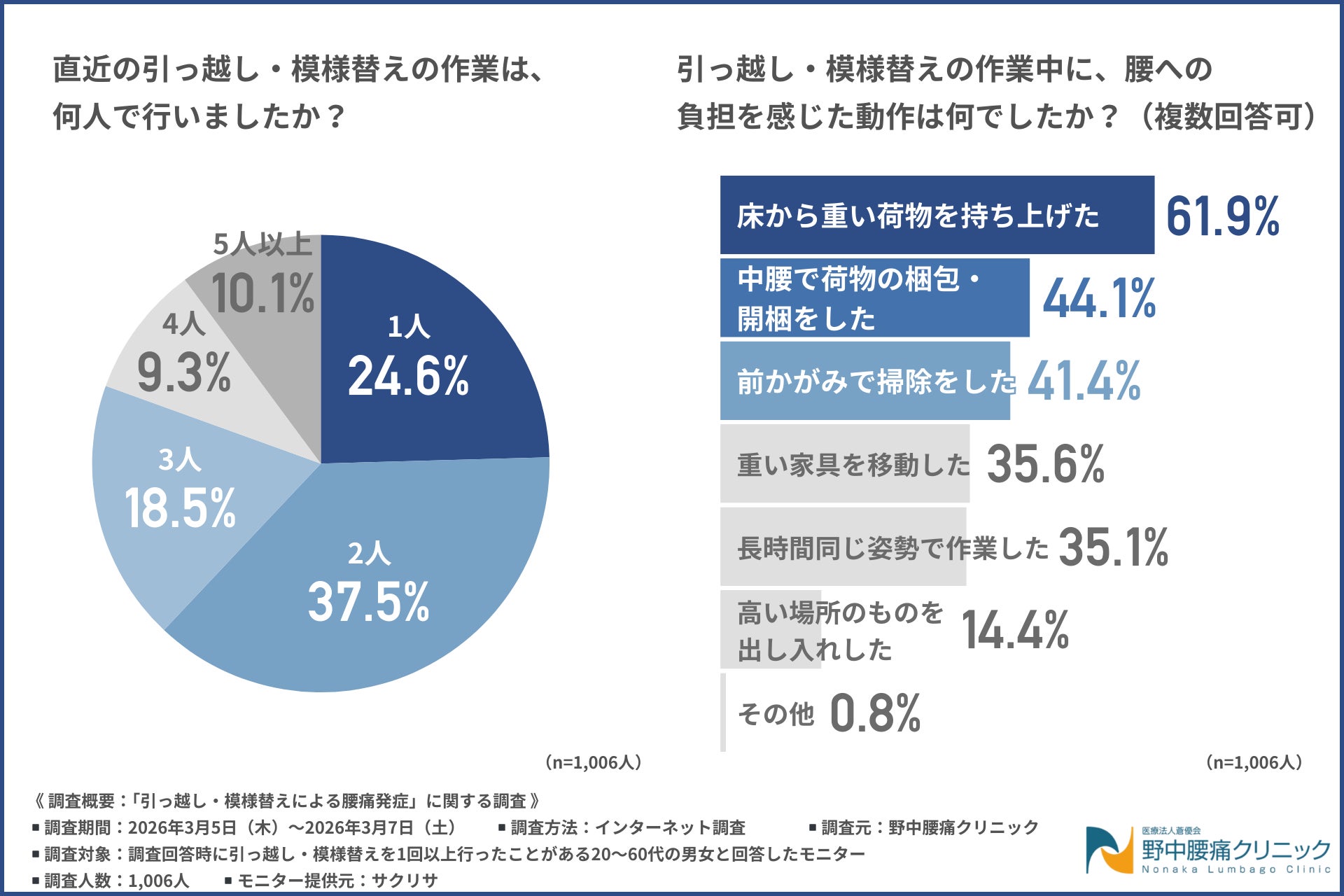
First, when asked, 'How many people participated in your most recent moving or redecorating task?', the following results were obtained:
'1 person (24.6%)'
'2 people (37.5%)'
'3 people (18.5%)'
'4 people (9.3%)'
'5 or more people (10.1%)'
In addition to working alone, there is a tendency for people to cooperate in small groups with family or friends. Particularly, tasks involving 1 to 3 people account for approximately 80%, suggesting a situation where the workload and amount of luggage transported per person tend to be high. In tasks with a small number of people, situations where unnatural postures are forced, such as moving heavy furniture, also increase, raising concerns about physical impact.
So, what kind of movements actually put a strain on the lower back during the work?
When asked, 'What movements caused you to feel strain on your lower back during moving or redecorating?', 'lifting heavy luggage from the floor (61.9%)' was the most common, followed by 'packing/unpacking luggage in a stooped posture (44.1%)' and 'cleaning while bending forward (41.4%)'.
The act of lifting heavy objects was shown to place a significant burden on the lower back. In addition, movements involving stooping or bending forward were also ranked high, suggesting that not only momentary loads but also prolonged postures like these can trigger back pain.
So, when you actually felt a strain on your lower back, how severe was the pain?
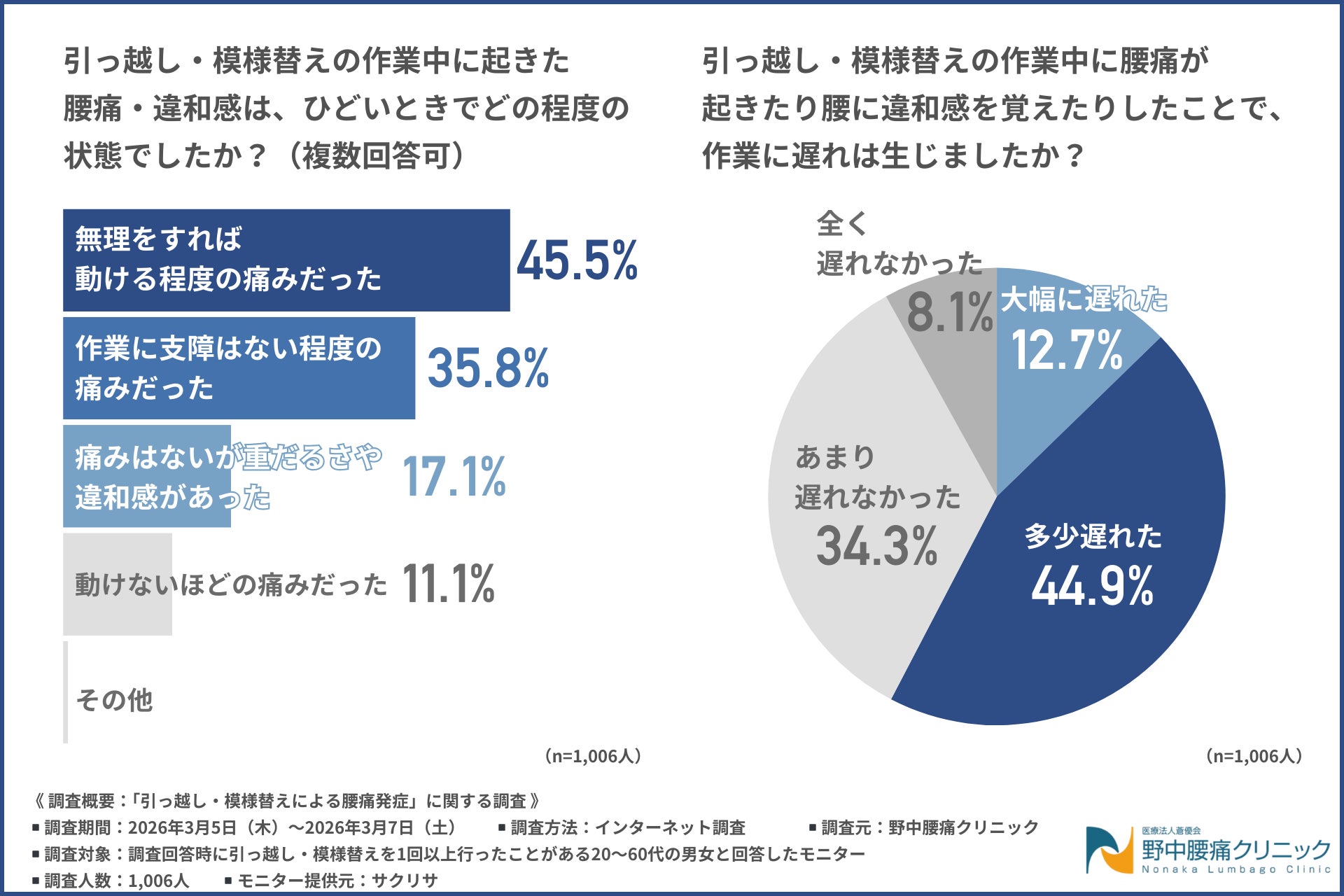
When asked, 'What was the worst condition of back pain or discomfort you experienced during moving or redecorating?', 'pain to the extent that I could move if I pushed myself (45.5%)' was the most common, followed by 'pain that did not interfere with work (35.8%)' and 'no pain but a dull ache or discomfort (17.1%)'.
It became clear that many people experienced clear pain or discomfort, though not severe enough to completely immobilize them. The state of 'being able to move if I pushed myself' suggests that repeatedly pushing oneself could further increase the burden on the lower back.
So, how much did such pain or discomfort affect the progress of the work?
When asked, 'Did back pain or discomfort during moving or redecorating cause delays in your work?', more than half responded 'significantly delayed (12.7%)' or 'somewhat delayed (44.9%)'.
More than half of the respondents experienced disruptions to their actual work schedule, indicating that back strain reduces work efficiency. In moving and redecorating tasks, which are often performed within a limited time, back pain is considered one of the factors leading to delays in work time.
Approximately 40% practiced 'ways of holding and postures that put less strain on the lower back' as a preventive measure for back pain during moving and redecorating.
So, what measures did people take to prevent back pain?
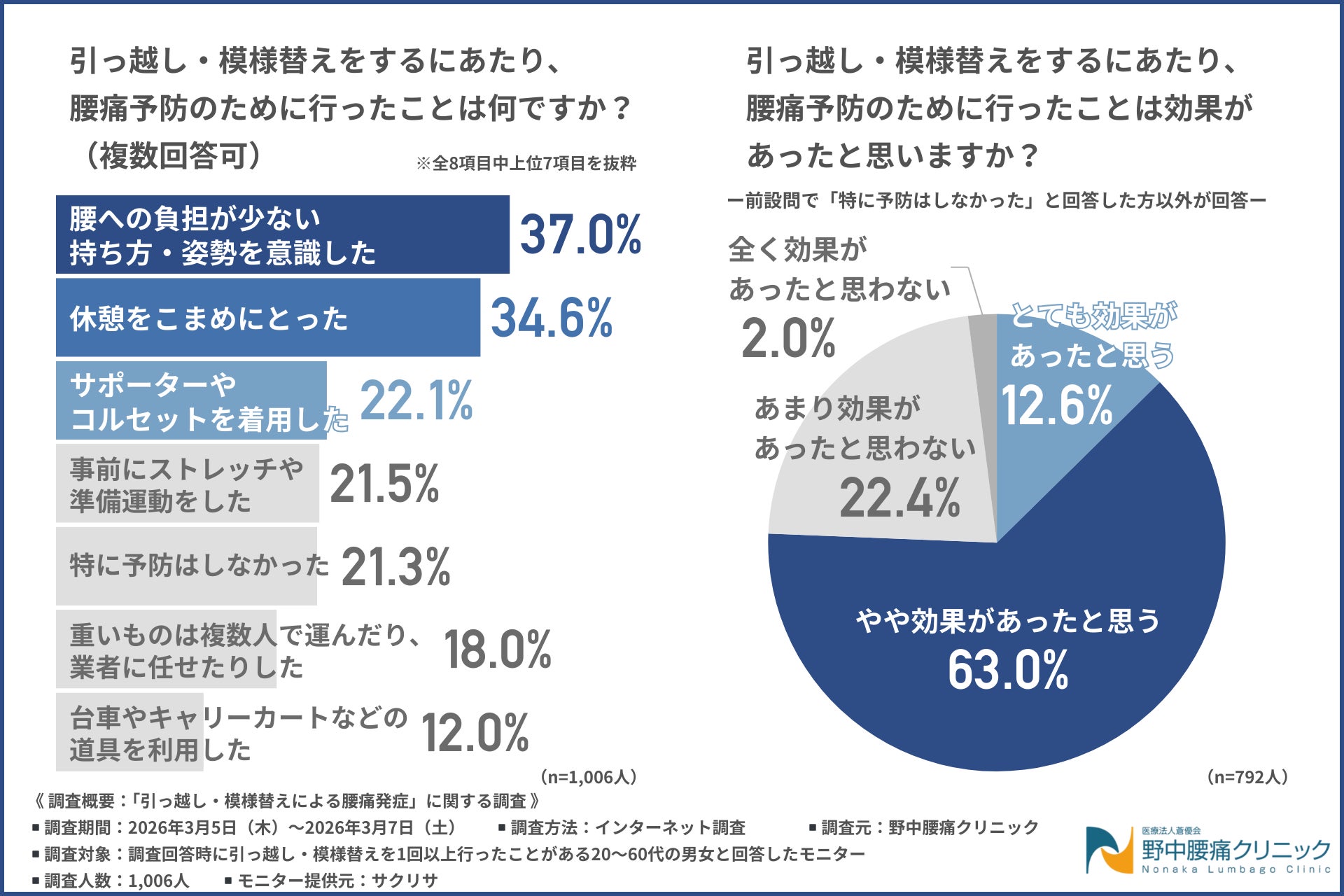
When asked, 'What did you do to prevent back pain when moving or redecorating?', 'conscious of ways of holding and postures that put less strain on the lower back (37.0%)' was the most common, followed by 'took frequent breaks (34.6%)' and 'wore a supporter or corset (22.1%)'.
In addition to conscious measures such as posture awareness and adequate breaks, physical preparations like wearing supporters or corsets were also ranked high, suggesting that multiple approaches are being taken to reduce the burden on the lower back.
So, how effective were these preventive measures actually felt to be?
Excluding those who answered 'did not take any particular preventive measures' in the previous question, when asked, 'Do you think the back pain prevention measures you took when moving or redecorating were effective?', more than 70% responded 'very effective (12.6%)' or 'somewhat effective (63.0%)'.
It was shown that many of those who took preventive measures felt a certain level of effectiveness. Even simple measures like posture adjustments and frequent breaks are considered effective ways to alleviate back strain. On the other hand, only a little over 10% felt a clear effect of 'very effective,' suggesting that self-taught prevention alone may not be sufficient to fully prevent the burden.
Conversely, what were the reasons for those who did not take any preventive measures in the first place?
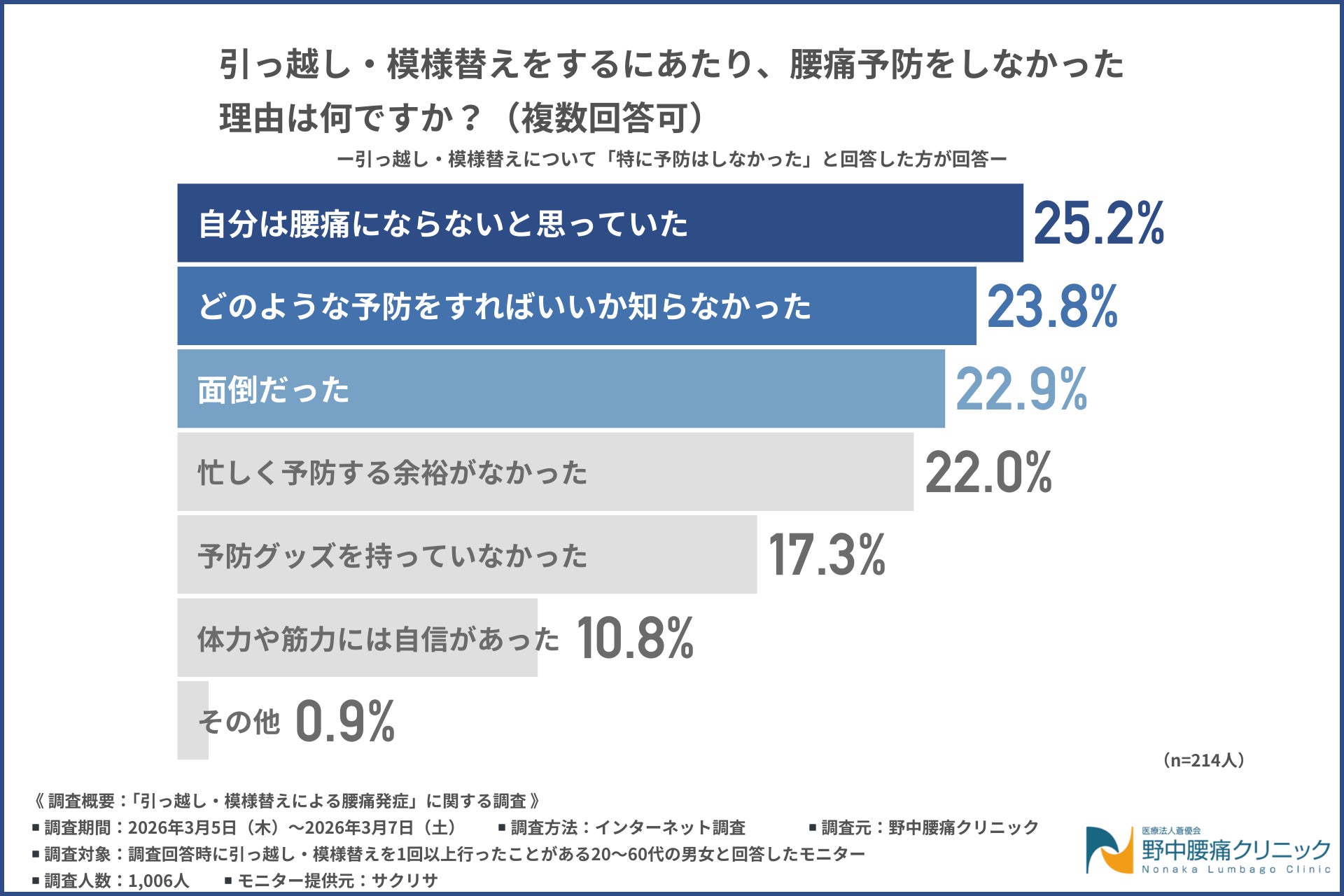
When asked those who answered 'did not take any particular preventive measures' regarding back pain prevention in the previous question, 'What were the reasons for not taking back pain prevention measures when moving or redecorating?', 'I thought I wouldn't get back pain (25.2%)' was the most common, followed by 'I didn't know what kind of prevention to do (23.8%)' and 'it was troublesome (22.9%)'.
It can be inferred that the main reasons for not taking measures were the belief of 'I'll be fine' and a lack of knowledge about prevention. In addition, constraints of effort and time, such as 'troublesome' and 'busy,' also had an impact, suggesting that back pain prevention tends to be put on the back burner during the hectic situation of moving and redecorating.
Reason for not going to a medical institution even with pain, 1st place is 'I thought it would heal naturally'!
So, when pain actually occurred, how did people deal with it?
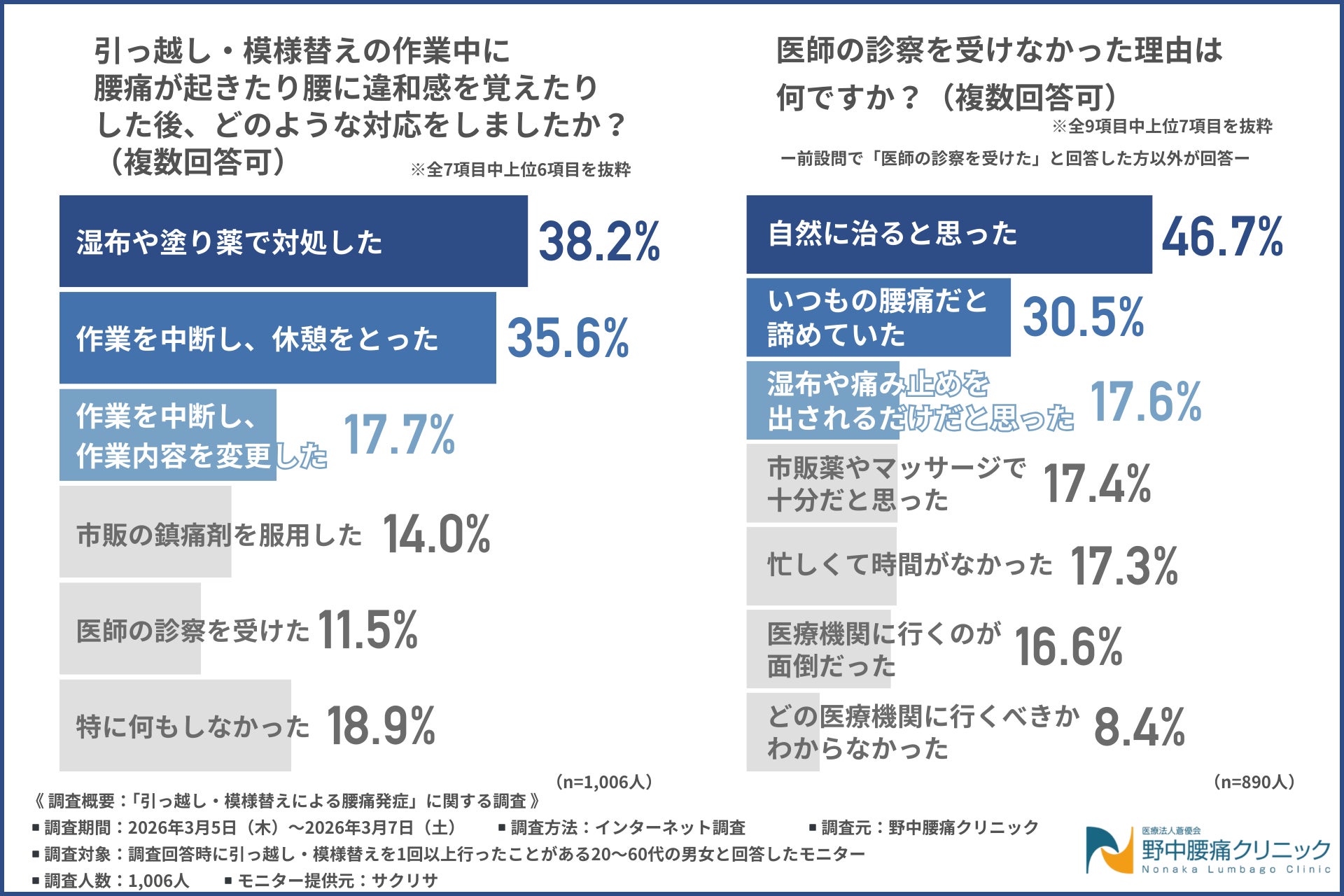
When asked, 'What did you do after experiencing back pain or discomfort during moving or redecorating?', 'dealt with it using patches or topical creams (38.2%)' was the most common, followed by 'stopped work and took a break (35.6%)' and 'stopped work and changed the content of the work (17.7%)'.
The results showed that self-treatment using easily available external medicines and temporary breaks accounted for the majority. Only about 10% of respondents answered 'consulted a doctor,' indicating that many people deal with it themselves without going to a medical institution. Also, responses such as 'stopped work' and 'changed the content of the work' were observed, suggesting that a certain number of people adjust their work methods when they feel pain.
So, why did many people not consult a doctor?
Excluding those who answered 'consulted a doctor' in the previous question, when asked, 'What were the reasons for not consulting a doctor?', 'I thought it would heal naturally (46.7%)' was the most common, followed by 'I had given up, thinking it was my usual back pain (30.5%)' and 'I thought they would just prescribe patches or painkillers (17.6%)'.
It became clear that approximately half of the respondents expected 'natural healing,' perceiving back pain as a temporary symptom. Also, some had given up, thinking it was 'their usual back pain,' or believed that medical institutions would only provide temporary pain relief. A sense of resignation towards chronic pain and low expectations for the effectiveness of medical treatment are considered factors that deter people from seeking medical attention.
So, if they were to receive treatment at a medical institution, what factors would be attractive?
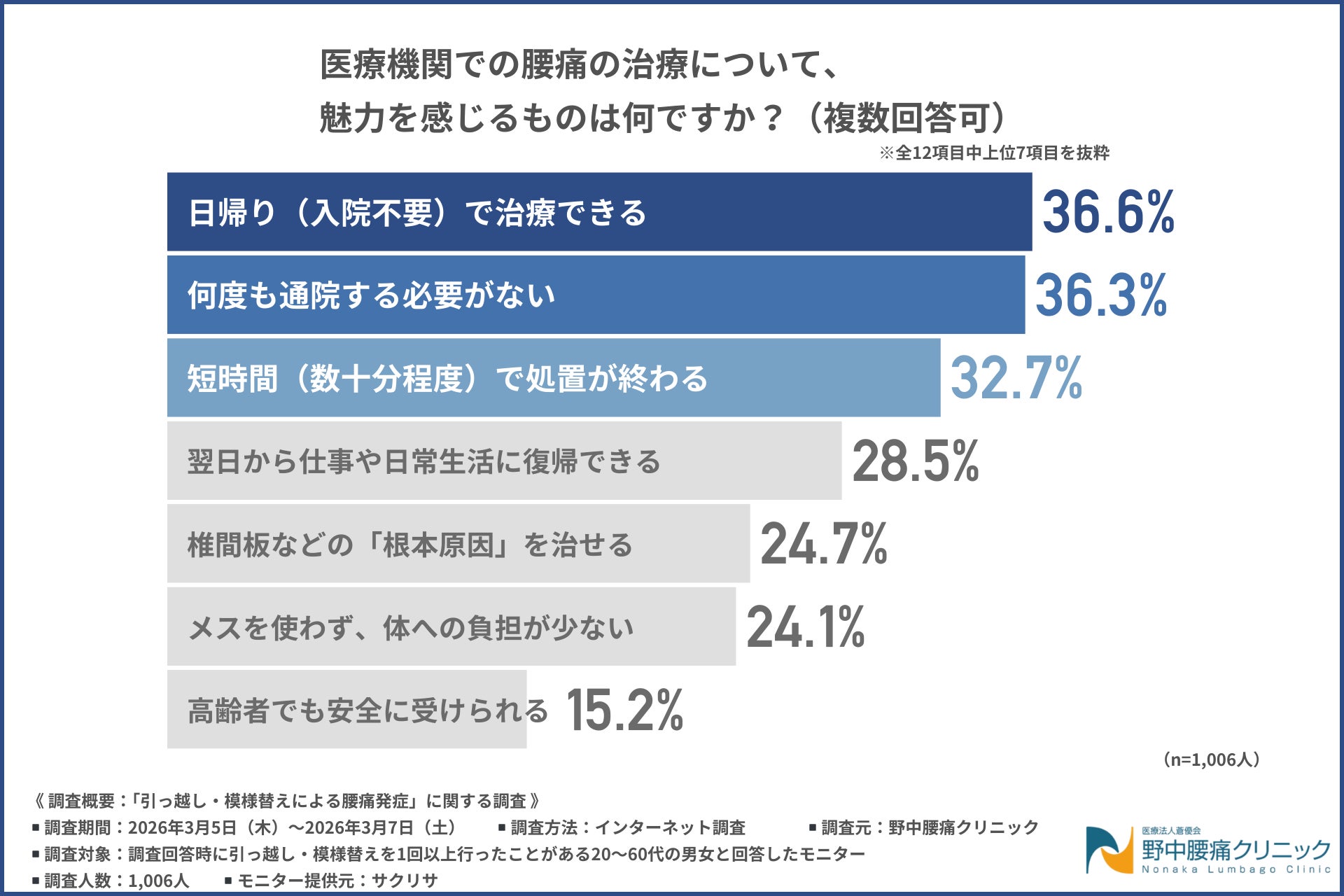
When asked, 'What aspects of back pain treatment at a medical institution do you find attractive?', 'can be treated on a day-trip basis (no hospitalization required) (36.6%)' was the most common, followed by 'no need for multiple visits (36.3%)' and 'procedure completed in a short time (about tens of minutes) (32.7%)'.
It can be inferred that a short time commitment, such as 'day-trip,' 'few visits,' and 'short duration,' is desired. For modern people who are busy with daily life and work, the ability to complete treatment easily and quickly seems to be an important condition for choosing a medical institution.
Summary: The Reality of Back Pain During Moving and Redecorating Tasks and the Demand for Fundamental Treatment
This survey revealed the reality that many people suffer from back pain during moving and redecorating tasks but do not seek medical treatment.
Most tasks are performed by a small number of people, and movements such as 'lifting heavy luggage from the floor' and 'packing/unpacking luggage in a stooped posture' were found to put a strain on the lower back. Furthermore, back problems were observed to cause delays and impact work schedules.
Measures to prevent back pain during moving and redecorating included relatively easy methods such as 'being conscious of postures that put less strain on the lower back' and 'taking frequent breaks.' Many of those who took these preventive measures felt a certain level of effectiveness, but it was also shown that a certain number of people did not take back pain prevention measures due to overconfidence in 'I'll be fine' or lack of knowledge.
After back pain occurred, many people opted for easy self-treatment, such as using patches or taking temporary rest, with only about 10% consulting a doctor. The reason for not consulting a doctor was often the belief that 'it would heal naturally' or that 'it takes too much time'.
FAQ
What is the most strenuous movement for the lower back during moving tasks?
According to the survey, 'lifting heavy luggage from the floor' was the most common at 61.9%, indicating a significant burden on the lower back.
What are the main reasons people don't go to a medical institution even if they feel back pain?
The most common reason, at 46.7%, was 'I thought it would heal naturally,' showing a tendency to view it as a temporary symptom.
What conditions are sought for back pain treatment at medical institutions?
Less time commitment, such as 'same-day treatment (no hospitalization required),' 'no need for multiple visits,' and 'procedure completed in a short time,' is highly valued.