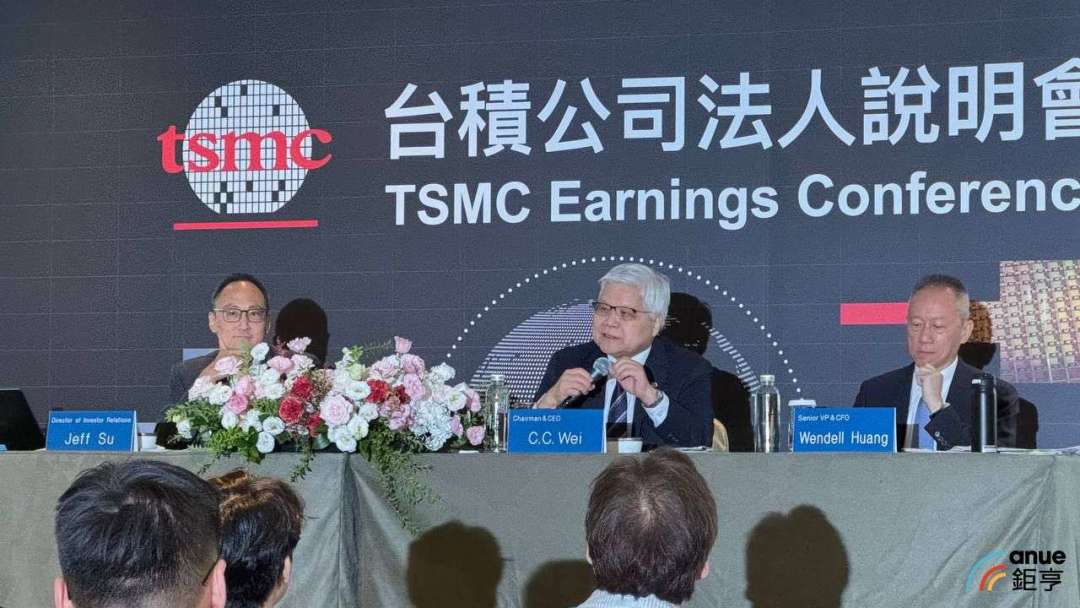
TSMC (2330-TW)(TSM-US) held its earnings call today (16th), where Chairman and CEO C.C. Wei stated that AI demand is exceptionally strong, and the momentum could extend through 2029 and 2030. While it's currently uncertain whether the chip market will still face supply shortages at that time, Wei emphasized that a new global AI industry is forming, driven by investments from cloud service providers (CSPs) and customer demand, with semiconductor chips serving as the foundational enabler.
During the call, foreign investors asked whether TSMC might still face supply shortages by the end of 2027, even as the company continues to increase capital expenditures and aggressively expand capacity in advanced processes and advanced packaging.
Wei responded that while it's difficult for the company to guarantee supply-demand conditions at a specific point in time, he believes AI demand could remain strong through 2029 and 2030. However, he could not precisely determine whether supply would still fall short at that point.
Wei highlighted that the development trend of the AI market is very stable, and the world is witnessing the formation of a new industry—'the AI industry.' AI will gradually integrate into daily life and transform production and operations across robotics, materials, and various industries.
Judging from the scale of investments by CSPs and major tech companies, AI is no longer just a short-term market theme but an emerging industry capable of reshaping the global economy and industrial structure. Regardless of how AI applications evolve, semiconductor chips remain the fundamental backbone.
Wei stated that the AI demand signals TSMC is receiving continue to exceed earlier expectations. While he couldn't provide exact growth rates for AI chips, he described customer demand as 'stronger, stronger, and even stronger,' indicating that demand for AI chips and related capacity is still rising.
In addition to GPUs and AI accelerators, the rise of Agentic AI has renewed the importance of CPUs in AI data centers. As AI systems require more task orchestration, data processing, and system control, CPU demand is also increasing accordingly.
Wei noted that regardless of whether customers adopt x86, Arm, or RISC-V architectures, nearly all related CPU vendors are TSMC customers. CPUs, GPUs, custom ASICs, and various XPUs mostly rely on TSMC's leading-edge processes, meaning that the increasing diversity in AI computing architectures remains beneficial for TSMC overall.
However, TSMC does not simply sum up all demand figures provided by customers to determine capacity expansion. Wei stated that while he believes every customer strives to provide accurate demand forecasts, aggregating all customer estimates does not necessarily equal the market's actual achievable demand. Therefore, TSMC must apply demand reduction, cross-verification, and careful judgment to customer forecasts.
TSMC employs both top-down and bottom-up approaches to assess demand, engaging not only with direct customers but also gaining deeper insights into their customers—particularly CSPs' capital expenditures, product roadmaps, and AI data center deployment progress.
Regarding capacity supply and demand, Wei acknowledged that the gap between current advanced process demand and available capacity is 'really large.' To meet the continuously rising demand, TSMC has raised its 2026 capital expenditure to $60–64 billion.
FACT BOX
- Source: PR Times
- Category: Event