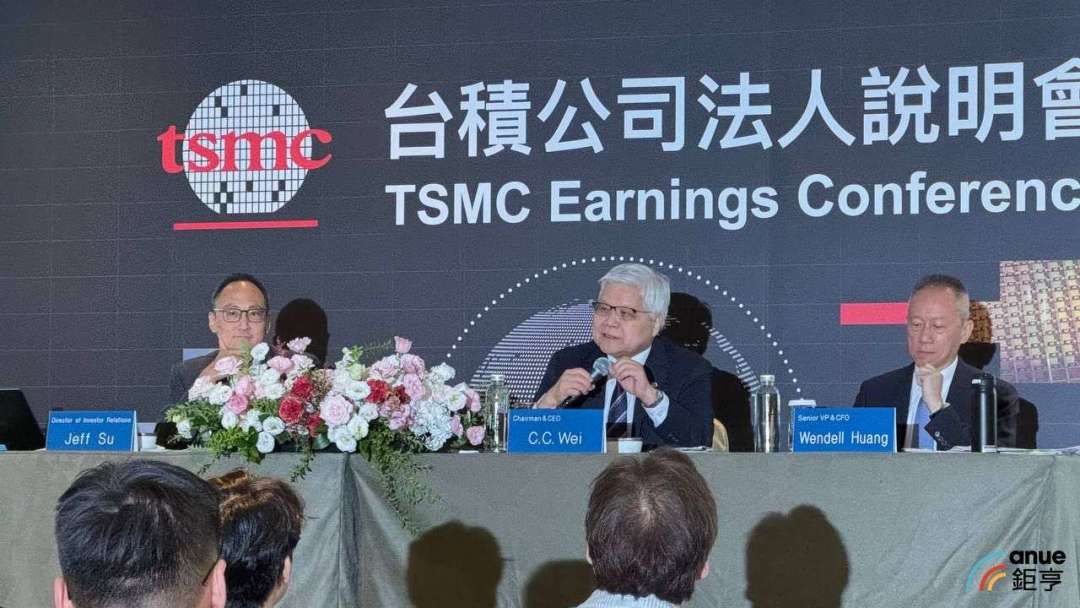
TSMC (2330-TW)(TSM-US) held its earnings call today (16th), addressing concerns over Samsung and Intel (INTC-US) aggressively capturing TSMC's market share. Chairman C.C. Wei stated that while government support and ample funding are important, there are no shortcuts in the advanced semiconductor foundry industry. The true determinants of competitiveness remain technology, manufacturing capability, and customer trust. He quoted a client, saying, 'Choosing a process partner is not like buying milk at 7-11—you can't switch suppliers overnight just because you're dissatisfied today.'
During the call, foreign investors questioned whether TSMC feared losing orders, noting that its Korean competitor had recently accumulated substantial profits and investment resources due to strong memory market conditions, while its U.S. rival received strong government policy support and had already begun engaging with some American chipmakers.
Wei responded candidly that he indeed felt envious of the Korean competitor's significant profits from memory business. He acknowledged that the U.S. competitor also enjoyed strong government backing. However, he revealed that TSMC, too, receives government support—'we just haven't announced it.'
Wei emphasized that while government support is welcome and abundant capital is helpful, the semiconductor industry must ultimately return to fundamentals. Drawing on over 30 to 40 years of industry experience, he stated that the three most critical core capabilities in foundry competition have never changed: technology, manufacturing, and customer trust. These are the very reasons TSMC has consistently won customer orders over the long term.
He stressed that there are no shortcuts in advanced process competition. Chip customers are not selecting a single commodity but a long-term technical partner capable of collaborating for years. Both parties must deeply understand process technology, jointly complete chip design, silicon IP integration, design verification, yield improvement, and production capacity preparation before successfully ramping to mass production.
Quoting a client, Wei said choosing a process technology partner is not like buying milk at 7-11—customers cannot switch suppliers the next day simply because they're dissatisfied today. For advanced chips, from selecting a process node and initiating product design to capacity preparation and volume production ramp-up, the entire collaboration cycle takes at least about five years.
Therefore, even if competitors have government funding or massive capital, they still require years to accumulate process technology, production yield, volume manufacturing experience, and customer trust. Competitors cannot simply replicate TSMC's competitive advantage through capital investment alone.
Wei stated that TSMC's long-term competitive strategy will not change due to competitors' capacity expansion. The company will continue investing in advanced process R&D, enhancing manufacturing efficiency, and collaborating early with customers on product and capacity planning to ensure timely volume production of customer products.
TSMC views customer success as the foundation of its own growth. Since advanced process collaboration involves massive R&D costs and multi-year product planning, customers evaluate foundry partners not only on single-node performance and pricing but also on their ability to deliver stable volume production, provide sufficient capacity, and protect customers' business and technical information over the long term.
Wei emphasized that technology, manufacturing capability, and trust form TSMC's 'success formula' in operating its foundry business over decades. Despite global efforts by various countries to promote local semiconductor manufacturing through policies and subsidies, TSMC remains confident in maintaining its competitive position in the advanced process market based on these three fundamental capabilities.
FACT BOX
- Source: PR Times
- Category: Event