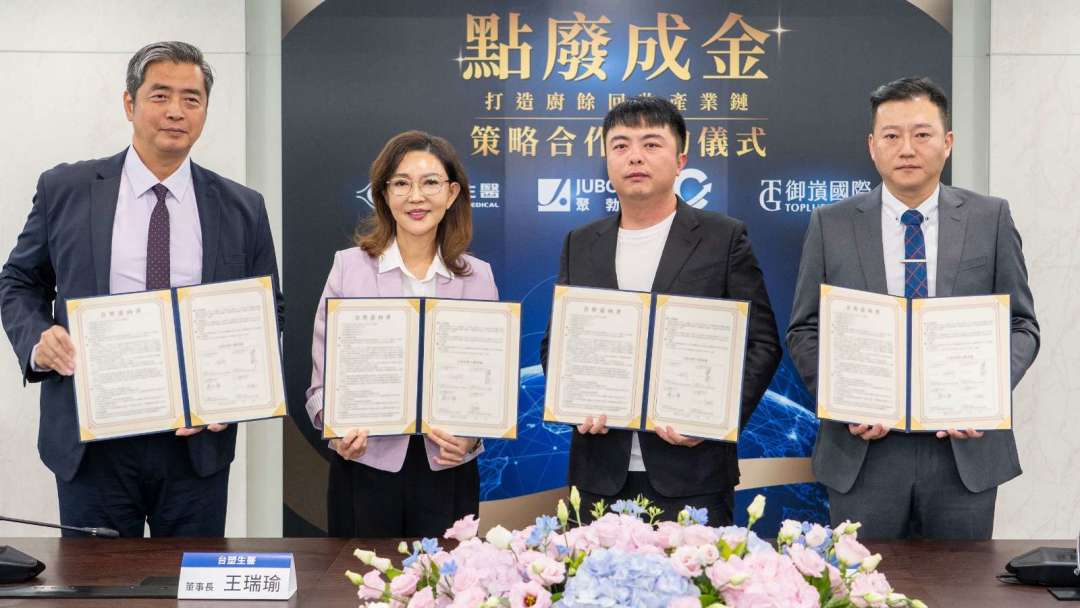
To realize the transformative vision of 'turning waste into value' and creating a sustainable energy cycle, Formosa Biomedical today (16th) announced a collaboration with renowned domestic F&B group Yuding International (3522-TW) and 'Juliy Smart,' a company possessing cutting-edge food waste decomposition technology. The three parties, together with 'Jubo International,' have jointly invested and signed a strategic cooperation agreement to launch a food waste recycling industrial chain. Formosa Biomedical will refine waste cooking oil into high-purity feedstock—critical for producing Sustainable Aviation Fuel (SAF)—to fill the massive gap in the global new energy supply chain.
Formosa Biomedical stated that this initiative aims not only to address the nation’s pressing waste management challenges at the source but also to achieve the sustainable value creation of 'turning waste into gold.' To realize this long-term vision, Formosa Biomedical has taken the lead in integrating top-tier resources, leveraging its biotechnology expertise to refine SAF from waste cooking oil, and integrating the upstream and downstream industrial chain to advance circular economy and sustainable development in new energy.
According to data gathered by Formosa Biomedical, Taiwan generates over 4 million tons of food waste annually, with household food waste accounting for approximately 65% and commercial food waste (restaurants, supermarkets, catering services, etc.) around 35%. Data from the Ministry of Environment shows that for household food waste, 42.8% is converted into animal feed (mainly for pig farming), 45.8% into fertilizer, and only 9.5% into energy. In contrast, nearly all commercial food waste is used for animal feed. Combined, approximately 62.6% of Taiwan’s food waste has historically been reused for pig farming. With the ban on using food waste as animal feed, over 60% of this waste now poses a severe environmental challenge, necessitating a major transformation in Taiwan’s food waste disposal system.
The Ministry of Environment’s vision and targets for future food waste management aim for 54.4% composting, 36.2% bioenergy, and 9.4% black soldier fly utilization by 2029. The ambitious 36.2% 'bioenergy' target clearly highlights the vast potential and national direction of converting food waste into high-value bioenergy. Formosa Biomedical’s leadership in forming this cross-sector alliance to launch a new venture precisely aligns with this national policy.
Wang Ruiyu, Chairman of Formosa Biomedical, stated, 'We aim not only to solve the nation’s current pressing challenges but also to leverage our biotech expertise to transform problematic waste into high-value new energy feedstock—truly turning waste into gold.'
In fact, refined waste cooking oil is currently the most sought-after green energy resource in the global aviation industry. With the 2030 mandate requiring airlines to use 5% SAF on international routes, market demand is experiencing explosive growth. Currently, about 80% of SAF feedstock relies on waste cooking oil, and the global supply chain is already facing severe supply bottlenecks.
According to statistics from the EU policy think tank 'Transport & Environment,' in 2023, Europe used nearly 7 million tons of waste cooking oil as biofuel feedstock—eight times the actual amount collected in Europe that year. Over half of this demand was met through imports from overseas markets, including Asia. Amid the massive supply-demand gap and generous subsidies, international concerns over 'large-scale fraud' have emerged, underscoring not only the shortage of SAF feedstock but also the critical importance of securing authentic, locally sourced waste oil for SAF development.
To ensure quality meets the highest international standards, Formosa Biomedical leverages its already established national-level 'ultra-trace laboratory' for rigorous quality control. Aviation fuel demands extreme stability, and this laboratory delivers rapid and precise analytical results, enabling R&D teams to accurately control every minute variable during the purification process. The company’s refined high-purity feedstock has successfully passed strict SGS testing and fully meets all physical and chemical requirements for downstream SAF production.
Liu Huiqi, General Manager of Formosa Biomedical, explained that refining waste cooking oil into high-purity SAF feedstock is an extremely precise purification process. Drawing on years of expertise in specialty chemicals and biotechnology, the company has successfully overcome challenges such as high impurity levels and unstable acid values in waste cooking oil.
Chairman Wang emphasized, 'Every step Formosa Biomedical takes is rooted in the urgent needs of the environment and the land. By integrating top-tier resources across sectors and leveraging our proud biotech expertise and new energy advantages to “turn waste into gold,” we are addressing food waste issues and filling the aviation fuel feedstock gap—a sustainable endeavor of profound significance for both Taiwan and the planet.'
Looking ahead, this 'from table to green energy' industrial chain will be tightly co-built by Formosa Biomedical and the three other partners. With Yuding International’s precise control at the F&B source, Juliy Smart’s advanced food waste decomposition technology, Jubo International’s on-the-ground operational integration, and Formosa Biomedical’s high-end refining capabilities and market access at the downstream end, the four strong players are joining forces to realize sustainable energy value.
FACT BOX
- Source: PR Times
- Category: Partnership