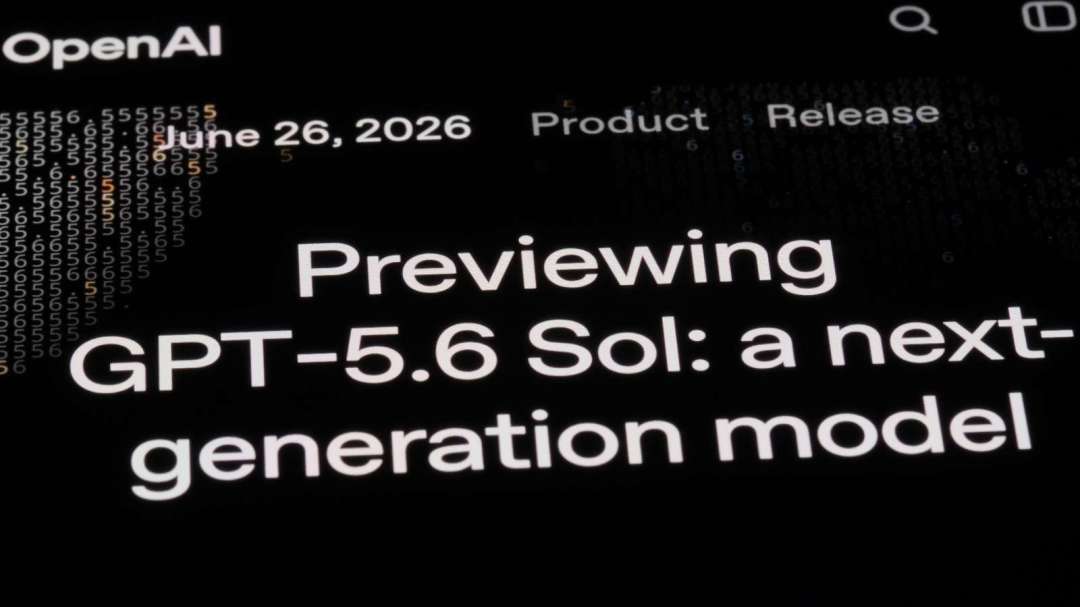
OpenAI officially launched its next-generation GPT-5.6 series on Thursday (9th), unveiling three celestial-themed models: the flagship GPT-5.6 Sol, the balanced GPT-5.6 Terra, and the lightweight GPT-5.6 Luna. All three are now available across ChatGPT, Codex, and API platforms. This marks OpenAI’s first use of a 'generation number + celestial tier' naming system, allowing models with different positioning to iterate independently, significantly enhancing flexibility.
GPT-5.6 Sol is designed for the most complex reasoning, intensive programming, cybersecurity analysis, and long-running agent tasks. OpenAI’s Sam Altman stated that Sol improves token usage efficiency by 54% over the previous generation in AI agent programming tasks, with performance 'on par with or better than top market competitors.'
According to third-party evaluator Artificial Analysis, GPT-5.6 Sol scored 80 points in programming capability—highest globally—surpassing Anthropic’s Claude Fable 5 at 77.2. When maximum deep reasoning mode is enabled, Sol ties Fable 5 in score, but uses less than half the output tokens, takes over half the time, and costs about one-third less.
GPT-5.6 Terra matches the performance of the previous GPT-5.5 but with API pricing cut in half, making it ideal for most everyday workloads. GPT-5.6 Luna focuses on low latency and high-frequency calls, offering the lowest cost option among the three.
OpenAI claims that in certain benchmark tests, Terra and Luna can achieve comparable or superior outputs at about one-sixteenth the cost of competing products, significantly redefining industry value standards.
Alongside the new models, OpenAI updated three key features: ChatGPT Work, Codex integration with desktop clients, and multi-agent orchestration via API.
ChatGPT Work is an automation assistant for enterprise teams. Users set a high-level goal—such as 'prepare next week’s client presentation'—and the system automatically breaks it down, performs continuous operations across email, calendar, Slack, cloud drives, and CRM, and directly outputs documents, reports, or web app prototypes.
Codex is now integrated into the ChatGPT desktop client (supporting Windows/macOS, web, and mobile), transitioning from a standalone tool to a unified interface, enabling seamless switching between chat, office agents, and programming.
New API features include Programmatic Tool Calling, allowing models to write and execute lightweight scripts in memory to coordinate tools, and the Beta release of multi-agent orchestration in the Responses API, enabling developers to build complex collaborative scenarios.
ChatGPT Work and Codex features are immediately available in the free version. Pro, Enterprise, and Edu users can access them now, while Plus and Business users will gain access in the coming days.
Analysts note that the GPT-5.6 series consolidates OpenAI’s leadership in advanced reasoning and programming via Sol, while aggressively targeting the mid-to-low market with Terra and Luna’s value proposition, responding to recent price wars initiated by competitors like xAI’s Grok 4.5. As multimodal models, agent tool usage, and enterprise automation converge, OpenAI is evolving from a pure model provider into a full-stack AI operating system encompassing 'models + collaboration platform + development infrastructure.'
FACT BOX
- Source: PR Times
- Category: New Product
- Organizations: Anthropic / xAI
- Products / services: GPT-5.6 Sol / GPT-5.6 Terra