As part of NEDO's commissioned project 'Development of Bio-derived Product Production Technology to Accelerate Carbon Recycling' (hereinafter referred to as 'this project'), the National Institute of Technology and Evaluation (NITE) has developed and launched the 'Microorganism Selection Support Tool' (hereinafter referred to as 'this database'), an integrated database that allows cross-sectional searches for microorganisms with desired characteristics from globally published major databases, based on their trait information.
This database integrates and organizes seven important types of microbial trait information, such as culture temperature, culture pH, and oxygen requirements, collected from approximately 67,000 microbial strain records listed in five internationally major publicly available databases, for each microbial species. It enables cross-sectional searches for microbial species from their trait information in Japanese. This is the first integrated database in Japan capable of searching for microbial species from trait information.
Previously, researchers had to manually search for microorganisms by reviewing data one by one in individual databases. This new database makes it easier for researchers in Japan who are building smart cells to find microorganisms with the characteristics they are interested in. We will continue to expand its functions based on user needs.
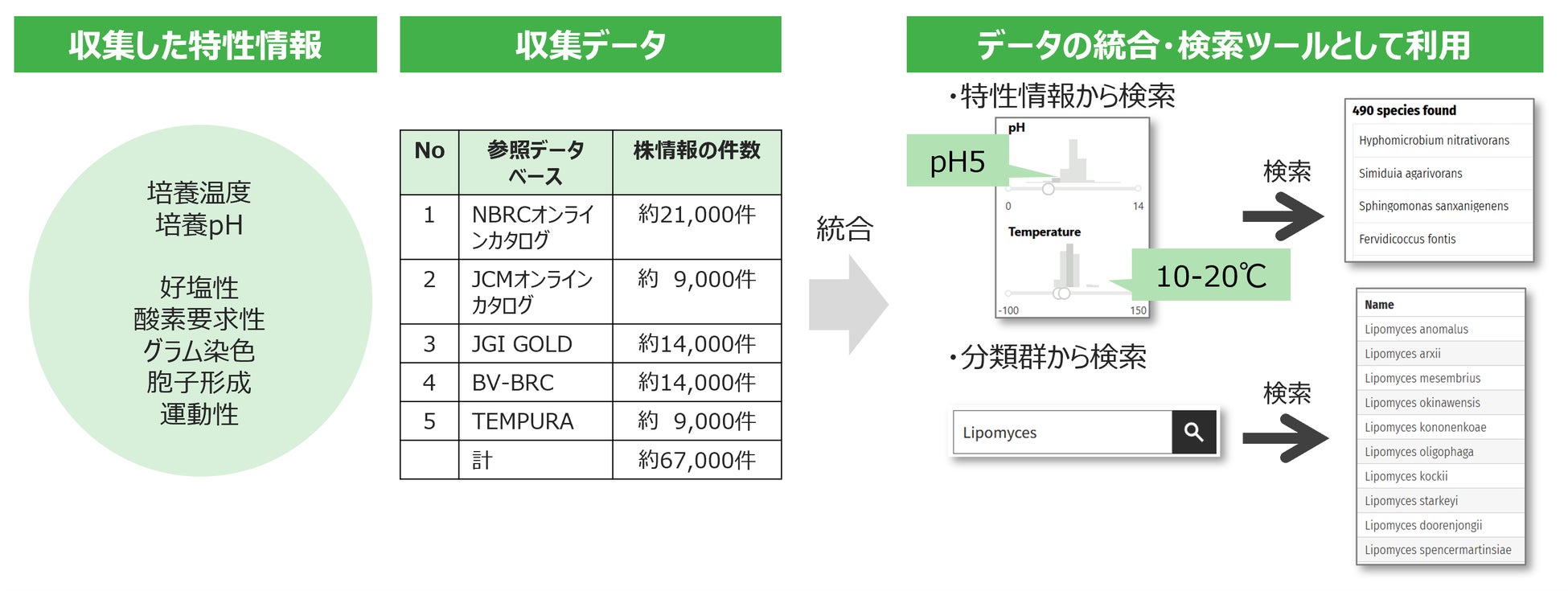
Figure: Image of this database
1. Background
In the field of biomaterial manufacturing, there is increasing activity in utilizing 'smart cells' – biological cells whose material production capabilities have been artificially maximized – to overcome bottlenecks from raw materials to final products. Developing smart cells is time-consuming and labor-intensive, so efficiently selecting microorganisms suitable for the desired substance and production conditions at the outset is crucial. However, conventionally, trait information such as culture temperature, culture pH, and oxygen requirements were scattered across multiple databases. This necessitated researchers to search and select microorganisms by examining data one by one in individual databases, posing a significant burden.
Against this background, NEDO has been working on expanding bioresources and developing foundational technologies for their discovery, aimed at creating industrial smart cells since fiscal year 2020 through this project*1. As part of this effort, NITE has collaborated on the development of a database to streamline microbial discovery.
2. Current Achievements
(1) Development of the Microorganism Selection Support Tool
We constructed a database that supports the selection of microorganisms and the consideration of culture conditions in Japanese by organizing and integrating seven types of trait information, such as culture temperature, culture pH, and oxygen requirements, for each microbial species. This information was gathered from approximately 67,000 microbial strain records listed in multiple databases, including the NBRC*2 online catalog (approx. 21,000 records), JCM online catalog (approx. 9,000 records), JGI GOLD (approx. 14,000 records), BV-BRC (approx. 14,000 records), and TEMPURA (approx. 9,000 records). This marks the first integrated database in Japan*3 capable of searching for microbial species based on trait information.
Furthermore, for culture temperature and culture pH, distribution is displayed as histograms, and the number of search results is shown in real-time, enabling more visual exploration.
By utilizing this database, researchers can efficiently investigate microorganisms with specific properties (e.g., culture temperature, culture pH, oxygen requirements, halophilicity).
(2) Release of the Microorganism Selection Support Tool
The database developed this time was released in February 2026 on the BioResource Data Platform (DBRP) operated by NITE.
・This database https://www.nite.go.jp/nbrc/dbrp/trait-search/
・BioResource Data Platform (DBRP) https://www.nite.go.jp/nbrc/dbrp/top
3. Future Plans
This database will enable researchers in Japan who are building smart cells to conduct comprehensive searches for microorganisms with desired characteristics across major global databases. Moving forward, NEDO and NITE plan to expand the database's functions in response to user needs.
[Annotations]
*1 This project
Project Name: Development of Bio-derived Product Production Technology to Accelerate Carbon Recycling
Project Period: Fiscal Year 2020 - Fiscal Year 2026
Project Overview: Development of Bio-derived Product Production Technology to Accelerate Carbon Recycling
https://www.nedo.go.jp/activities/ZZJP_100170.html
*2 NBRC
Abbreviation for NITE Biological Resource Center, which is a Biological Resource Center (BRC) operated by NITE.
*3 First in Japan
As of March 2026, according to NITE's research.
FACT BOX
- Source: PR TIMES
- Category: product_launch|research