Successful Development of Domestically Produced High-Resolution Space X-ray Telescope
Researchers from Nagoya University, the University of Tokyo, Natsume Optics Co., Ltd., RIKEN, and Meijo University have successfully developed and demonstrated the performance of a domestically produced high-resolution space X-ray telescope by fusing technologies from astronomy and synchrotron radiation science. The telescope achieved high resolution of FWHM 0.7 arcseconds and HPD 14 arcseconds, and was launched aboard the FOXSI-4 solar flare observation rocket. This technology is expected to become a foundational technology for high-resolution space X-ray observations using small spacecraft such as microsatellites and small planetary probes.
📋 Article Processing Timeline
- 📰 Published: April 9, 2026 at 02:36
- 🔍 Collected: April 8, 2026 at 18:00
- 🤖 AI Analyzed: April 18, 2026 at 16:35 (238h 35m after Collected)
Nagoya University
The University of Tokyo
Natsume Optics Co., Ltd.
RIKEN
Meijo University
[Key Points of This Research]
-
Successfully developed and demonstrated the performance of a domestically produced high-resolution space X-ray telescope (Note 1) by fusing technologies from the fields of astronomy and synchrotron radiation science.
-
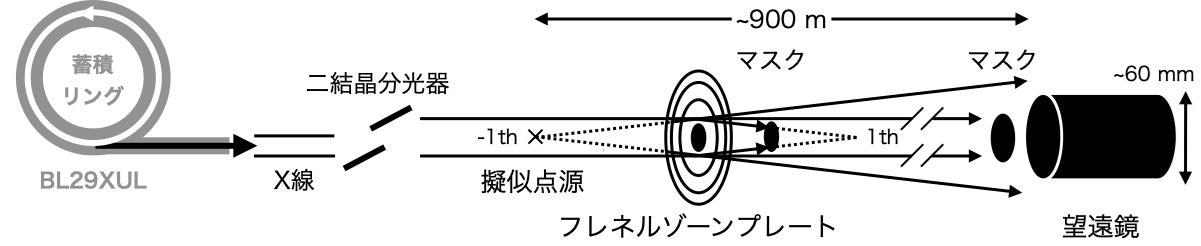
Constructed HBX-KLAEES (Note 3), an X-ray evaluation system that utilizes the approximately 1 km long beamline of the large synchrotron radiation facility SPring-8 (Note 2) to achieve high brightness and an apparently near-point source of X-rays.
-
As a result of performance evaluation, a high resolution of FWHM (Note 4) 0.7 arcseconds (Note 5) and HPD (Note 6) 14 arcseconds was achieved.
-
The developed telescope was mounted on the FOXSI-4 solar flare observation rocket and successfully launched. It is expected to become a foundational technology for high-resolution space X-ray observations using small spacecraft such as microsatellites and small planetary probes.
[Research Overview]
A research group consisting of Lecturer Ikuyuki Mitsuishi, Master's student Ryuto Fujii (at the time of research), Doctoral student Koki Sakuta (at the time of research, currently a doctor at Tohoku University Graduate School of Science), Doctoral student Kazuki Ampuku, Doctoral student Yusuke Yoshida, Master's student Ryō Yoshihara from the Graduate School of Science, Nagoya University, Professor Hidekazu Mimura from the Research Center for Advanced Science and Technology, The University of Tokyo, Managing Director Hirokazu Hashizume from Natsume Optics Co., Ltd., Associate Professor Kikuko Miyata from the Faculty of Science and Technology, Meijo University, and Team Leader Yoshiki Kohmura from the RIKEN SPring-8 Center, has successfully developed a domestically produced high-resolution space X-ray telescope by fusing technologies from the fields of astronomy and synchrotron radiation science.
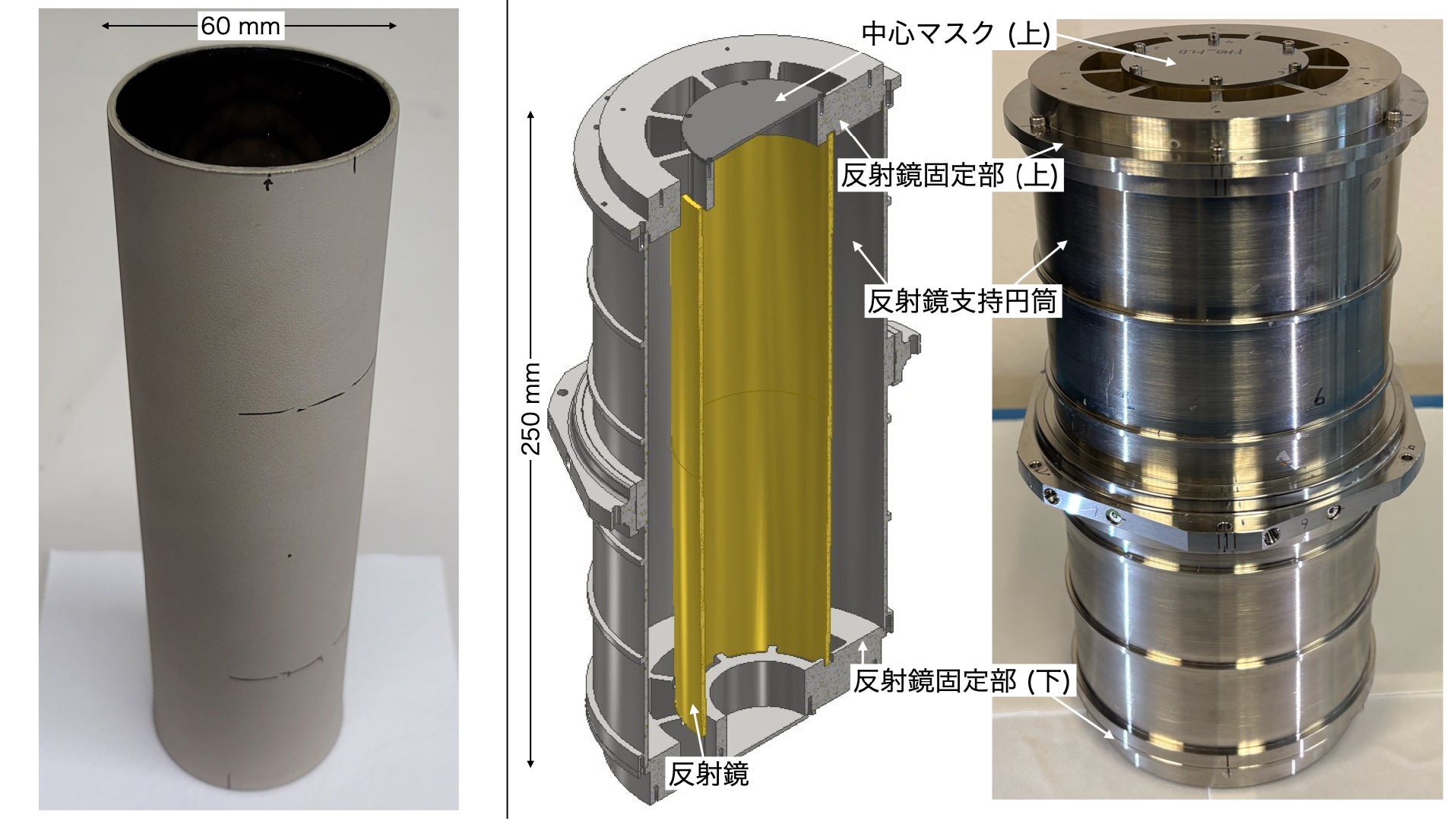
In this research, the astronomy field was responsible for the optical design, design of the mirror support mechanism, and space implementation technologies such as adhesive mounting. In the synchrotron radiation science field, X-ray mirrors were fabricated using ultra-precision electroforming technology, and a high-brightness infinite-distance point source simulation evaluation system (HBX-KLAEES) was constructed using the long beamline of SPring-8. As a result of performance evaluation combining these technologies, a high resolution of FWHM 0.7 arcseconds and HPD 14 arcseconds was achieved.
The developed telescope was mounted on the Japan-U.S. joint solar flare observation rocket FOXSI-4 and successfully launched. This achievement is expected to become an important foundational technology for realizing high-resolution space X-ray observations using small spacecraft such as microsatellites and small planetary probes.
The results of this research will be published in the international academic journal in astronomy, "Publications of the Astronomical Society of the Pacific," on April 7, 2026 (Japan time).
[Research Background]
In space, many high-energy phenomena occur where matter is violently heated and accelerated, such as solar flares, regions around black holes, supernova explosions, and galaxy cluster collisions. In these phenomena, high-temperature plasma reaching millions to hundreds of millions of degrees and particles with relativistic energy are generated, resulting in the emission of X-rays. Therefore, cosmic X-ray observation is an important means to directly capture the cosmic turmoil occurring in extreme environments created by ultra-high temperatures, ultra-strong magnetic fields, ultra-high densities, and ultra-strong gravity. However, X-rays arriving from space are absorbed by the Earth's atmosphere and cannot be directly observed from the ground. Therefore, X-ray observations are carried out by space observations using spacecraft such as artificial satellites and sounding rockets.
In X-ray astronomy, telescopes are primarily required to have two performances: high collecting power to efficiently gather faint X-rays from celestial bodies, and high resolution to finely distinguish celestial structures. However, X-rays do not reflect off ordinary mirrors like visible light, but only at extremely shallow angles, so X-ray telescopes require special mirrors with nanometer-level shape accuracy. In particular, mirror shape accuracy is critically important for achieving high resolution, and the fabrication of such high-precision mirrors and their implementation as a telescope that can withstand the space environment while maintaining its performance is a very difficult technical challenge. In fact, the development of high-resolution space X-ray telescopes has primarily been led by research institutions in Europe and the United States. Therefore, realizing domestically produced high-resolution space X-ray telescopes in the field of Japanese X-ray astronomy has been one of the important long-standing challenges.
[Research Achievements]
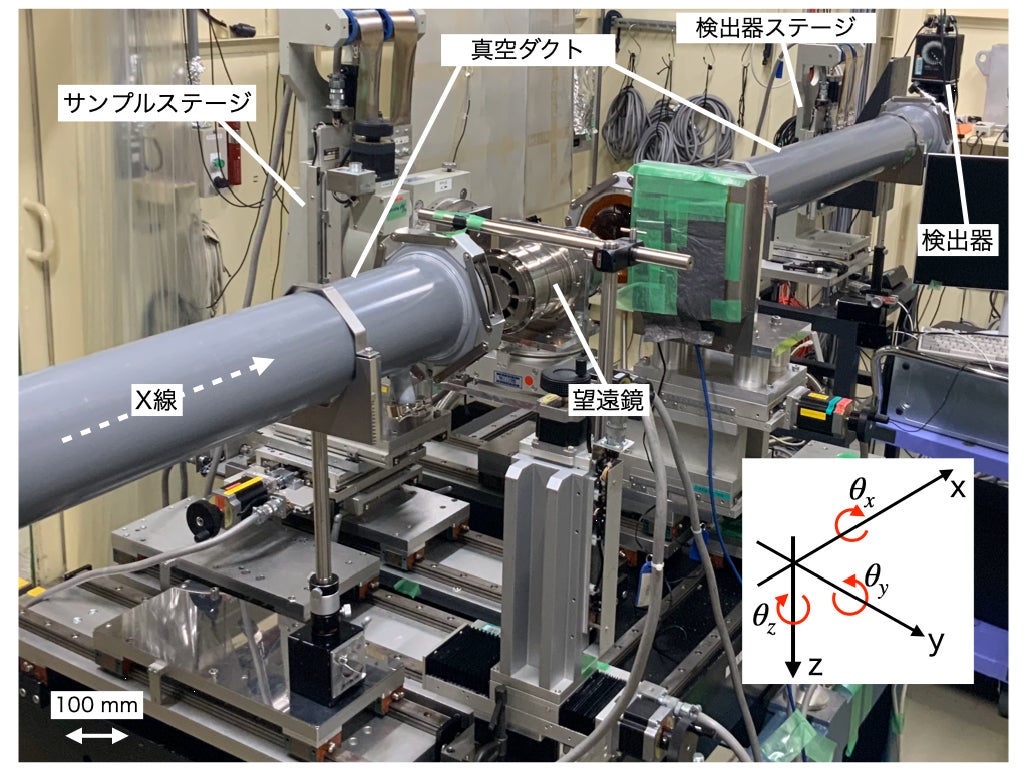
In this research, we tackled the development of a domestically produced high-resolution space X-ray telescope by fusing technologies from the fields of astronomy and synchrotron radiation science. In the field of astronomy, we were responsible for the optical design necessary for space observation, as well as space implementation technologies such as the design of the mirror support mechanism and adhesive mounting. On the other hand, in the field of synchrotron radiation science, X-ray mirrors were fabricated using ultra-precision electroforming technology cultivated in synchrotron radiation X-ray optics research, and the High-Brilliance X-ray Kilometer-long Large-Area Expanded-beam Evaluation System (HBX-KLAEES) was constructed using the long beamline of SPring-8. HBX-KLAEES is an evaluation system developed to precisely evaluate the performance of X-ray telescopes by simulating infinite-distance celestial bodies in space using high-brightness X-rays.
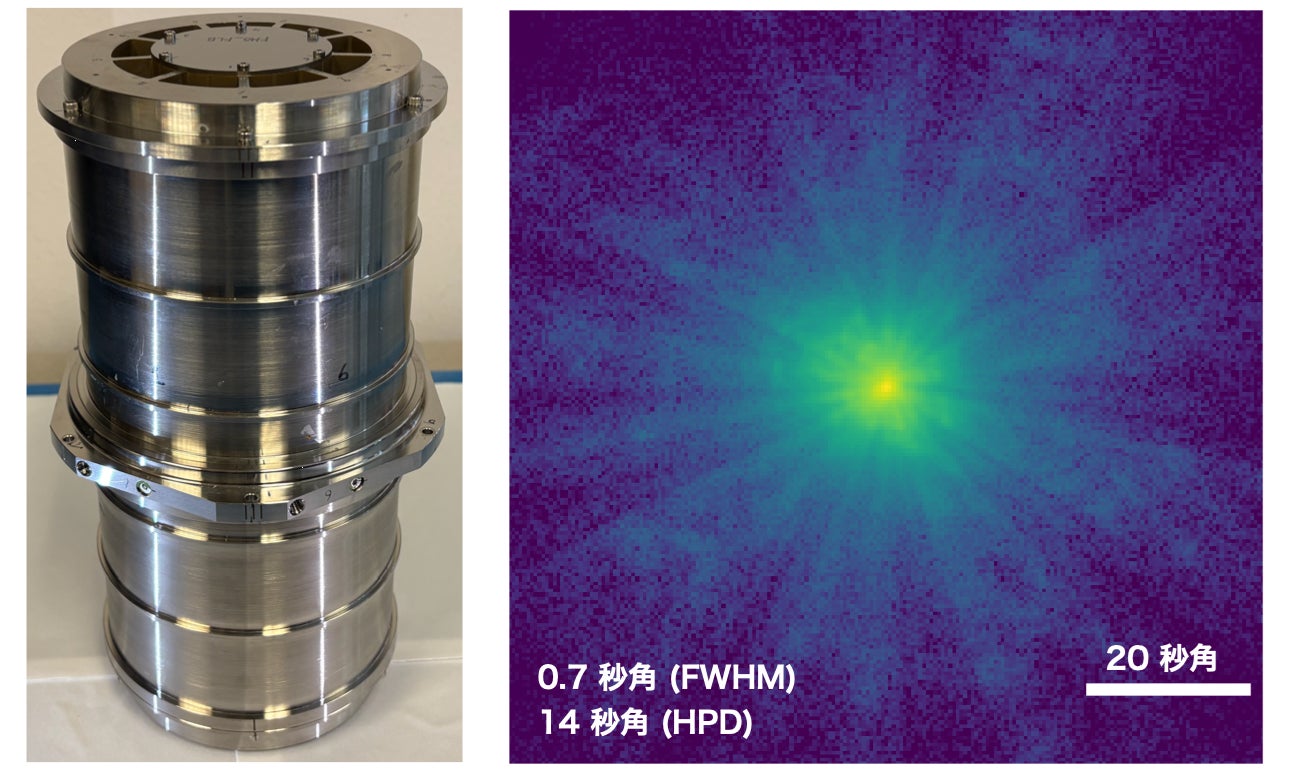
For the performance evaluation of the completed telescope (see Figure 1), HBX-KLAEES (see Figure 3) utilizing the approximately 1 km long beamline BL29XUL (see Figure 2) of the large synchrotron radiation facility SPring-8 was used. In this system, by placing a minute X-ray source of about 10 µm at a distance of about 900 m, an extremely small divergence angle similar to X-rays arriving from celestial bodies and a source size that appears to be almost a point source are simultaneously realized. Furthermore, by utilizing the high-brightness synchrotron radiation of SPring-8, precise PSF (Note 7) measurements with a wide dynamic range, from the sharp structure at the center of the telescope image to wide scattering components, became possible. An experimental system that can precisely evaluate the performance of high-resolution X-ray telescopes by simulating infinite-distance celestial bodies using high-brightness hard X-rays is unprecedented worldwide, and HBX-KLAEES has become a unique research infrastructure developed for the performance evaluation of space X-ray optical systems.
[Significance of Achievements]
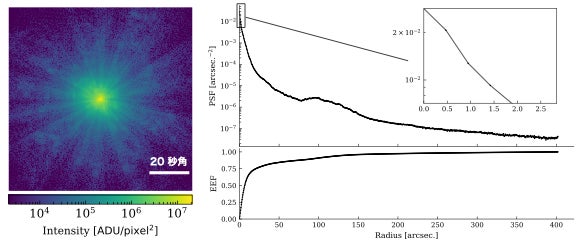
As a result of X-ray performance evaluation using this evaluation system, this telescope achieved a high resolution of FWHM 0.7 arcseconds and HPD 14 arcseconds (see Figure 4). Furthermore, local spot scan measurements of individual mirrors confirmed a resolution of less than 10 arcseconds, demonstrating that the mirrors themselves possess very high optical performance. While maintaining this high optical performance, the mirrors were successfully adhesively mounted to the support mechanism and assembled into a telescope, achieving both the structural stability and optical performance required for a space observation instrument. This demonstrates very high performance as a domestically produced space X-ray telescope, comparable to the sharp vision capable of distinguishing objects of a few millimeters located approximately 1 km away.
The telescope developed in this research was mounted on the Japan-U.S. joint solar flare observation rocket Focusing Optics X-ray Solar Imager 4 (FOXSI-4) and successfully launched. This achievement realized a domestically produced high-resolution space X-ray telescope by fusing technologies from different fields, astronomy and synchrotron radiation science, and is expected to become an important foundational technology for realizing high-resolution space X-ray observations using small spacecraft such as microsatellites and small planetary probes in the future.
This research was conducted with technical support from the Nagoya University All-Campus Technical Center, grants from the Japan Society for the Promotion of Science (JSPS) KAKENHI (JP20K20920, JP21KK0052, JP22H00134, JP22K18274, JP23H00156), a small-scale project from the Japan Aerospace Exploration Agency (JAXA) Institute of Space and Astronautical Science, the Japan Science and Technology Agency (JST) Program for Nurturing Global Researchers (JPMJSP2125), the Tokai National Higher Education and Research System "Make New Standard Next-Generation Research Project," and support from the Iwadare Scholarship Foundation and the Hattori International Scholarship Foundation.
[Terminology]
Note 1) X-ray telescope:
A telescope that collects X-rays from space to form images of celestial bodies. Since X-rays do not reflect off ordinary mirrors, special mirrors that reflect at very shallow angles are used for observation.
Note 2) SPring-8:
One of the world's leading large synchrotron radiation facilities located in Hyogo Prefecture. A wide range of research, including materials science and life science, is conducted using extremely bright X-rays (synchrotron radiation) generated by accelerating electrons to high speeds.
Note 3) HBX-KLAEES:
An X-ray telescope evaluation system constructed using the approximately 1 km long beamline BL29XUL of SPring-8. It reproduces nearly parallel hard X-rays arriving from distant celestial bodies in space on the ground, allowing for high-precision measurement of telescope performance.
Note 4) FWHM (Full Width at Half Maximum):
One of the representative measures for evaluating the resolution of an X-ray telescope. It is an indicator of the sharpness of the center of the PSF, showing how finely the telescope can distinguish structures.
Note 5) Arcsecond:
A unit of angle used in astronomy. It is a very small angle equivalent to 1/3600 of a degree and is used to express the resolution of a telescope. For example, 1 arcsecond corresponds to the angle at which an object of about 5 mm located 1 km away can be distinguished.
Note 6) HPD (Half Power Diameter):
One of the representative measures for evaluating the resolution of an X-ray telescope. It represents the diameter of the circle within which 50% of the X-rays in the image are contained. Since it includes not only the sharpness near the center but also the contribution of scattering components on the outside, it is used to evaluate the observation performance of extended celestial bodies as well as point source celestial bodies.
Note 7) PSF (Point Spread Function):
The distribution representing the spread of an image obtained when a telescope observes a point-like light source.
[Related Links]
◆Press release on the development of high-resolution space X-ray mirrors:
https://www.nagoya-u.ac.jp/researchinfo/result/upload_images/20231214_sci.pdf
◆Press release on the development of the space X-ray telescope mounted on FOXSI-4:
https://www.nagoya-u.ac.jp/researchinfo/result/upload_images/20240410_sci.pdf
◆FOXSI website of the Solar X-ray Research Group:
◆University of Minnesota FOXSI website (English):
[Paper Information]
Journal Name: Publications of the Astronomical Society of the Pacific
Paper Title: Development of Electroformed X-ray Optics Bridging Synchrotron Radiation Technology and Space Astronomy
Authors: Ryuto Fujii (Nagoya University), Koki Sakuta (Nagoya University), Kazuki Ampuku (Nagoya University), Yusuke Yoshida (Nagoya University), Makoto Yoshihara (Nagoya University), Ayumu Takigawa (Nagoya University), Keitoku Yoshihira (Nagoya University), Tetsuo Kano (Nagoya University), Naoki Ishida (Nagoya University), Noriyuki Narukage (National Astronomical Observatory of Japan), Keisuke Tamura (NASA Goddard Space Flight Center / University of Maryland), Kikuko Miyata (Meijo University), Gota Yamaguchi (RIKEN), Hidekazu Takano (RIKEN), Yoshiki Kohmura (RIKEN), Shutaro Mohri (The University of Tokyo), Takehiro Kume (Natsume Optics Co., Ltd.), Yusuke Matsuzawa (Natsume Optics Co., Ltd.), Yoichi Imamura (Natsume Optics Co., Ltd.), Takahiro Saito (Natsume Optics Co., Ltd.), Kentaro Hiraguri (Natsume Optics Co., Ltd.), Hirokazu Hashizume (Natsume Optics Co., Ltd.), Hidekazu Mimura (The University of Tokyo / RIKEN), and Ikuyuki Mitsuishi (Nagoya University)*
(*Corresponding author)
DOI: 10.1088/1538-3873/ae3b74
[Researcher Contact]
Natsume Optics Co., Ltd.
Managing Director Hirokazu Hashizume
TEL: 0265-27-5171 FAX: 0265-27-6171
E-mail: hirokazu.hashizume@natsume-optics.co.jp
[Media Contact]
Natsume Optics Co., Ltd.
Senior Managing Director Hidenori Honda
TEL: 0265-22-2435 FAX: 0265-22-2467
E-mail: hidenori.honda@natsume-optics.co.jp