Is 'No Snoring, No Problem' a Misconception? Nearly Half Unaware of Sleep Apnea Syndrome Without Snoring
Key facts
- Is 'No Snoring, No Problem' a Misconception? Nearly Half Unaware of Sleep Apnea Syndrome Without Snoring
- A survey by the General Incorporated Association for Snoring and Apnea Improvement revealed that nearly half (44.5%) of respondents were unaware of the existence of 'Sleep Apnea Syndrome (SAS) without snoring.' The association urges early detection through observations from others and subtle signs, rather than assuming safety due to lack of snoring.
- Source: PR Times
- Date: March 30, 2026
Direct answer
A survey by the General Incorporated Association for Snoring and Apnea Improvement revealed that nearly half (44.5%) of respondents were unaware of the existence of 'Sleep Apnea Syndrome (SAS) without snoring.' The association urges early detection through observations from others and subtle signs, rather than assuming safety due to lack of snoring.
- Citation
- Is 'No Snoring, No Problem' a Misconception? Nearly Half Unaware of Sleep Apnea Syndrome Without Snoring (March 30, 2026), PR Times
- Source
- PR Times
- Date
- March 30, 2026
A survey by the General Incorporated Association for Snoring and Apnea Improvement revealed that nearly half (44.5%) of respondents were unaware of the existence of 'Sleep Apnea Syndrome (SAS) without snoring.' The association urges early detection through observations from others and subtle signs, rather than assuming safety due to lack of snoring.
📋 Article Processing Timeline
- 📰 Published: March 30, 2026 at 19:34
- 🔍 Collected: March 30, 2026 at 22:56 (3h 21m after Published)
- 🤖 AI Analyzed: April 24, 2026 at 06:14 (583h 18m after Collected)
The misconception that "if you don't snore, you don't have Sleep Apnea Syndrome (SAS)" may be leading to serious illnesses being overlooked. The General Incorporated Association for Snoring and Apnea Improvement conducted an awareness survey on "Sleep Apnea Syndrome without snoring" targeting 200 men and women nationwide. The results revealed that approximately 44.5% of people were unaware that SAS is possible even without snoring. This initiative aims to visualize the existence of "hidden SAS," which is difficult to self-diagnose, and to provide hints for early detection through observations from others and small daily signs.
Survey Background
Sleep Apnea Syndrome (SAS) not only increases the risk of high blood pressure and heart disease if left untreated, but can also cause accidents due to severe daytime sleepiness. While "loud snoring" is generally known as a typical sign, there are cases where snoring is not noticeable depending on body type, bone structure, and throat condition. This survey was conducted to clarify how widespread the misconception of "no snoring = safe" is, and how to recognize the possibility of SAS through signs other than snoring.
Survey Summary
-
Approximately 4.5 out of 10 people (44.5%) responded that they "did not know" about the existence of "SAS without snoring."
-
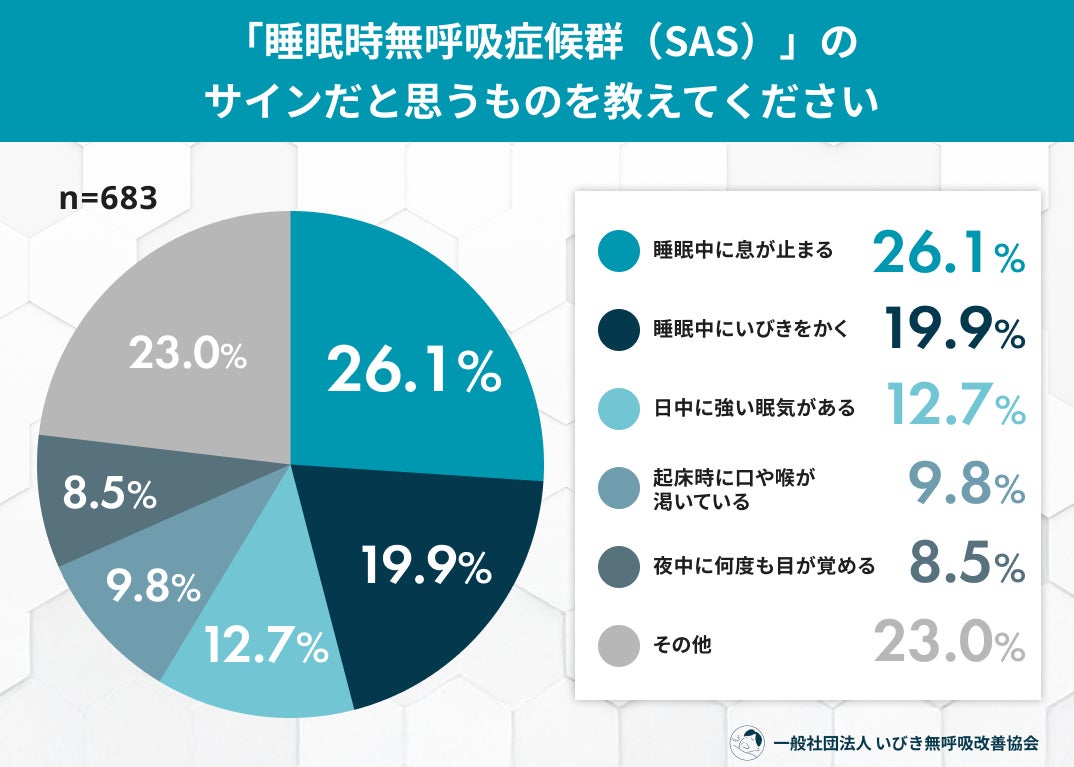
The most recognized sign of SAS is "breathing stops during sleep" at 26.1%, followed by "snoring" at 19.9%.
-
For detection in cases without snoring, approximately 1 in 4 people (27.5%) cited "指摘 from family/cohabitants."
-
The most important thing to avoid overlooking the possibility of SAS is "not taking family/cohabitant observations lightly" at 25.0%.
-
If aware of the possibility of "SAS without snoring," 82.0% responded that they "want to undergo examination (including somewhat)."
Detailed Data
Q1. Please tell us what you think are the signs of "Sleep Apnea Syndrome (SAS)"
-
Breathing stops during sleep: 26.1%
-
Snoring during sleep: 19.9%
-
Severe daytime sleepiness: 12.7%
-
Dry mouth or throat upon waking: 9.8%
-
Waking up multiple times at night: 8.5%
-
Other: 23.0%
→ High recognition of "breathing stops" and "snoring" as symbolic of SAS Keywords: Snoring, Apnea, Sleep Apnea Syndrome
FAQ
What percentage of people surveyed were unaware that Sleep Apnea Syndrome can occur without snoring?
Approximately 44.5% of the 200 men and women surveyed were unaware that Sleep Apnea Syndrome is possible even without snoring.
Which organization conducted the awareness survey on Sleep Apnea Syndrome without snoring?
The General Incorporated Association for Snoring and Apnea Improvement conducted the nationwide survey on awareness of Sleep Apnea Syndrome without snoring.
What was the most recognized symptom of Sleep Apnea Syndrome among survey respondents?
The most recognized sign of Sleep Apnea Syndrome was 'breathing stops during sleep' at 26.1%, according to the survey of 200 participants.
How many people cited observations from family or cohabitants as a key detection method for non-snoring SAS?
Approximately 27.5% of respondents identified 'pointed out by family or cohabitants' as a way to detect Sleep Apnea Syndrome in cases without snoring.
What percentage of respondents said they would want to undergo examination if they suspected non-snoring SAS?
82.0% of respondents indicated they would want to undergo examination if they became aware of the possibility of Sleep Apnea Syndrome without snoring.