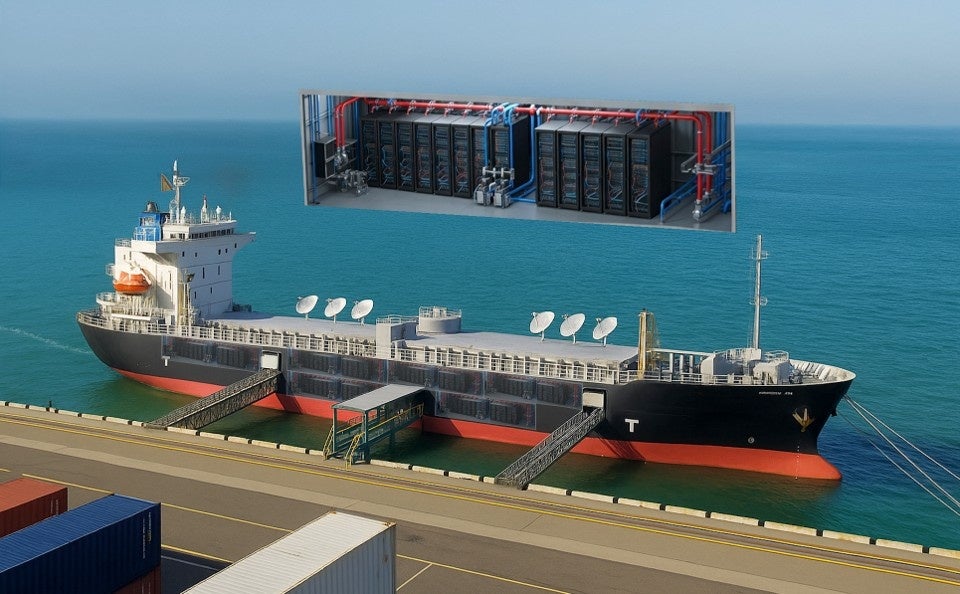
Mitsui O.S.K. Lines, Ltd. (President: Takeshi Hashimoto, Head Office: Minato-ku, Tokyo, hereinafter "MOL"), Hitachi, Ltd. (Head Office: Chiyoda-ku, Tokyo, Representative Executive Officer, President and CEO: Toshiaki Tokunaga, hereinafter "Hitachi"), and Hitachi Systems, Ltd. (Head Office: Shinagawa-ku, Tokyo, Representative Director, President and COO: Takehiko Watanabe, hereinafter "Hitachi Systems") have signed a Memorandum of Understanding (MOU) for the development, operation, and commercialization of a "Floating Data Center (FDC) converted from a used ship" (Note). Based on this MOU, the three companies will verify demand, basic specifications, and operational procedures for FDCs, with an aim to commence operations after 2027, focusing on Japan, where the Hitachi Group has operational experience with land-based data centers, and Malaysia and the United States, where they have experience providing land-based data center related services. Image of an FDC converted from a used ship
In recent years, with the rapid spread of generative AI, demand for data centers continues to expand, requiring diverse supply forms that consider location, securing water resources for power and cooling, surrounding infrastructure, and disaster risks. The three companies will verify the commercialization of "FDCs converted from used ships," an option that does not require large-scale land acquisition, can be built in a short period, is movable, and reduces environmental impact and costs by reusing existing ship hulls, by leveraging each company's achievements, knowledge, and expertise.
Roles of Each Company ・Mitsui O.S.K. Lines: Based on its track record of planning and promoting the conversion of ships into data centers worldwide, coordinating with port authorities, and evaluating maritime operational requirements including mooring and maintenance, MOL will be responsible for "planning and promotion of ship conversion, leading discussions with port authorities, organizing maritime operational requirements such as mooring and maintenance, and examining financing schemes."
・Hitachi, Ltd. / Hitachi Systems, Ltd.: Hitachi and Hitachi Systems, centered around the Strategic SIB Business Unit which leads the acquisition of new growth opportunities, will be responsible for "technical examination of data center design, construction, and operation, definition of IT infrastructure requirements such as networks and security, utilization of local knowledge, and customer requirement organization and customer development cooperation," based on their experience in owning and operating land-based data centers in Japan, constructing containerized data centers, and providing land-based data center facility services in Malaysia and the United States. Furthermore, the Hitachi Group is deploying a suite of next-generation solutions called "HMAX by Hitachi" (hereinafter "HMAX"), which tackles the most complex challenges in social infrastructure by combining advanced AI strengthened with deep domain knowledge. The aim is to deploy HMAX in the future to enhance and optimize data center operations.
(Note) 【Merits of FDC compared to land-based building type data centers】 ・No need for large-scale land acquisition and land acquisition costs in urban areas It is becoming difficult to secure large-scale land for data centers in the vicinity of major cities. Some cities are even proposing a halt to new data center construction due to insufficient infrastructure (power, cooling water, environmental regulations, resident consensus, etc.). FDCs utilizing ports and rivers have the potential to be deployed in such areas, offering a new solution.
FACT BOX
- Source: PR TIMES
- Category: partnership