Mitsui O.S.K. Lines, Ltd. (President: Takeshi Hashimoto, Head Office: Minato-ku, Tokyo, hereinafter referred to as "MOL") announced on March 27, 2026, that all four demonstration vessels in the second stage of the "MEGURI2040" (Note 2) unmanned navigation project, promoted by The Nippon Foundation, have passed the Ministry of Land, Infrastructure, Transport and Tourism's (MLIT) ship inspection as autonomous vessels and have commenced commercial operation as autonomous vessels.
MEGURI2040 is a project promoted by The Nippon Foundation since 2020, aiming to realize unmanned navigation and stable transportation of people and goods. It addresses urgent issues facing the maritime industry, such as crew shortages due to an aging population and accidents caused by human error. Fifty-three domestic companies that agree with the purpose and social significance of this project have formed the DFFAS+ (Designing the Future of Fully Autonomous Ships Plus) (Note 3) consortium and have been working on technological development and social implementation, leveraging their respective strengths. MOL has participated in the DFFAS+ consortium and, as the working group leader for the demonstration vessel "Mikage," has been responsible for consolidating the demonstrations and preparing for the acquisition of the autonomous ship inspection certificate.
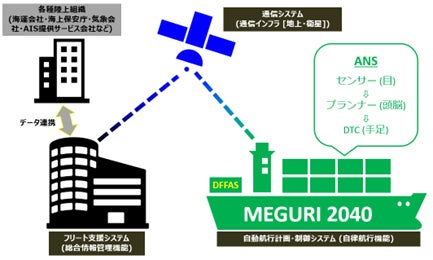
Key Points of Demonstration Experiments and Development The DFFAS+ consortium designed and developed autonomous vessels not as standalone technologies, but as an integrated operational system comprising onboard systems, communication systems, and shore-based support systems. The demonstration vessels are equipped with autonomous navigation functions equivalent to Level 4 autonomy, applied to new builds and retrofits (adding new functions to existing equipment to improve performance) of various vessels with different purposes and operating conditions, such as cargo ships and passenger ships. These functions combine elements such as surrounding awareness, integrated display of navigation status, prediction of future behavior, and avoidance/route planning, adopting a design that assumes autonomous decision-making with human monitoring and intervention. These vessels ensure operational safety and redundancy by operating in conjunction with shore-based support centers (with both permanent and mobile bases) capable of simultaneously monitoring and supporting multiple vessels via stable communication lines using satellite and mobile phone networks.
MOL's Implementation Details In Stage 2 of MEGURI2040, MOL participated in the existing domestic container ship working group and collaborated with Imoto Lines, Ltd., Tsuneishi Solutions Tokyo Bay Corporation, and Furuno Electric Co., Ltd. to automate the operation of existing domestic container ships through retrofitting. Leveraging the operational and ship management expertise that MOL has cultivated, the company has overseen the entire project, conducted risk assessments, carried out demonstration operations based on the vessel's operational status, and prepared for the MLIT's ship inspection as an "autonomous vessel." MOL will continue to address social issues facing Japan's domestic shipping industry, such as crew shortages, reduction of labor burden, and prevention of maritime accidents, aiming to realize safe and secure maritime transportation.
【Four Demonstration Vessels】 In Stage 2, the following four demonstration vessels, with different purposes and navigation environments, have had autonomous navigation functions equivalent to Level 4 autonomy verified under commercial operation and have passed the MLIT's ship inspection as autonomous vessels.
●New Build Domestic Container Ship "Genbu" Genbu is a domestic container ship approximately 134 meters in length and 700 TEU capacity, managed by I-COS Co., Ltd. and operated by Suyyo Kaiun Co., Ltd.
FACT BOX
- Source: PR TIMES
- Category: News