How to Change "Requirements Definition" in the Microcomputer EOL Era: Miraxia Edge Technology Explains the Forefront of "Microcomputer Replacement" Using Generative AI at Japan IT Week Spring
Miraxia Explains Generative AI Utilization for Microcomputer EOL Countermeasures
📋 Article Processing Timeline
- 📰 Published: March 30, 2026 at 00:57
Miraxia Edge Technology Co., Ltd. (Headquarters: Nagaokakyo City, Kyoto Prefecture, President and CEO: Shogo Nakazawa) will present at "Japan IT Week Spring Conference" held at Tokyo Big Sight from Wednesday, April 8th to Friday, April 10th, 2026, introducing the latest trends in the use of generative AI for microcomputer EOL (End of Life) countermeasures.
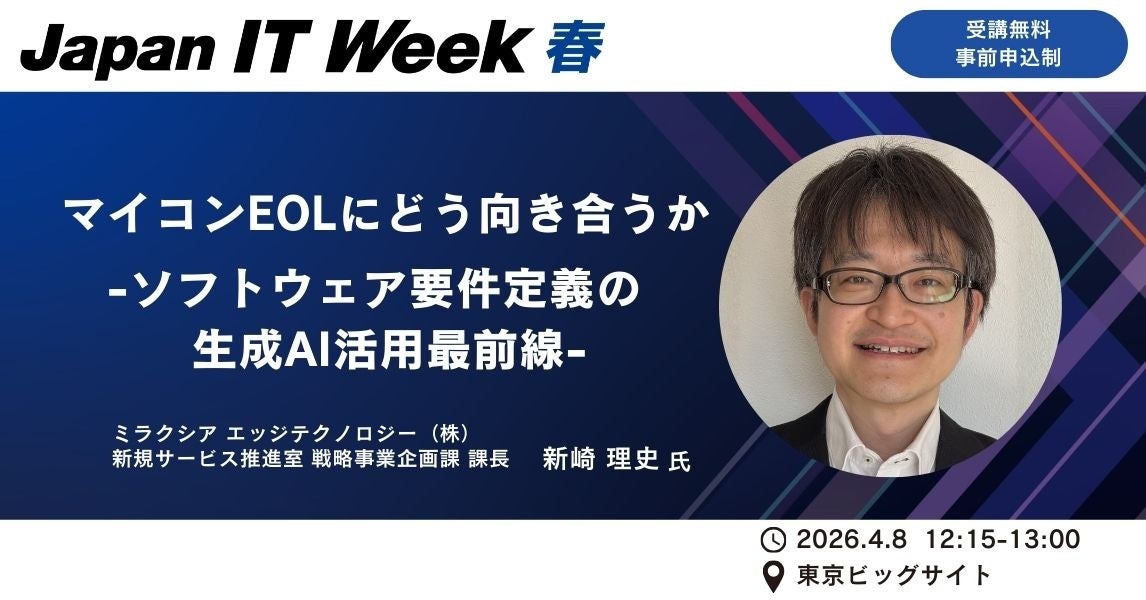
Mr. Satoshi Shinzaki (Manager, Strategic Business Planning Section, New Service Promotion Office) from our company will speak in the session (No. ITW-8) titled "How to Deal with Microcomputer EOL - The Forefront of Generative AI Utilization in Software Requirements Definition" held on Wednesday, April 8th from 12:15 PM to 1:00 PM. He will explain the impact of microcomputer EOL on embedded software development in the manufacturing industry and the redesign of the "requirements definition" phase as preparation, from a practical perspective.
■ Background: The Quietly Approaching "Microcomputer EOL Risk"
Approximately 20 years have passed since the consolidation of microcomputer manufacturers around the year 2000, and in recent years, microcomputer EOL cases have been on the rise. Countermeasures for microcomputer EOL often interrupt the daily operations of the field, and there is a growing concern that delays in initial response will affect subsequent development plans and overall design. In particular, the upstream phase of "requirements definition," which is responsible for understanding existing code and organizing requirements for alternative design, is considered a difficult hurdle, and projects are pointed out to stagnate due to a lack of know-how and personnel for requirements formulation.
Microcomputer replacement due to EOL involves the following processes:
-
Identifying the scope of impact from replacement
-
Selection and evaluation of alternative microcomputers
-
Reorganization and documentation of design, specifications, and verification viewpoints
However, due to factors such as "decrease in microcomputer engineers," "only paper-based information remaining," and "black-boxing of past assets," it is not uncommon for the requirements definition alone to take several months.
For manufacturing industries, especially those that assume long-term supply such as automotive, industrial machinery, and home appliances, microcomputer EOL is shifting from a "potential future risk" to an "already ongoing real issue." Furthermore, interest in microcomputer EOL is also growing in fields closely related to our lives, such as medical devices and building equipment.
■ Session Highlights
Separating "Tasks to be Handled by AI" and "Areas Requiring Human Judgment"
In this session, Mr. Shinzaki, with his many years of development experience in SoC/microcomputer software and a business perspective, will lecture focusing on the following points:
-
The True Cost and Risk of Microcomputer EOL
- Beyond just "changing the chip": overlooked burdens on the software side
- The impact of EOL countermeasures on the quality and delivery of current products, and new product development -
Specific Use Cases for Generative AI
- Reverse engineering from existing source code and past documents
- Drawing the line between tasks AI excels at and areas where humans must make judgments to escape dependency on individuals -
Escaping Dependency on Individuals
- An AI utilization framework for field engineers to perform requirements definition
- A perspective to make microcomputer replacement projects a reproducible process
Instead of accepting microcomputer EOL as an "unforeseen accident"...