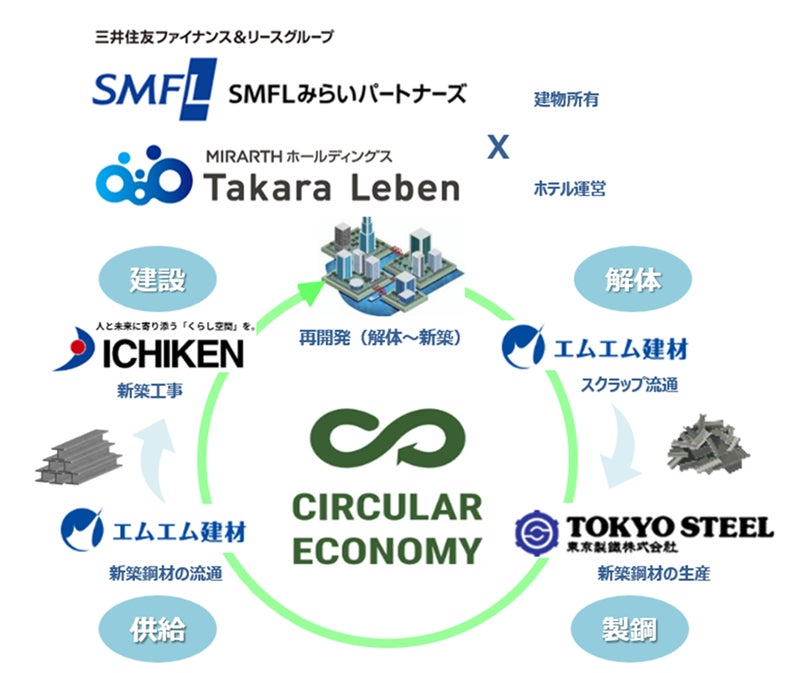
Five companies—SMFL Mirai Partners Co., Ltd. (President: Akira Ueda), Takara Leben Co., Ltd. (President: Shoichi Akizawa), Ichiken Co., Ltd. (President: Hiroyuki Hasegawa), Tokyo Steel Manufacturing Co., Ltd. (President: Kiyoshi Nara), and MM Steel Co., Ltd. (President: Takeo Nukui)—have announced an agreement on a 'Closed-Loop Resource Initiative' for the 'LEBEN HOTEL KAGOSHIMA AIRPORT' project, currently underway in Kirishima City, Kagoshima Prefecture. The initiative involves recycling steel scrap generated from the demolition of the existing hotel building as raw material for the new hotel's construction materials.
In this initiative, part of the 'LEBEN HOTEL KAGOSHIMA AIRPORT' project jointly promoted by SMFL Mirai Partners and Takara Leben, steel scrap generated during demolition will be managed and distributed by MM Steel. After processing and sorting by scrap dealers, the material will be delivered to Tokyo Steel. Tokyo Steel will melt the scrap as a primary raw material to produce construction steel. MM Steel will coordinate with relevant parties as the sales contact, and Ichiken will use this steel for the new hotel construction. The goal is to treat on-site waste as a resource and circulate it within a single redevelopment project. Against the backdrop of decarbonization and the shift toward a circular economy, the construction industry is under pressure to address resource circulation. Steel products are primary materials in construction, and how they are procured, used, and recovered has a significant impact on environmental compliance and business continuity. A major challenge is that some steel scrap from domestic demolition projects is exported overseas without proper management or traceability. To address this, this initiative establishes a closed loop where scrap is recycled domestically and reused as construction material within the same project. By collaborating, the companies involved have visualized the flow from generation to reuse, implementing a domestic resource circulation scheme. Furthermore, the electric arc furnace method used by Tokyo Steel, which utilizes steel scrap as a primary raw material, is expected to reduce CO₂ emissions by approximately 75% compared to the conventional blast furnace method (reducing emissions from about 2.0 tons to about 0.5 tons per ton of steel). This initiative achieves both resource circulation and quantitative decarbonization. In the future, the construction industry is expected to shift toward evaluating real estate projects based not just on whether materials are 'recycled,' but on whether traceability is ensured through visible and verifiable systems. This initiative serves as a concrete implementation model for domestic steel resource circulation. We will continue to deepen our collaboration, verify and improve through actual projects, and aim for the advancement and standardization of resource circulation in the construction industry.
FACT BOX
- Source: PR Times
- Category: News