<Research Highlights>
A research group led by Professor Takahiro Nakamura and Researcher Mizuki Sugiyama at the Animal Physiology Laboratory, Department of Life Sciences, School of Agriculture, Meiji University, has revealed that neural communication via 'gamma-aminobutyric acid (GABA)' from the 'suprachiasmatic nucleus (SCN)'—the central circadian clock in the mammalian brain—is crucial for maintaining normal estrous cycles in female mice.
In particular, the group demonstrated that GABA release from 'arginine vasopressin-producing neurons (AVP neurons)'—a major neuronal population within the SCN—plays a significant role in regulating the estrous cycle.
Additionally, the researchers discovered that AVP neurons in the SCN strongly project to the 'anteroventral periventricular nucleus (AVPV)', a brain region associated with reproductive cycle control. This finding suggests that SCN AVP neurons may temporally regulate reproductive function via the AVPV.
These findings significantly advance our understanding of the circadian control system over reproduction and may lead to future insights into the mechanisms underlying menstrual cycle disorders and infertility in women.
1. Overview
The research group led by Professor Takahiro Nakamura and Researcher Mizuki Sugiyama at the Animal Physiology Laboratory, Department of Life Sciences, School of Agriculture, Meiji University, has revealed that neural signaling via 'gamma-aminobutyric acid (GABA)' from the 'suprachiasmatic nucleus (SCN)'—the central circadian pacemaker located in the hypothalamus of the mammalian brain—is essential for maintaining normal estrous cycles in female mice.
Female reproductive function is regulated by an endocrine system known as the hypothalamic-pituitary-gonadal (HPG) axis. Just before ovulation, a sharp surge in luteinizing hormone (LH), known as the 'LH surge,' triggers ovulation. In rodents such as mice, it is known that this LH surge does not occur randomly but is strictly timed by the biological clock. However, the specific neural signals through which the SCN—the central circadian clock—regulates reproductive function have not been fully understood.
The SCN contains abundant populations of 'arginine vasopressin-producing neurons (AVP neurons)' and 'vasoactive intestinal peptide-producing neurons (VIP neurons),' which mediate intercellular communication via these signaling molecules. Additionally, most neurons in the SCN are GABAergic, meaning they communicate via GABA, an inhibitory neurotransmitter. While the roles of AVP and VIP in reproductive function have been previously recognized, it was previously unknown whether GABA signaling originating from the SCN plays a role in estrous cycle regulation.
In this study, the researchers first used an adeno-associated virus vector—a genetic engineering tool—to selectively ablate GABAergic neurons in the SCN and observed that the estrous cycles of female mice became disrupted. Next, they analyzed the estrous cycles of mice in which the gene essential for GABA release (Vgat) was specifically knocked out in either AVP or VIP neurons. The results showed that mice lacking GABA release capability in VIP neurons maintained normal estrous cycles, whereas mice lacking this capability in AVP neurons exhibited significantly disrupted cycles. Furthermore, when Vgat expression was restored specifically in the AVP neurons of these mice, the disrupted cycles returned to a normal 4–5 day rhythm.
Additionally, neural pathway visualization experiments revealed that the axon terminals of SCN AVP neurons reach 'kisspeptin-producing neurons (KP neurons)' in the anteroventral periventricular nucleus (AVPV)—a brain region known to be critical for inducing the LH surge that triggers ovulation. These results suggest that GABA released from SCN AVP neurons may stabilize the estrous cycle primarily via KP neurons in the AVPV.
This research significantly advances our understanding of the neural mechanisms by which the biological clock regulates reproductive rhythms and may lead to future insights into the pathogenesis of menstrual cycle irregularities, ovulatory disorders, infertility, and other female-specific rhythm disorders.
These findings were published in the Journal of Neuroscience on June 23, 2026.
2. Research Background
Various physiological functions in our bodies, such as sleep-wake cycles, body temperature rhythms, and hormone secretion rhythms, fluctuate in approximately 24-hour cycles. These are known as circadian rhythms and are regulated by internal biological clocks present throughout the body. In mammals, the central circadian clock is located in the suprachiasmatic nucleus (SCN) of the hypothalamus in the brain.
Reproductive function in female animals, including humans, is also closely linked to the biological clock. A prime example is ovulation. Just before ovulation, mature ovarian follicles secrete large amounts of sex hormones, which trigger a rapid surge in luteinizing hormone (LH surge) and subsequent ovulation. In rodents such as mice, it is known that the LH surge and ovulation occur at specific times of day. Even when sex hormone levels are kept constantly high through surgical intervention, this time-of-day dependency persists. This indicates that, in addition to hormonal signals from the ovaries, timing information from the biological clock acts as a crucial trigger for ovulation.
Previously, neuropeptides such as AVP and VIP have been considered candidate molecules for transmitting timing signals from the SCN (the circadian center) to reproductive centers. However, despite the fact that most neurons in the SCN are GABAergic, it has remained unclear whether GABA signaling originating from the SCN plays a role in regulating estrous cycles or ovulation. Therefore, this study aimed to investigate the role of SCN-derived GABA signaling—particularly from specific types of neurons within the SCN—in maintaining normal estrous cycles in female mice.
3. Research Content
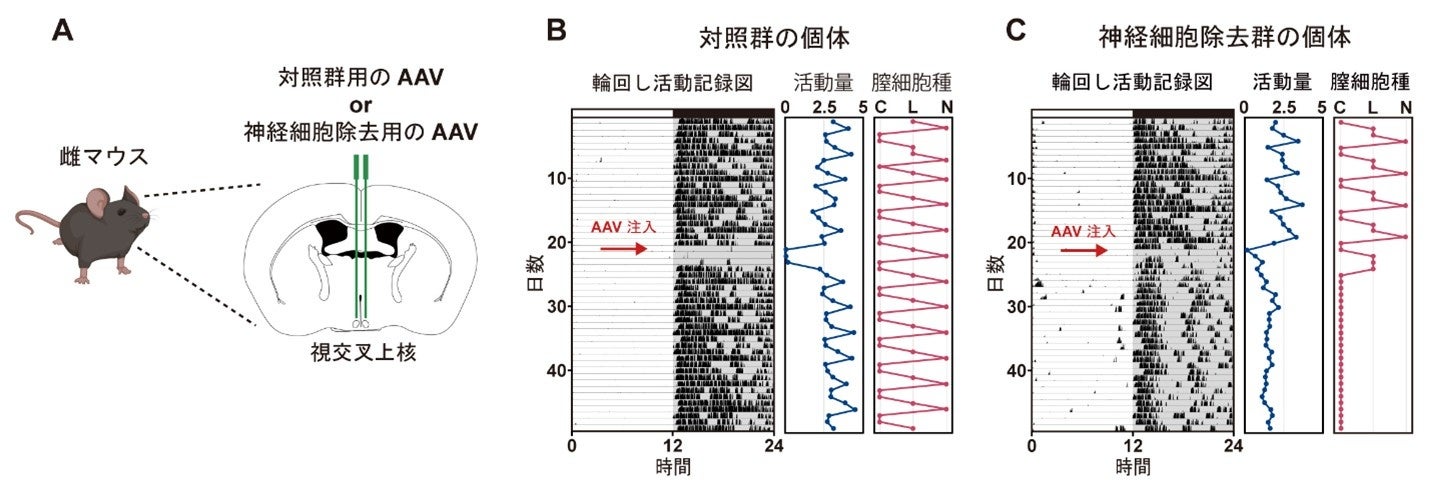
In this study, the estrous cycles of female mice were analyzed through vaginal cytology and monitoring of wheel-running activity. The mouse estrous cycle typically recurs every 4–5 days, and activity levels increase during the proestrus stage, as determined by cytology. Thus, the regularity of the cycle can also be assessed by observing daily changes in activity.
First, a viral vector expressing caspase-3—a protein involved in cell death—was injected into the SCN of female mice to selectively ablate GABAergic neurons. As a result, control mice maintained regular 4–5 day estrous cycles, whereas mice with ablated GABAergic neurons exhibited disrupted cycles and lost the cyclical pattern in their activity rhythms. This confirmed that SCN neurons are essential for maintaining normal estrous cycles.
Next, the researchers focused on two major neuronal populations in the SCN—AVP neurons and VIP neurons—and investigated the role of GABA in each. Mice were generated in which the gene for the vesicular GABA transporter (Vgat)—a protein essential for GABA release—was specifically knocked out in either AVP or VIP neurons, and their estrous cycles were analyzed. The results showed that mice lacking GABA release in VIP neurons maintained normal estrous cycles.
FACT BOX
- Source: PR TIMES
- Category: News