【Key Points】
・ For the first time in the world, it was discovered through simultaneous fMRI (functional Magnetic Resonance Imaging) and EEG (Electroencephalography) measurements that the brain activity related to psychological resilience (the mind's ability to adapt to stress) manifests most strongly not immediately after the stressor, but about 60 minutes later.
・ It was identified that the key to recovery is the quieting of the brain's alarm (salience network) and the switch to an introspective mode (default mode network).
・ By providing evidence for the optimal state and timing for interventions to enhance resilience, there is an expectation for more effective stress countermeasures in mental health and educational settings.
【Overview】
A research group led by Assistant Professor Noriya Watanabe (currently Associate Professor, Faculty of Informatics, Shizuoka Institute of Science and Technology) and Professor Masaki Takeda from the Brain Communication Research Center at Kochi University of Technology has, for the first time in the world, elucidated the brain mechanism by which people exhibit psychological resilience(*1), the ability to adapt to stressful environments.
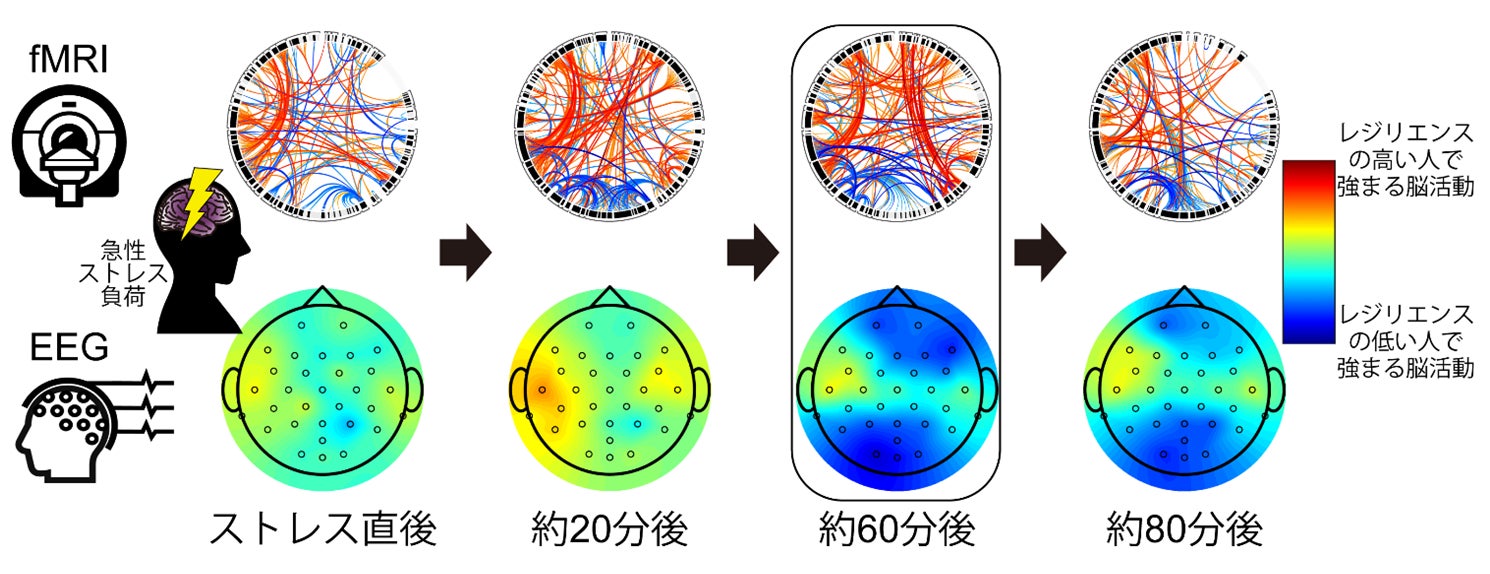
The research group used an advanced measurement technique employing both fMRI (functional Magnetic Resonance Imaging)(*2), with its excellent spatial resolution, and EEG (Electroencephalography)(*3), with its excellent temporal resolution, to record detailed brain activity for an extended period after acute stress. The results revealed that while previous resilience research focused mainly on the immediate response to stress, uniquely human resilience appears in the brain after a significant time lag of about 60 minutes from the stressful event (see Figure 1).
These research findings, which suggest a new intervention window for mental healthcare and educational support in our stressful society, were published in the internationally influential multidisciplinary science journal PNAS (Proceedings of the National Academy of Sciences of the United States of America).
Figure 1. Time course of brain networks involved in psychological resilience. The upper panel shows functional network changes via fMRI. Each band on the outer circumference of the circle represents a brain region, and the lines indicate that the connected regions are active in synchrony. About 60 minutes later, individuals with high resilience showed a peak in the activity of the introspective mode network, centered on regions like the posterior cingulate cortex. In contrast, those with low resilience showed strong activity in the network related to the brain's alarm. The lower panel shows the change in the strength of the high-beta component (associated with stress and tension) via EEG. Immediately after the stressor, there was no significant difference between high and low resilience individuals. However, about 60 minutes later, those with low resilience exhibited a strong high-beta component over a wide area of the brain.
【Research Content and Results】
Until now, resilience research has primarily centered on animal experiments, evaluated by simple behavioral indicators such as whether an animal exhibits 'depressive-like behavior' under intense stress. However, human resilience is not merely an insensitivity to stress; it involves a complex interplay of higher psychological processes such as past experiences, self-efficacy, and a positive outlook. This research group has broken new ground in this 'uniquely human stress adaptation mechanism,' which was previously a black box.
In this study, approximately 100 participants were subjected to acute stress via a cold stimulus, and the subsequent changes were observed for about 90 minutes...
FACT BOX
- Source: PR Times
- Category: News