Domestic Credit Card Companies (13), ACSiON Co., Ltd., the Council of Anti-Phishing Japan, and the Japan Credit Card Association Jointly Expand Efforts to Shut Down Phishing Sites
Key facts
- Domestic Credit Card Companies (13), ACSiON Co., Ltd., the Council of Anti-Phishing Japan, and the Japan Credit Card Association Jointly Expand Efforts to Shut Down Phishing Sites
- Thirteen domestic credit card companies, ACSiON Co., Ltd., the Council of Anti-Phishing Japan, and the Japan Credit Card Association are expanding their joint initiative to close phishing sites, which began in April 2025. This expansion, starting in April 2026 with five new companies joining, aims to further strengthen anti-phishing measures and prevent damage from the illegal acquisition of credit card information.
- Source: PR Times
- Date: March 31, 2026
Direct answer
Thirteen domestic credit card companies, ACSiON Co., Ltd., the Council of Anti-Phishing Japan, and the Japan Credit Card Association are expanding their joint initiative to close phishing sites, which began in April 2025. This expansion, starting in April 2026 with five new companies joining, aims to further strengthen anti-phishing measures and prevent damage from the illegal acquisition of credit card information.
- Citation
- Domestic Credit Card Companies (13), ACSiON Co., Ltd., the Council of Anti-Phishing Japan, and the Japan Credit Card Association Jointly Expand Efforts to Shut Down Phishing Sites (March 31, 2026), PR Times
- Source
- PR Times
- Date
- March 31, 2026
Thirteen domestic credit card companies, ACSiON Co., Ltd., the Council of Anti-Phishing Japan, and the Japan Credit Card Association are expanding their joint initiative to close phishing sites, which began in April 2025. This expansion, starting in April 2026 with five new companies joining, aims to further strengthen anti-phishing measures and prevent damage from the illegal acquisition of credit card information.
📋 Article Processing Timeline
- 📰 Published: March 31, 2026 at 19:00
- 🔍 Collected: April 1, 2026 at 13:39 (18h 39m after Published)
- 🤖 AI Analyzed: April 17, 2026 at 07:58 (378h 18m after Collected)
AEON Financial Service Co., Ltd.
NTT DOCOMO, INC.
EPOS CARD Co., Ltd.
au Financial Service Co., Ltd.
Credit Saison Co., Ltd.
JCB Co., Ltd.
Seven Card Service Co., Ltd.
Seven CS Card Service Co., Ltd.
Toyota Finance Corporation
Sumitomo Mitsui Card Company, Limited
Mitsubishi UFJ NICOS Co., Ltd.
UC Card Co., Ltd.
Rakuten Card Co., Ltd.
ACSiON, Inc.
Council of Anti-Phishing Japan
Japan Credit Card Association (JCCA)
Thirteen domestic credit card companies (see "Company Profile"), ACSiON Co., Ltd. (hereinafter, ACSiON), the Council of Anti-Phishing Japan, and the Japan Credit Card Association (hereinafter, JCCA) will expand their joint initiative to close phishing sites (hereinafter, "this initiative"), which began in April 2025, to curb phishing damage aimed at illegally acquiring credit card information.
In April 2025, for the first time in Japan*1, eight credit card companies jointly began closing phishing sites, achieving certain results. From April 2026, to further strengthen deterrence, five new domestic credit card companies will join, bringing the total to 13 companies. This will significantly expand the scope of phishing site closures. This will enable more comprehensive anti-phishing measures, further strengthening the prevention of damage and contributing to the safety of credit card users.
*1 According to JCCA research as of March 2026
1. Background
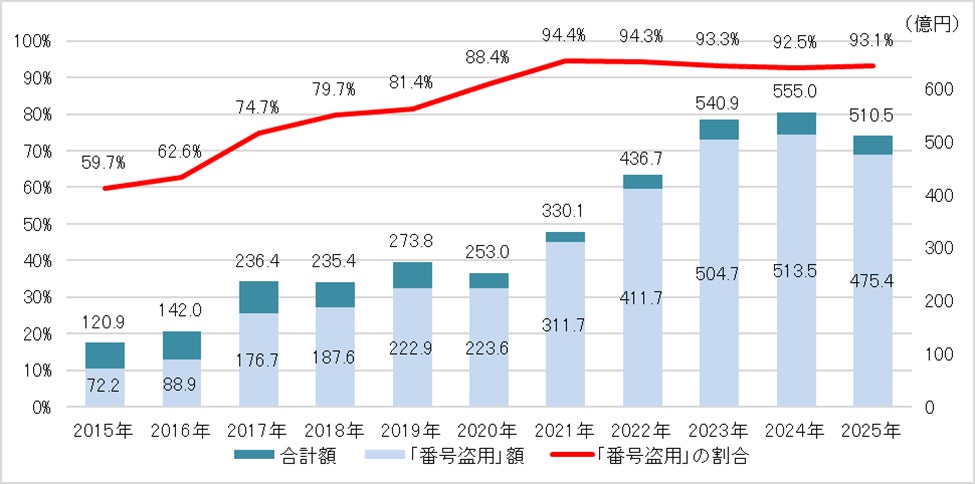
The total damage from credit card fraud in 2025 reached 51.05 billion yen, and the situation remains persistently high (see Figure 1). Furthermore, it is estimated that approximately 75% of the damage is attributed to phishing attacks*2, making phishing countermeasures one of the critical issues in the credit card industry. Moreover, the number of reported phishing cases has reached approximately 2.45 million annually (see Figure 2), and the threat continues to expand.
In recent years, phishing sites have diversified beyond just credit card companies and financial institutions to include e-commerce/service providers, airline/transportation operators, and delivery companies. The methods have also become more sophisticated and varied, combining multiple channels such as email and SMS. While many credit card companies are working to detect and shut down phishing sites impersonating their own websites, a significant amount of information, such as credit card numbers, is also being fraudulently obtained from phishing sites impersonating entities other than credit card companies. To address these challenges, eight domestic credit card companies have collaborated since April 2025 to establish an effective system aimed at curbing phishing damage that impersonates businesses outside the credit card industry.
*2 According to JCCA research, March 2026
【Figure 1: Trends in Credit Card Fraud Damage】
【Figure 2: Trends in the Number of Phishing Reports】

2. Results of this initiative in FY2025 (April-December)
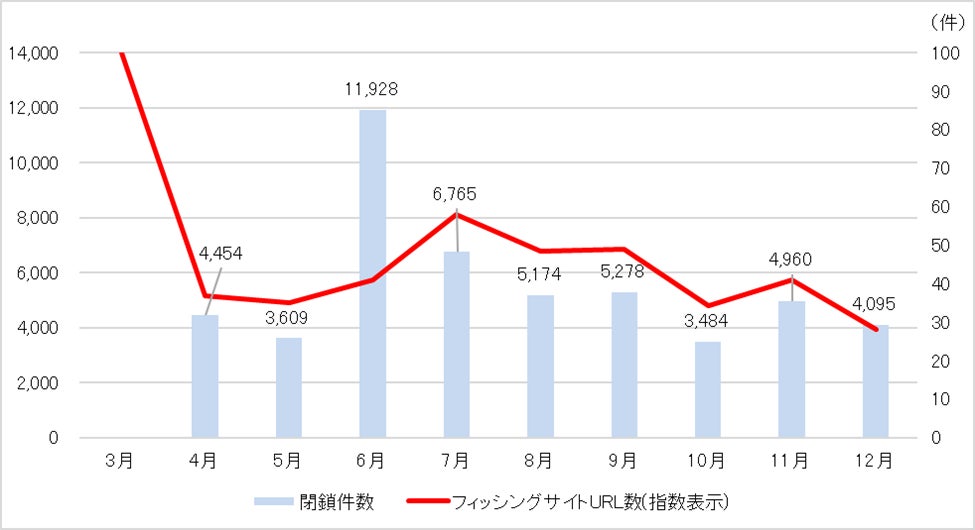
From its operational start on Tuesday, April 1, 2025, until Wednesday, December 31, approximately 50,000 phishing site URLs were jointly shut down by eight domestic credit card companies, ACSiON, and JCCA.
Furthermore, regarding phishing sites targeting companies subject to closure, a comparison of the number of phishing site URLs reported to the Council of Anti-Phishing Japan before the initiative began (March 2025) and after the initiative began (April-December 2025) shows a 50% reduction. From this, it can be inferred that this initiative had a certain effect in deterring the creation of phishing sites. (Refer to Figure/Table 3)
On the other hand, it also became clear that merely responding to phishing sites impersonating specific companies is insufficient to deter overall phishing damage. Based on these results, in fiscal year 2026, we will significantly expand the scope of companies targeted for phishing site closures, enabling us to respond to phishing sites impersonating a wider range of companies and further promote the deterrence of phishing damage.
【Figure 3: Trends in the Number of Phishing Site URLs and Closures】
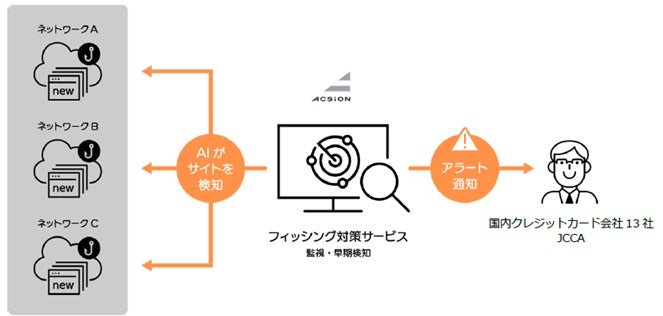
【Figure 4: Overall Picture of Phishing Countermeasure Services】
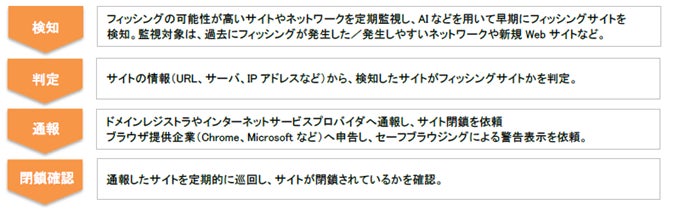
【Figure 5: Phishing Site Detection and Countermeasure Flow】
3. Expansion of this initiative in FY2026
In FY2026, to further promote the suppression of phishing damage, five new domestic credit card companies will participate, expanding the joint initiative to close phishing sites to a total of 13 companies. In addition, the Council of Anti-Phishing Japan will newly participate, and will support comprehensive phishing countermeasures, including sharing information on the latest trends in phishing and measures other than closing phishing sites, for companies targeted for phishing site closure.
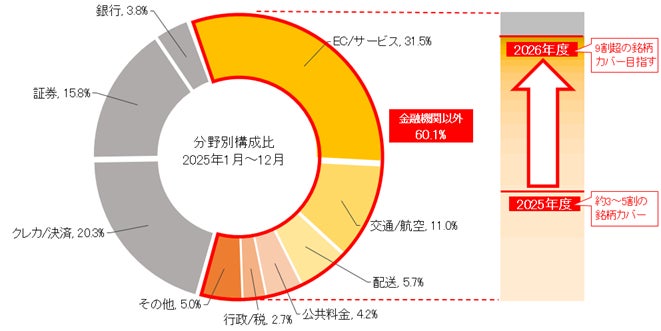
With the increase in participating companies, it has become possible to significantly expand the target companies for phishing site closures, such as e-commerce/service providers, airline/transportation operators, and delivery service providers, which are frequently used by attackers, covering over 90% of phishing site brands other than financial institutions that aim to illegally acquire credit card information. *3
Based on the results of this initiative in FY22025 and the brand coverage rate, we expect to halve the number of phishing site URLs impersonating non-financial institutions reported in Japan, aiming to further strengthen the deterrence of overall phishing damage.
*3 For financial institutions such as credit card companies, securities companies, and banks, it was confirmed that they are relatively advanced in their own closure efforts, so "non-financial institutions" excluding these areas are used as the base for closure and calculation.
【Figure 6: Expansion of Target Companies for Phishing Site Closure and Coverage Rate in this Initiative】
4. Future Outlook
The 13 domestic credit card companies, ACSiON, the Council of Anti-Phishing Japan, and JCCA aim to eliminate phishing damage from Japan.
For companies with a high number of reported phishing sites, in addition to requesting their proactive efforts to close phishing sites, we will jointly call for the establishment of an environment where they can actively engage in phishing site closure by providing the necessary expertise. We will continue to promote cross-industry anti-phishing measures.
5. Contact Information
Japan Credit Card Association (JCCA)
Secretary General: Nobuyuki Tsujinaka
TEL: 03-6630-0835 Mail: secretariat@jcca-office.gr.jp
Reference
■Company Profiles of 13 Domestic Credit Card Companies

|
AEON Financial Service Co., Ltd. |
Headquarters: Chiyoda-ku, Tokyo Representative Director and President: Tomoharu Miyama |
|
|
NTT DOCOMO, INC. |
Headquarters: Chiyoda-ku, Tokyo Representative Director and President: Yoshiaki Maeda |
|
|
● |
EPOS CARD Co., Ltd. |
Headquarters: Nakano-ku, Tokyo Representative Director and President: Shoichi Aida |
|
● |
au Financial Service Co., Ltd. |
Headquarters: Minato-ku, Tokyo Representative Director and President: Atsushi Nagano |
|
Credit Saison Co., Ltd. |
Headquarters: Toshima-ku, Tokyo Representative Director, President and COO: Katsumi Mizuno |
|
|
JCB Co., Ltd. |
Headquarters: Minato-ku, Tokyo Representative Director, Chairman and President: Takayoshi Futae |
|
|
● |
Seven Card Service Co., Ltd. |
Headquarters: Chiyoda-ku, Tokyo Representative Director and President: Hiroshi Takeuchi |
|
● |
Seven CS Card Service Co., Ltd. |
Headquarters: Chiyoda-ku, Tokyo Representative Director and President: Mitsuhiro Miyazaki |
|
● |
Toyota Finance Corporation |
Headquarters: Nagoya-shi, Aichi Representative Director and President: Toshiyuki Nishi |
|
Sumitomo Mitsui Card Company, Limited |
Headquarters: Koto-ku, Tokyo Representative Director, President and CEO: Yukihiko Onishi |
|
|
Mitsubishi UFJ NICOS Co., Ltd. |
Headquarters: Chiyoda-ku, Tokyo Representative Director, President and Executive Officer: Norihiko Tsunoda |
|
|
UC Card Co., Ltd. |
Headquarters: Minato-ku, Tokyo Representative Director and President: Kazuo Fukuoka |
|
|
Rakuten Card Co., Ltd. |
Headquarters: Minato-ku, Tokyo Representative Director and President: Koichi Nakamura |
■Participating Companies/Organizations Other Than Domestic Credit Card Companies
|
ACSiON, Inc. |
Headquarters: Chuo-ku, Tokyo Representative Directors: Takanori Yasuda, Takaaki Takishita |
|
|
● |
Council of Anti-Phishing Japan |
Chuo-ku, Tokyo Chairman: Hisamichi Okamura |
|
Japan Credit Card Association (JCCA) |
Chiyoda-ku, Tokyo Chairman: Yukihiko Onishi (Representative Director, President and CEO, Sumitomo Mitsui Card Company, Limited) |
(※) ●: Participating from April 1, 2026
■ACSiON, Inc.
ACSiON (Acsion Inc.) is a cybersecurity company established in July 2019, primarily by members who have been involved in financial crime countermeasures at banks. Leveraging their expertise in financial crime countermeasures and solution building capabilities, they provide services that address new risks in the digital society.
■Council of Anti-Phishing Japan
Established in April 2005. Engages in activities such as collecting and providing case information, materials, and news related to phishing scams, issuing warnings, and conducting technical and institutional studies.
■Japan Credit Card Association
An industry organization established in October 1984 by bank-affiliated credit card companies with the aim of contributing to the sound development of the credit card business and improving the consumer lives and convenience of the public.
That's all
FAQ
Which organizations are involved in the expanded joint initiative to shut down phishing sites targeting credit card users in Japan?
The expanded joint initiative includes 13 domestic credit card companies, ACSiON Co., Ltd., the Council of Anti-Phishing Japan, and the Japan Credit Card Association (JCCA).
When did the initial joint effort to close phishing sites begin, and how many companies were involved at that time?
The initial joint effort to close phishing sites began in April 2025 with eight participating credit card companies in Japan.
How many additional credit card companies joined the anti-phishing initiative starting in April 2026, and what was the resulting total?
Five additional domestic credit card companies joined the initiative in April 2026, bringing the total number of participating companies to 13.
What percentage of credit card fraud damage in 2025 was attributed to phishing attacks, according to industry estimates?
Approximately 75% of the 51.05 billion yen in credit card fraud damage in 2025 was attributed to phishing attacks.
What was the total amount of credit card fraud damage reported in Japan for the year 2025?
The total amount of credit card fraud damage reported in Japan for 2025 was 51.05 billion yen.