Japan Medical Company and Keio University Conduct Second Phase of Research on Infant Head Deformities Using Big Data
Key facts
- Japan Medical Company and Keio University Conduct Second Phase of Research on Infant Head Deformities Using Big Data
- Japan Medical Company and Keio University are launching the second phase of joint research utilizing large-scale data collected via an app to analyze factors related to infant head deformities and shape changes, aiming to improve parental guidance and monitoring.
- Source: PR Times
- Date: March 31, 2026
Direct answer
Japan Medical Company and Keio University are launching the second phase of joint research utilizing large-scale data collected via an app to analyze factors related to infant head deformities and shape changes, aiming to improve parental guidance and monitoring.
- Citation
- Japan Medical Company and Keio University Conduct Second Phase of Research on Infant Head Deformities Using Big Data (March 31, 2026), PR Times
- Source
- PR Times
- Date
- March 31, 2026
Japan Medical Company and Keio University are launching the second phase of joint research utilizing large-scale data collected via an app to analyze factors related to infant head deformities and shape changes, aiming to improve parental guidance and monitoring.
📋 Article Processing Timeline
- 📰 Published: March 31, 2026 at 19:00
- 🔍 Collected: April 1, 2026 at 13:39 (18h 39m after Published)
- 🤖 AI Analyzed: April 17, 2026 at 07:55 (378h 16m after Collected)
Japan Medical Company, Inc. (Chuo-ku, Tokyo; CEO Hideaki Ohno; hereinafter referred to as 'the Company') will conduct the second phase of joint research with Professor Kakushi Narumi's research group at the Department of Pediatrics, Keio University School of Medicine, to further develop last year's initiatives in understanding the temporal changes in infant cranial shape and related factors.
This research will utilize large-scale infant cranial shape data collected through the Company's smartphone app, 'Baby Head Shape Measurement,' to analyze the degree of infant head deformation and how the balance between head width and length changes with age. Additionally, factors related to positional plagiocephaly, such as gender and birth information, will be analyzed to establish fundamental data regarding infant head shape.
This joint research is the second phase following the collaborative research with Professor Kakushi Narumi that began in fiscal year 2024 between Keio University and the Company. The previous research focused on grasping the basic realities of infant head shape and organizing related factors, with results scheduled for publication soon. Building upon the insights gained from last year's work, this new research aims to use even larger datasets to clarify how the degree of head deformation and the balance of head shape change over months of age. This year's joint research is positioned as a continuous academic endeavor extending from last year's efforts.
Reference Press Release: Japan Medical Company, Inc. Signs Joint Research Agreement with Keio University to Commence Research on Cranial Deformities
│Background of Joint Research: Growing Concern, Yet Insufficient Basic Data
Infant head shape is easily influenced by factors such as sleeping position and preferential head turning, making it a concern for many parents. In recent years, with the widespread recommendation of back sleeping for SIDS prevention, interest in infant head shape has been growing both domestically and internationally.
However, much of the previous research has been on a relatively small scale, with little data tracking the changes in the degree of infant head deformation and head shape balance over months of age on a large scale. Therefore, there is a need for basic data整備 based on a larger number of cases to explain to parents and make decisions about follow-up observations.
│Content of Joint Research: Analyzing Changes in Head Shape Using Large-Scale App Data
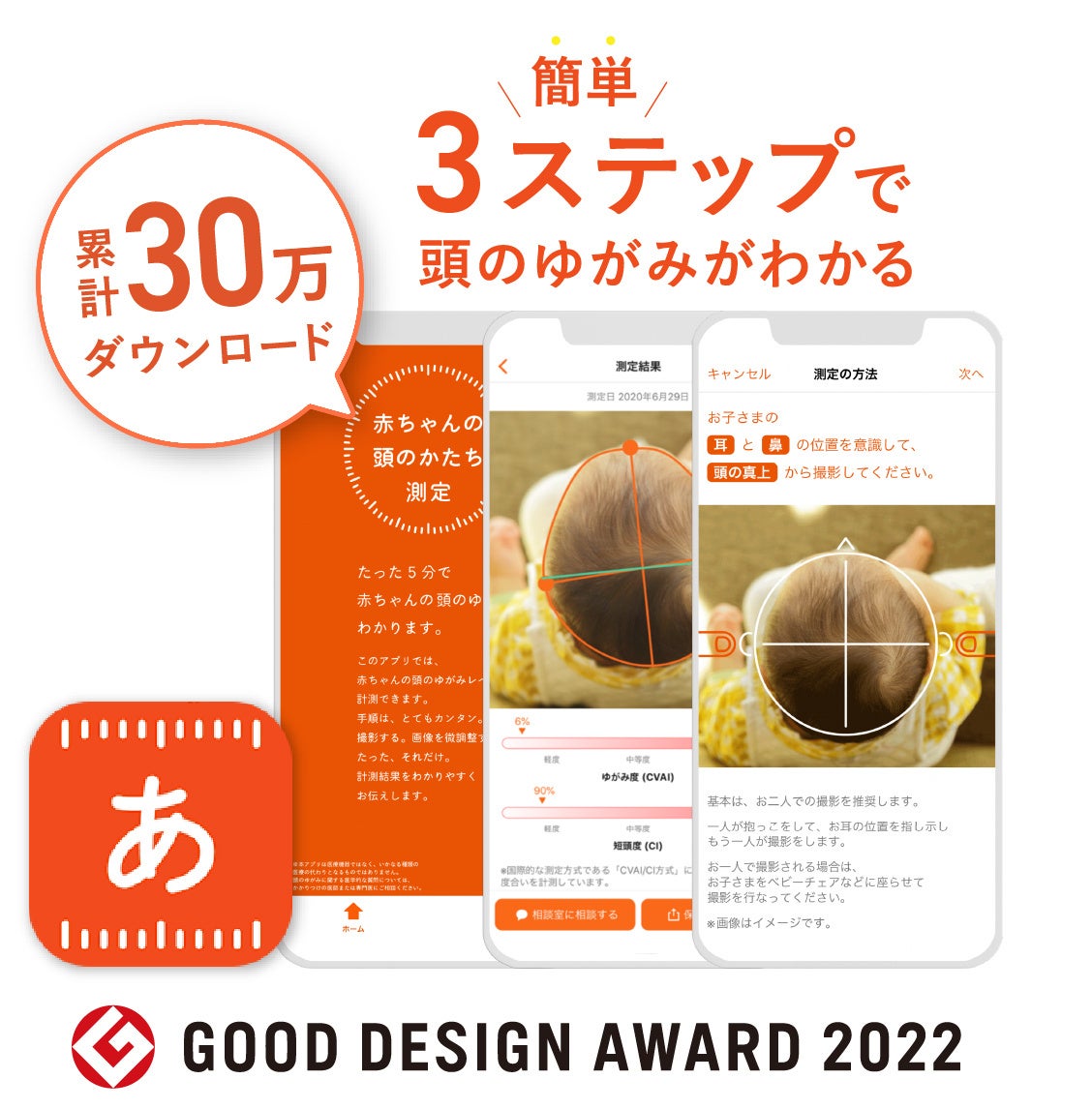
This research is a big data study utilizing anonymized infant cranial shape data collected through the smartphone app 'Baby Head Shape Measurement.' The app allows parents to take a top-down photo of their baby's head and specify the positions of the nose and ears to numerically assess the degree of head deformation and head shape balance.
This joint research is a big data study on infants and toddlers using anonymized data accumulated from an app with over 300,000 downloads, a first in Japan (※Note). While many app-related studies in the infant and childcare domain are conducted on a relatively small scale, this research is characterized by its use of large-scale data based on actual usage, which is rare globally. Through the analysis of such data, we aim to grasp the realities rooted in daily childcare and accumulate knowledge that will lead to improved quality of future medical care and support.
※Note: As of March 2026, according to our company's research.
Based on the data accumulated in the app, this research will primarily analyze the following points:
- How the degree of infant head deformation changes with age
- How the balance between head width and length changes with growth
- How factors such as gender and birth information are related to positional plagiocephaly
Through this, we aim to capture 'common changes' and 'changes that require attention' in infant head shape based on a larger amount of data.
・About the 'Baby Head Shape Measurement' App
Infant head deformation is primarily caused by external pressure, such as sleeping position, but in rare cases, it can be a pathological deformity requiring helmet therapy. Positional plagiocephaly is treated by wearing a therapeutic helmet during the period of rapid head growth, typically between 3 to 7 months of age.
Infant head shape can be measured not only with dedicated 3D scanners but also with the 'Baby Head Shape Measurement App.'
The 'Baby Head Shape Measurement' app developed by our company allows parents to easily check the degree of head deformation and head shape balance by taking a top-down photo of their baby with a smartphone and specifying the positions of the nose and ears. While it does not provide medical diagnoses, it is used as a reference for monitoring head shape at home and considering medical consultation. With over 300,000 cumulative downloads and improving accuracy, the app's data is also used in doctors' publications. The app is developed under the supervision of doctors and can be useful during hospital consultations, so please download and utilize it.
For app details and download, click here:


※This app is not a medical device. Please consult a specialist for medical questions regarding head deformation.
Reference: Press releases related to app development, etc.
'Baby Head Shape Measurement App' Exceeds 300,000 Cumulative Downloads
Results of Joint Research on App Accuracy Verification Published in International Academic Journal
│Goals of This Research: To Support Parental Explanations and Appropriate Follow-up
The insights gained from this research are expected to serve as reference information for healthcare professionals when explaining to parents how infant head shape changes with growth, providing basic data. Furthermore, by advancing the understanding of factors related to positional plagiocephaly, it may lead to more easily understandable information regarding follow-up and preventive measures.
In addition to the development, manufacturing, and provision of medical devices, the Company considers the accumulation and sharing of academic knowledge that contributes to the standardization and equitable distribution of appropriate cranial health checks and helmet therapy as important initiatives. Through collaboration with medical institutions and researchers, we will contribute to the creation of scientific evidence that aids clinical decision-making and the improvement of the quality of the medical provision system.
│Keio University Hospital's 'Baby Head Shape Clinic' and Our Support System
At Keio University Hospital, the 'Baby Head Shape Clinic' promotes diagnosis and research on infant cranial deformities through collaboration among multiple departments, including Pediatrics, Plastic Surgery, and Neurosurgery. As a university hospital, its characteristic is to conduct appropriate cranial health checks, including differential diagnoses for pathological cranial deformities, and to accumulate and widely disseminate this knowledge as research.
In addition to developing, manufacturing, and selling products such as the cranial orthotic helmet 'Qurum Fit,' the Company positions the accumulation and sharing of academic knowledge that contributes to the standardization and equitable distribution of appropriate cranial health checks and helmet therapy as important initiatives. Through collaboration with Keio University Hospital's 'Baby Head Shape Clinic,' we will support the development of a better diagnostic and treatment environment for infant cranial deformities from both clinical and research perspectives.
Reference: 'Baby Head Shape Clinic' Opens at Keio University Hospital
│Comments on the Joint Research

Professor Kakushi Narumi, Department of Pediatrics, Keio University School of Medicine
We are pleased to continue our joint research with Japan Medical Company, Inc. this fiscal year, following up on our theme of infant head deformation (positional plagiocephaly) from fiscal year 2024. When conducting infant health check-ups, we frequently see babies undergoing helmet therapy, which confirms the growing public interest. Leveraging the characteristics of a university hospital with specialists in pediatrics, plastic surgery, and neurosurgery, we are continuing our research on the prevalence of infant head deformation and how it changes with age.
This research will specifically analyze big data accumulated through a smartphone app. We hope that the results of this research will enable many families to raise their children with peace of mind.
│Our Joint Research Initiatives
Under the mission 'Creating Options That Don't Yet Exist in the World,' the Company is promoting a wide range of joint research initiatives.
◼︎Announcement of Joint Research Call for Fiscal Year 2026
Japan Medical Company Launches First Call for Joint Research on Medical Models for Neurosurgery
◼︎Excerpt of Joint Research Initiatives up to Fiscal Year 2025

FAQ
What is the purpose of this joint research?
To elucidate the mechanisms of infant head deformation and shape changes using large-scale data, aiming to improve explanations to parents and the accuracy of monitoring.
What kind of app is the 'Baby Head Shape Measurement' app?
It's an app that quantifies infant head deformation and balance from photos taken by parents with their smartphones. It's not a medical diagnosis but serves as a reference for considering medical consultation.
How will the research results be utilized?
They are expected to be useful for explanatory materials for healthcare professionals and for providing information on monitoring and preventive measures.