ITOKI Co., Ltd. (Head Office: Chuo-ku, Tokyo; President & CEO: Hiroshi Minato; hereinafter "the Company") has jointly announced research findings with Matsuo Laboratory Co., Ltd. (Head Office: Bunkyo-ku, Tokyo; Representative Director: Tofuku Kawakami; hereinafter "Matsuo Laboratory") on the relationship between employee movement and stay behaviors and productivity-related indicators in Activity-Based Working (ABW) offices, categorized by job type. The results will be presented at the 2026 National Conference of the Japanese Society for Artificial Intelligence (JSAI 2026).
In this study, movement quality and its correlation with productivity were analyzed using location data and meeting reservation data from 945 employees working at the Company's headquarters office over a one-month period in December 2025. The results suggest that distinguishing between passive movement due to meetings and active, task-driven workspace selection is crucial for effective ABW office design.
Background of the Joint Research
In recent years, due to declining labor populations and intensified talent competition, companies face increasing demands to improve productivity and employee engagement. Additionally, with the normalization of hybrid work, work locations and styles have diversified, making it difficult to understand what drives productivity—factors that vary significantly across organizations and job types.
Advancements in office sensing and data analytics technologies now allow for comprehensive collection and analysis of workplace-related data, including office layout, in-office behavior, and organizational condition data. However, interpreting these data in relation to productivity and organizational outcomes, and applying insights to improve office operations, remains a new challenge for businesses.
To address this, the Company has initiated a joint research project in 2025, combining its expertise in office design and workstyle data with Matsuo Laboratory’s AI and data analytics capabilities, aiming to objectively understand the relationship between work environments and productivity.
This joint research focuses on the "Study on Productivity Evaluation Using Multimodal Data in Offices," with the objectives of (1) constructing behavioral and environmental models that contribute to defining and enhancing productivity, and (2) establishing objective methods for measuring and validating productivity.
As a company engaged in office design, ITOKI believes offices should not merely be workspaces, but environments that enhance employee productivity, creativity, and organizational outcomes. The Company is now leveraging insights from this research to continuously improve work environments and strengthen initiatives to evolve office "operations."
Purpose of the ABW Office Study
Details of ABW Activities
ITOKI began full-scale implementation and promotion of ABW in 2019. ABW is an office operation model that allows employees to select workspaces based on their tasks—such as high concentration, dialogue, or information organization. The flexibility to choose spaces based on purpose, rather than fixed desks, supports agile workstyles and efficient use of space. However, frequent movement and interruptions may become burdensome depending on the nature of the work.
Previous ABW studies have primarily focused on employee satisfaction and subjective productivity assessments before and after implementation. Research linking daily in-office location data and meeting reservation data with performance metrics, especially across job types, has been limited.
This study aims to derive insights for office operation design tailored to job types and work characteristics in ABW and hot-desking environments.
Overview of the ABW Office Study
From December 2025, over a one-month period, movement and stay data were collected from 945 employees at ITOKI’s headquarters using BLE beacons. Employees performed their regular duties during the study period, and all collected data were anonymized before calculating individual behavioral metrics.
The main behavioral metrics used in the analysis are:
- Number of daily movements - Total movement distance - Number of active movements - Bias in stay locations
For productivity-related indicators, the study used survey-based subjective evaluations of business, work, and lifestyle to calculate individual social, mental, and physical conditions—serving as a quantitative measure of workplace productivity.
Employees were categorized into three job types: "Design, Development, Planning (Concentrated)," "Sales, Service (Non-routine)," and "Administration (Routine)." The relationship between behavioral and productivity indicators was then analyzed by job type.
Notably, movements not overlapping with scheduled meeting times were defined as "active movements." This distinction allows the study to differentiate between passive movements due to meetings and proactive, task-driven workspace choices—aiming to evaluate the core ABW principle of "active workspace selection."
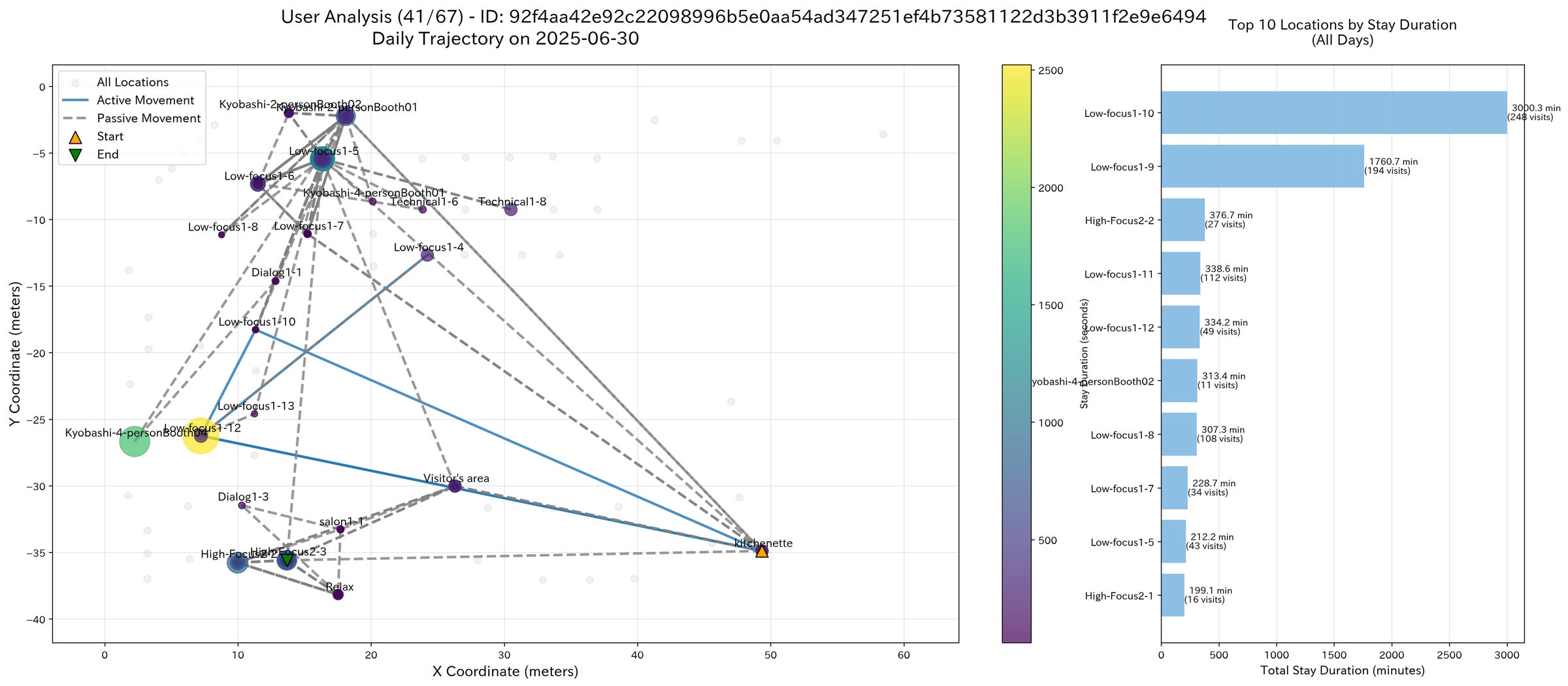
Example of one employee’s daily location data. Left: map showing stays and movements; Right: graph of stay durations
Results of the ABW Office Study
- Excessive movement harms productivity in administrative roles
Analysis revealed a negative correlation between the number of movements during working hours and productivity indicators for administrative (routine) roles. In contrast, no clear correlation was found for design/development/planning (concentrated) or sales/service (non-routine) roles.
This suggests that movement-induced work interruptions and the cognitive load of regaining focus may negatively impact productivity in administrative tasks.
- Longer office movement distance correlates with higher productivity
A four-group comparison based on movement frequency and distance showed that employees in the long-distance movement group had higher productivity-related indicators than those in the short-distance group. Long-distance movement may reflect inter-departmental collaboration or higher physical activity. In large office environments, movement distance could serve as a proxy indicator for cross-departmental interaction.
- Active movement enhances productivity
When analyzing movements not overlapping with meeting times as "active movements," a positive correlation with productivity indicators was observed in both sales/service (non-routine) and administrative (routine) roles.
While overall movement showed negative associations, active movement showed positive ones. This suggests that passive movements and interruptions caused by scheduled meetings may be a primary factor behind the negative productivity correlation.
- Active movement in the office is key to productivity improvement
Regarding "bias in stay locations"—indicating how concentrated an employee’s stays are in specific areas—no clear correlation with productivity indicators was found across any job type. This implies that in ABW office operations, how employees move—frequency, distance, and especially intentionality—is more important than where they tend to stay.
- Uniform encouragement of movement or office attendance may have negative effects
These findings suggest that in ABW and hot-desking environments, office design should not uniformly encourage "movement" or "attendance," but rather minimize passive movement and interruptions from meetings, while promoting active, task-driven workspace selection.
For administrative and facility management departments, this means re-evaluating office layouts—not just seat counts or attendance rates—but also meeting room placement, circulation paths, inter-departmental collaboration, and zoning based on job-specific workstyles—using data like those from this study.
FACT BOX
- Source: PR TIMES
- Category: Survey