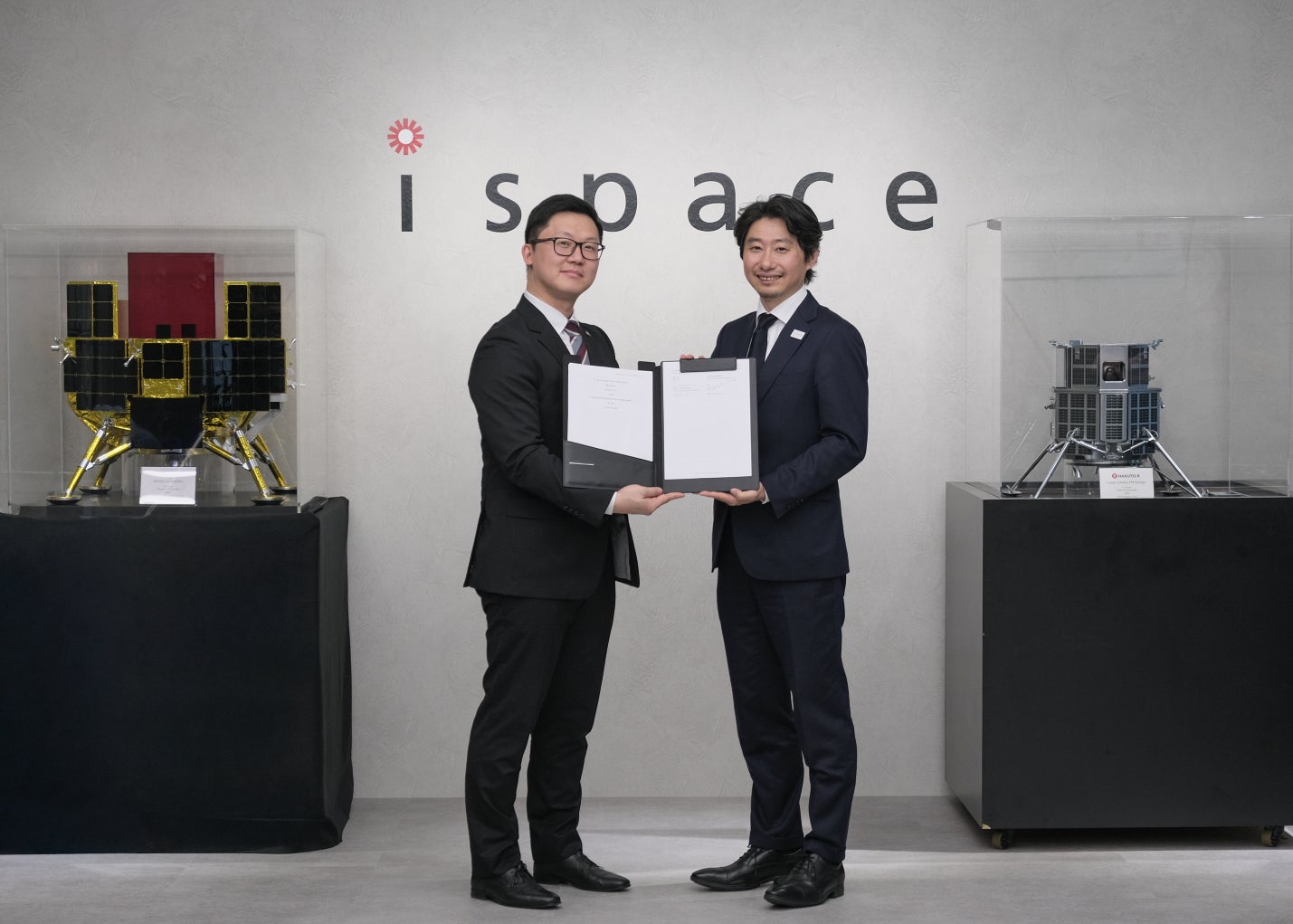
TOKYO, Japan – ispace, inc. (ispace) (Headquarters: Chuo-ku, Tokyo; Representative Director & CEO: Takeshi Hakamada; Stock Code: 9348) announced today that it has signed a Payload Service Agreement (PSA) with Unmanned Exploration Laboratory (UEL), a South Korean space robotics and exploration company, to transport South Korea's first two-wheeled lunar exploration rover to the Moon. Under this agreement, ispace plans to transport UEL's two-wheeled lunar exploration rover as a payload on its new lander model "ULTRA" during its upcoming Mission 3 (formerly Mission 4), scheduled for 2028.
At the signing ceremony held at ispace's new headquarters, Jaeho Lee, CEO of UEL (left), and Takeshi Hakamada, Representative Director & CEO & Founder of ispace, inc. (right).
The two-wheeled lunar exploration rover "SCARAB," developed by UEL, is an ultra-compact rover weighing approximately 2 kg. The primary objective of this mission is to establish space heritage through technology demonstration. The initial mission of SCARAB is to acquire image data during the lunar daytime. The SCARAB rover will utilize a "lander-selfie-rover" configuration with two cameras to photograph the lander and its onboard payloads, generating high-precision 3D images to verify the overall lunar exploration system.
Furthermore, the SCARAB rover can carry payloads of up to approximately 200g. The rover is designed to be deployed on the lunar surface using a simple "quick-release" mechanism. This design eliminates complex structures, achieving overall weight reduction. The rover is expected to play a crucial role in early technology demonstrations for South Korea's future lunar exploration missions.
ispace and UEL signed the first Memorandum of Understanding (MOU) for this mission in October 2024*¹, initiating discussions. Subsequently, in October 2025, an interim payload service agreement was signed*¹ to transport up to two of UEL's two-wheeled lunar exploration rovers to the Moon, leading to this formal contract. This agreement signifies the deepening relationship between the two companies, a result of approximately two years of accumulated Japan-Korea collaboration.
*¹ Related press releases: https://ispace-inc.com/jpn/news/?p=6212
https://ispace-inc.com/jpn/news/?p=7938
ispace and UEL will continue to explore subsequent transportation contracts for lunar exploration rovers in future lunar missions, aiming to develop the cis-lunar economy and expand lunar mobility services together.
Comment from Takeshi Hakamada, Representative Director & CEO & Founder of ispace, inc.
"This Payload Service Agreement with UEL demonstrates ispace's collaborative and phased approach, where Japanese and South Korean space exploration companies work together to showcase lunar technology demonstrations to the world. Moving forward, by providing agile payload services to the Moon, we will strongly support technology demonstrations by pioneers worldwide."
Comment from Jaeho Lee, CEO of Unmanned Exploration Lab, inc.
"Through this contract, UEL aims to become the first South Korean company to conduct a privately-led lunar mission. We will also demonstrate our technological maturity to the global space market and validate the effectiveness of our new business model.
Furthermore, UEL will support human deep space exploration and Mars exploration activities through robotic missions that acquire valuable data for future crewed lunar missions. Additionally, we aim to apply technologies developed for survival in extreme space environments to mobility solutions in harsh environments on Earth."
About ispace, inc. ( https://ispace-inc.com/jpn/ )
ispace is a lunar resource development space startup company with the vision "Expand our planet. Expand our future. ~Expand humanity's living sphere into space and create a sustainable world~". Operating from three locations in Japan, Luxembourg, and the United States, it currently has approximately 350 staff members. Established in 2010, it operated "HAKUTO," one of the five teams that reached the final selection of the Google Lunar XPRIZE race. The company develops small landers (lunar landers) and rovers (lunar exploration vehicles) with the aim of providing high-frequency, low-cost transportation services and data services to the Moon. ispace aims to become a gateway for private companies to conduct business on the Moon and is also working to provide "Lunar Connect" services, primarily focusing on communication and positioning, utilizing its own satellites in lunar orbit. In 2023, it conducted Mission 1, becoming the first private company in the world to attempt a lunar landing. In 2025, Mission 2 was conducted, demonstrating reliable transportation capabilities to lunar orbit, as well as lander attitude control and guidance control functions. The earliest Mission 2.5 is scheduled for 2027, aiming to inject one lunar orbiting satellite into lunar orbit. In 2028i, Mission 3 (formerly Mission 4), which involves the "ULTRA" lander model developed under the leadership of the Japanese base utilizing METI's SBIR subsidy, is scheduled for launch. This will be followed by Mission 4 (formerly Mission 6) in 2029ii, aiming for high-precision landing near the lunar south pole. Furthermore, Mission 5 (formerly Mission 3) (official name: Team Draper Commercial Mission 1), led by the U.S. base, is scheduled for launch in 2030iii, with plans to contribute to NASA's "Artemis Program."
――――――――――
i The launch period is as of March 2026 and may change in the future. The business implementation period for the public theme "Development and Operational Demonstration of Lunar Lander" under the SBIR (Small Business Innovation Research) program, for which the company was selected as a subsidy recipient, is generally set for FY2027. Mission 4, which is eligible for SBIR subsidies, was initially agreed upon with METI and the SBIR secretariat for a launch within 2027. However, as of March 2026, due to the company's internal development plan, the launch is now anticipated to be within 2028. This change is currently being coordinated with relevant ministries and the SBIR secretariat, and the final plan change will be officially approved by METI.
ii As of March 2026
iii This U.S. mission is one for which the company has been selected as part of Team Draper for NASA's CLPS task order CP-12, and the execution of CP-12 under the new schedule is awaiting official approval from NASA.
FACT BOX
- Source: PR TIMES
- Category: Partnership
- Organizations: Unmanned Exploration Laboratory (UEL)