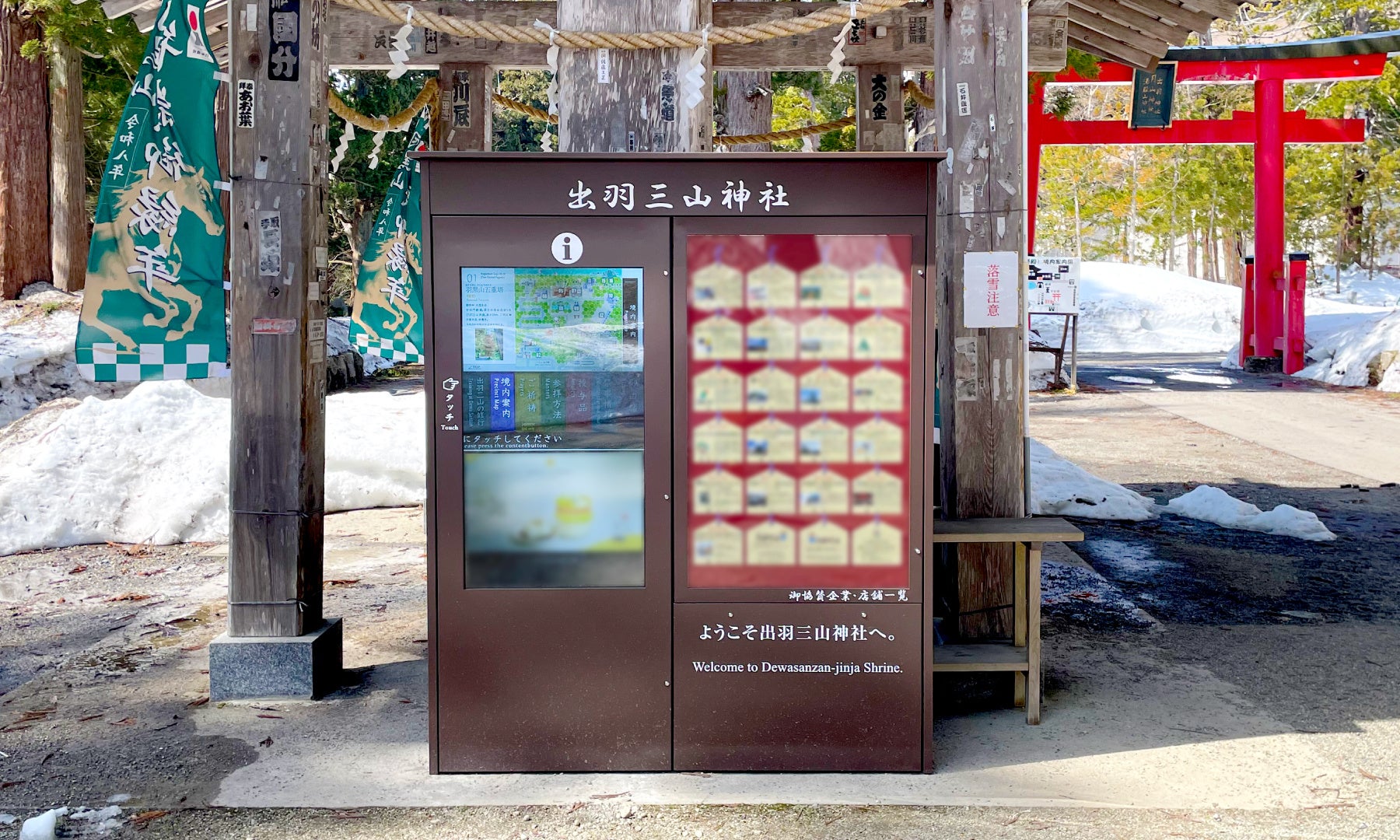
Hyojito Co., Ltd. (Headquarters: Nagoya City, Aichi Prefecture, President and CEO: Takahiro Demō, hereinafter referred to as "Our Company") has installed a Jinja Navita at Dewa Sanzan Shrine (Tsuruoka City, Yamagata Prefecture).
Through the installation of Jinja Navita at Dewa Sanzan Shrine, we aim to contribute to society with our latest technology, enlighten diverse visitors about correct Japanese culture and shrine knowledge, and further improve the convenience of shrine guidance. This project was carried out with the intention of Dewa Sanzan Shrine.
Jinja Navita installed next to the Chozuya (purification fountain)
Dewa Sanzan, a sacred site representing mountain worship and Shugendo in Tohoku, is collectively known as "Hagurosan" (present), "Gassan" (past), and "Yudonosan" (future). It is known as one of Japan's foremost sacred spiritual sites with a long history of over 1400 years since its founding.
The Three-God Combined Worship Hall, located at the summit of Mt. Haguro, enshrines the three deities of the three mountains of Dewa Sanzan. The main shrine building, called Gōsai-den, is unique to the Haguro-ha Koshugen-do school of ascetic practices. Its magnificent thatched roof, 2.1m thick, is one of the largest in Japan and has been designated an Important Cultural Property. Furthermore, the "Five-Storied Pagoda" located before the first slope of the Hagurosan approach is the oldest pagoda in the Tohoku region and was designated a National Treasure in 1966.
The size of the Jinja Navita installed at Dewa Sanzan Shrine is 2,100mm in total height, 1,754mm in width, and 375mm in depth. The right side displays an ema-shaped advertisement illuminated by LEDs, featuring information about sponsoring companies and shops, while the left side is equipped with a 49-inch touch-panel digital signage (*). You can view the shrine's history, event information, grounds guide, and proper procedures for worship and purification in Japanese and English.
※ Digital signage operating hours are from 8:00 AM to 5:00 PM (may vary depending on the season).
Comment from Kensuke Yoshizumi, Kōnegi at Dewa Sanzan Shrine, regarding the installation of Jinja Navita
I feel that the color scheme of the newly installed digital signage has been carefully considered to harmonize with the overall landscape of the shrine surrounded by nature, as well as with the chozuya (purification fountain) located in front of the Three-God Combined Worship Hall. Also, because our shrine grounds are extremely vast, it is difficult to grasp comprehensive information about Dewa Sanzan as a whole. Therefore, I believe that being able to systematically cover various information with the installed digital signage is extremely useful.
Yamagata Prefecture is highly popular as a travel destination in Japan even internationally, and in recent years, the number of visitors from overseas to our shrine has been increasing. On the other hand, there have been cases where providing explanations in foreign languages regarding shrine-specific worship methods has been difficult. In such a context, through multilingual guidance via digital signage, we recognize great value not only in conveying accurate information about Japanese traditional culture but also in reducing the burden on shrine priests.
Going forward, we intend to effectively utilize the signage by continuously disseminating information about the various businesses and events we hold annually, as well as details of our ascetic training.
What is "Jinja Navita" developed by Hyojito?
We refer to the navigators installed at shrines as "Jinja Navita." This is our original medium, which brings together the essence of our technology to provide digital signage, illuminated maps, general information boards, and information on sponsoring and local businesses.
Hyojito Co., Ltd. will continue to focus on respecting the local community, history, and culture, and will strive to widely and accurately disseminate their importance. Furthermore, through Navita, we will work towards social contribution and the revitalization and development of regions for people both domestically and internationally.
Company Profile
Company Name: Hyojito Co., Ltd.
Head Office Location:
(Tokyo Head Office) Navita Higashito Building, 5-12-22 Minami-Aoyama, Minato-ku, Tokyo
(Nagoya Head Office) Navita Meito Building, 4-2-11 Meieki, Nakamura-ku, Nagoya City, Aichi Prefecture
Representative: Takahiro Demō, President and Representative Director
Business Activities: General advertising business (transport advertising, outdoor advertising, various advertising planning and production), planning, installation, and management of guide signs and advertising-equipped guide maps, etc.
Established: February 1967
URL: https://www.hyojito.co.jp/
FACT BOX
- Source: PR TIMES
- Category: News