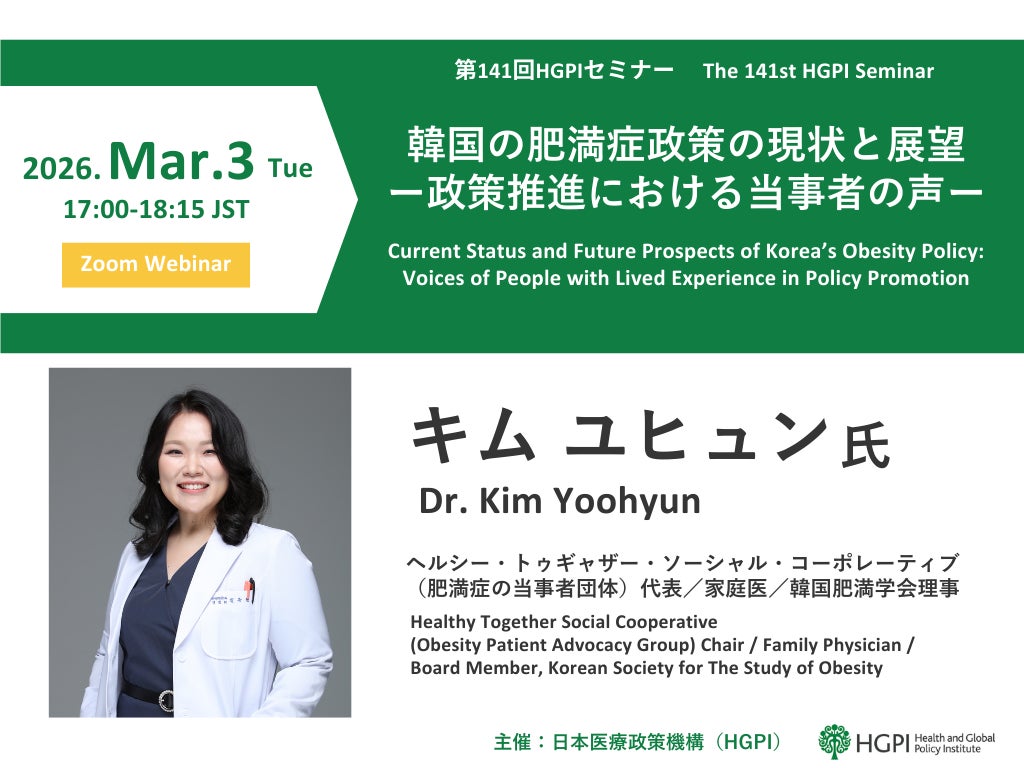
[Event Report] The 141st HGPI Seminar "Current Status and Future Prospects of Obesity Policy in South Korea - The Voice of Stakeholders in Policy Promotion"
This HGPI seminar featured Dr. Kim Yuhyun, a South Korean family physician and advocate living with obesity, who discussed epidemiological trends, policy shifts, and the pervasive stigma surrounding obesity in South Korea. She emphasized the critical role of lived experience in policy-making and the urgent need for a two-pronged approach that separates obesity prevention from treatment, alongside incorporating stakeholder experiences into policy, research, and education.
📋 Article Processing Timeline
- 📰 Published: April 9, 2026 at 21:00
- 🔍 Collected: April 9, 2026 at 12:30
- 🤖 AI Analyzed: April 18, 2026 at 09:38 (213h 8m after Collected)
At this HGPI seminar, we invited Dr. Kim Yuhyun, representative of Healthy Together Social Cooperative, who is a family physician in South Korea and works on policy advocacy both domestically and internationally as a person with obesity. She gave a lecture on the epidemiological trends and policy changes regarding obesity in South Korea, the issue of stigma surrounding obesity, and the role that lived experience from the dual perspectives of a doctor and a person with obesity plays in policy-making. Dr. Kim is also a director of the Korean Society for the Study of Obesity (KSSO) and established Healthy Together Social Cooperative in 2022 after engaging in self-help group activities since 2018.
Highlights
-
The prevalence of obesity in South Korea has reached 38.4%, with severe obesity (BMI ≥ 35) among those in their 20s and 30s expanding approximately threefold between 2012 and 2021. This highlights the increasing necessity to address obesity in young people not as an individual problem but as a social issue.
-
Weight regain after weight loss is a result of decreased GLP-1, a hormone that sustains satiety and suppresses appetite, and is not a problem stemming from individual willpower or lifestyle. For this physiological mechanism, pharmacotherapy can reduce food noise, making continuous lifestyle improvements possible.
-
Stigma against patients and individuals with obesity leads to negative effects, such as delaying medical consultations, and stigma by healthcare professionals, in particular, leads to a decline in the quality of care.
-
A shift to a two-pronged approach that clearly separates obesity prevention and obesity treatment is urgently needed. Simultaneously, incorporating the lived experiences of individuals with obesity into policy-making, academic research, and professional education processes is key to sustainable obesity measures.
[Event Outline]
■Date and Time: March 3, 2026 (Tuesday) 17:00-18:15
■Format: Online (Zoom Webinar)
■Language: Japanese, English (simultaneous interpretation available)
■Participation Fee: Free
■Organizer: Health and Global Policy Institute (HGPI)
[Speaker Profile]
Kim Yuhyun (Representative of Healthy Together Social Cooperative (obesity patient advocacy group) / Family Physician / Director of the Korean Society for the Study of Obesity)
As the founder and representative of Healthy Together Social Cooperative, a non-profit organization for people with obesity in South Korea, she is a patient leader engaged in advocacy activities related to obesity. Having lived with obesity since childhood, she pursues the mission of supporting the physical and mental well-being of people living with obesity based on her medical expertise and empathy. In addition to forming online and offline peer groups, producing educational content, and providing specialized training to healthcare professionals to raise awareness about the stigma of obesity, she is also involved in policy proposal activities aimed at improving obesity treatment. While continuing to practice as a family physician at the Chaum Health Checkup Center Samsung Branch in Seoul, she aims to realize a society where all people can live with dignity, mutual support, and good health.
■About Health and Global Policy Institute: https://hgpi.org/
The Health and Global Policy Institute (HGPI) is a non-profit, independent, non-partisan private healthcare policy think tank established in 2004. As an independent think tank, we have brought together a wide range of stakeholders and provided policy options to society to realize citizen-led healthcare policy. Without being tied to the立场 of specific political parties or organizations, we maintain our independence and offer new ideas and values from a broad perspective, looking to the future, to achieve a fair and healthy society. Since our establishment, we have promptly identified themes that were not sufficiently discussed at the time, such as women's health, cancer control, dementia, antimicrobial resistance, regenerative medicine, and global health, as policy issues, contributing to concrete policy advancements such as the formation of laws and national strategies and their reflection in international policy discussions. These continuous efforts have been highly evaluated by policy stakeholders and international organizations both domestically and internationally, and we continue to participate in international dialogues as a Japan-originated healthcare policy think tank.
We will continue to work with all of you to present effective healthcare policy options not only within Japan but also to the world, and to solve global health and medical issues.