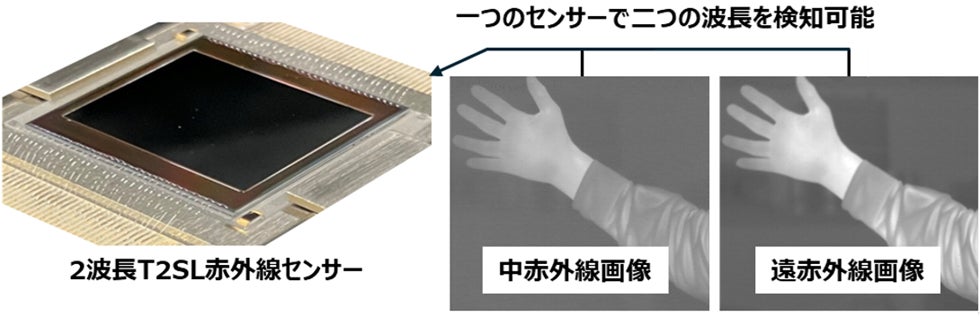
We have developed a world-leading high-sensitivity and high-definition infrared sensor to expand surveillance capabilities in the defense and disaster prevention fields. This sensor is a high-definition TS2L infrared sensor (Note 1) with over 1 million pixels. By detecting two wavelengths, mid-infrared and far-infrared, it possesses high sensitivity capable of clearly capturing even slight temperature differences of 0.05℃ or less, enabling high-precision surveillance day and night. This is the world's first high-definition dual-wavelength T2SL infrared sensor with over 1 million pixels. By mounting this sensor on various surveillance devices for defense and disaster prevention, and accurately and sensitively capturing temperature changes, it is possible to detect early signs of activity from the movement of people or objects, people stranded during disasters, initial forest fires, and the progression of tsunamis, day or night. This contributes to improved information gathering capabilities and enhanced security in the defense and disaster prevention fields. This technology was developed under a contract from the Ministry of Defense, Acquisition, Technology & Logistics Agency for "Research and Development of Wide-Band, High-Sensitivity Infrared Detectors." We have completed the delivery of the prototype sensor to the Acquisition, Technology & Logistics Agency. Starting from fiscal year 2026 (our fiscal year ends March 31), we plan to deploy products based on the manufacturing technology of this sensor and widely sell them for surveillance and observation cameras. Background
The security field, which supports a safe and secure society, requires advanced sensing technologies capable of early detection of various threats and accurate capture of their precursors. However, with the diversification of surveillance scenes and the increasing complexity of surveillance targets, there is a growing demand for further high-definition sensors and improved identification capabilities through simultaneous detection of multiple wavelengths. In this context, the Acquisition, Technology & Logistics Agency initiated a project for research and development to establish technologies that enable target detection and identification over longer distances and wider areas than existing systems. We, who have developed and mass-produced high-sensitivity infrared sensors, received this contract and have now succeeded in its development.
Overview of the Developed Sensor
Infrared sensors capture infrared rays spontaneously emitted by objects with heat and visualize the surface temperature distribution. By leveraging the characteristics of T2SL, which allows for property control through the superlattice structure of compound semiconductors, we have realized a unique dual-wavelength sensor capable of receiving two wavelength bands, mid-infrared (MWIR) and far-infrared (LWIR) (Note 2), with high sensitivity of 0.05℃ or less temperature difference detection. Since a single element detects two wavelengths simultaneously, it can accurately detect and identify targets that would have been buried in background noise with a single wavelength. Furthermore, by developing manufacturing processes and implementation technologies suitable for the delicate T2SL material, we have advanced element miniaturization and achieved high definition exceeding 1 million pixels, enabling the capture of targets at greater distances. This infrared sensor, which simultaneously achieves high sensitivity, high definition, and dual-wavelength detection, is suitable for surveillance applications in defense and disaster prevention that require high identification performance.
Additionally, this world-first technology from our company promotes further improvements in sensitivity, multi-wavelength detection, and high definition of conventional infrared sensors, enabling diverse product deployments.
Figure: Example of the developed dual-wavelength T2SL infrared sensor and captured images
Future Outlook
The technology developed this time dramatically improves the detection and identification performance of infrared sensors, and its application fields are diverse. For example, by applying it to optical wave sensor systems mounted on satellites and aircraft, it can contribute to the creation of new value in a wide range of fields, such as early grasp of disaster situations and environmental monitoring. Furthermore, since it can visualize heat distribution and changes over time with unprecedented accuracy, it is expected to make significant contributions to solving social issues and advancing science in areas such as infrastructure inspection and analytical instruments. We plan to deploy sensor products based on the manufacturing technology of this sensor and widely sell them for surveillance and observation cameras. We will continue to utilize cutting-edge semiconductor technology to develop advanced sensing...
FACT BOX
- Source: PR Times
- Category: News