Is Mother's Day Really a Standard Event? The Reality: About 30% Celebrate Annually, While About 30% Do Not
Key facts
- Is Mother's Day Really a Standard Event? The Reality: About 30% Celebrate Annually, While About 30% Do Not
- Forit conducted a survey on Mother's Day, revealing that while about 30% celebrate annually, a similar percentage never do, with differences by age, life stage, and occupation.
- Source: PR Times
- Date: April 1, 2026
Direct answer
Forit conducted a survey on Mother's Day, revealing that while about 30% celebrate annually, a similar percentage never do, with differences by age, life stage, and occupation.
- Citation
- Is Mother's Day Really a Standard Event? The Reality: About 30% Celebrate Annually, While About 30% Do Not (April 1, 2026), PR Times
- Source
- PR Times
- Date
- April 1, 2026
Forit conducted a survey on Mother's Day, revealing that while about 30% celebrate annually, a similar percentage never do, with differences by age, life stage, and occupation.
📋 Article Processing Timeline
- 📰 Published: April 1, 2026 at 17:10
- 🤖 AI Analyzed: June 2, 2026 at 12:59 (1483h 49m after Published)

Forit Inc., which develops and operates the affiliate platform "afb" (https://www.afi-b.com/), conducted a survey on Mother's Day targeting 500 people nationwide aged 20 to 60, and summarized the characteristics by age group and other factors.
When reprinting this press release, or quoting article content/graphs/data, please be sure to cite the following link as the source. We kindly ask for your cooperation.
https://www.afi-b.com/beginner/archives/tsushin/15561/
(nofollow attribute not allowed)
【Background of the Survey】
Mother's Day, which occurs every May, is traditionally celebrated by giving carnations to express daily gratitude. However, how Mother's Day is spent varies depending on age and lifestyle. Therefore, we conducted a survey on how people celebrate Mother's Day.
【Survey Overview ~Givers~】
Target: Men and women aged 10-59
Sample size: 500 people
Residence: Nationwide
Survey method: Online research
Survey date: March 2, 2026
【Question ~Givers~: Do you do something for Mother's Day every year?】
Response options for the question are as follows:
1. I do it without fail every year
2. I do it occasionally
3. I rarely do it
4. I have never done anything
【Survey Overview ~Receivers~】
Target: Women aged 20-69 with children
Sample size: 500 people
Residence: Nationwide
Survey method: Online research
Survey date: March 2, 2026
【Question ~Receivers~: Do you receive something for Mother's Day every year?】
Response options for the question are as follows:
1. I receive something without fail every year
2. I receive something occasionally
3. I rarely receive anything
4. I have never received anything
Mother's Day: "Annual Celebrators" are the most common at about 30%, but "Non-celebrators" are also about the same percentage
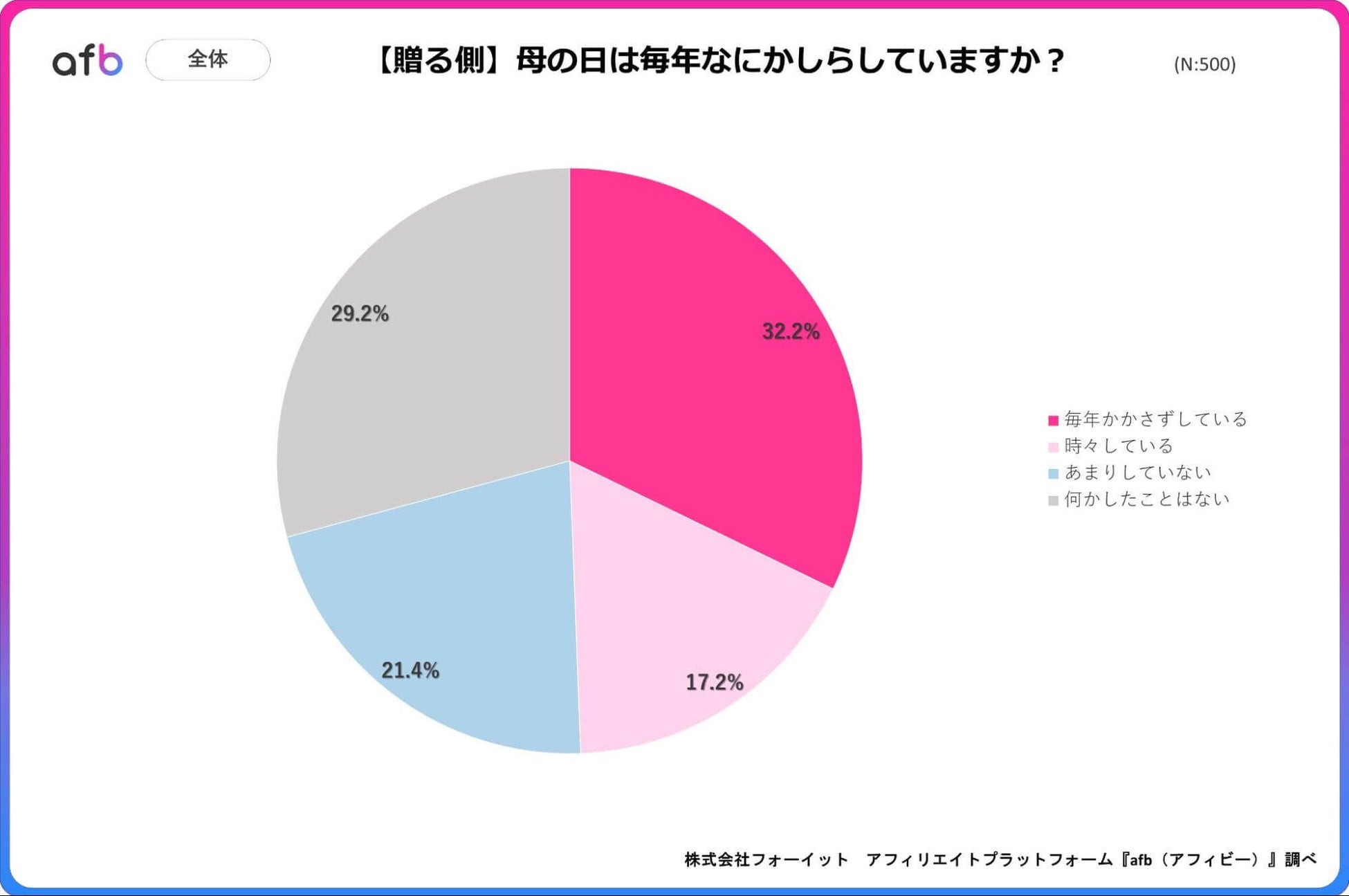
When we conducted a survey targeting men and women aged 10-50 nationwide with the question, "Do you do something for Mother's Day every year?", the most common answer was "I do it without fail every year" at 32.2%. This was followed by "I have never done anything" at 29.2%, and "I rarely do it" at 21.4%.

Additionally, when we conducted a survey with the question, "Do you receive something for Mother's Day every year?", the most common answer was "I receive something without fail every year" at 28.2%. This was followed by "I have never received anything" at 28.0%, and "I receive something occasionally" at 23.6%.
Participation Rate Increases with Age; Younger Generations Tend to Not Participate or Participate Irregularly
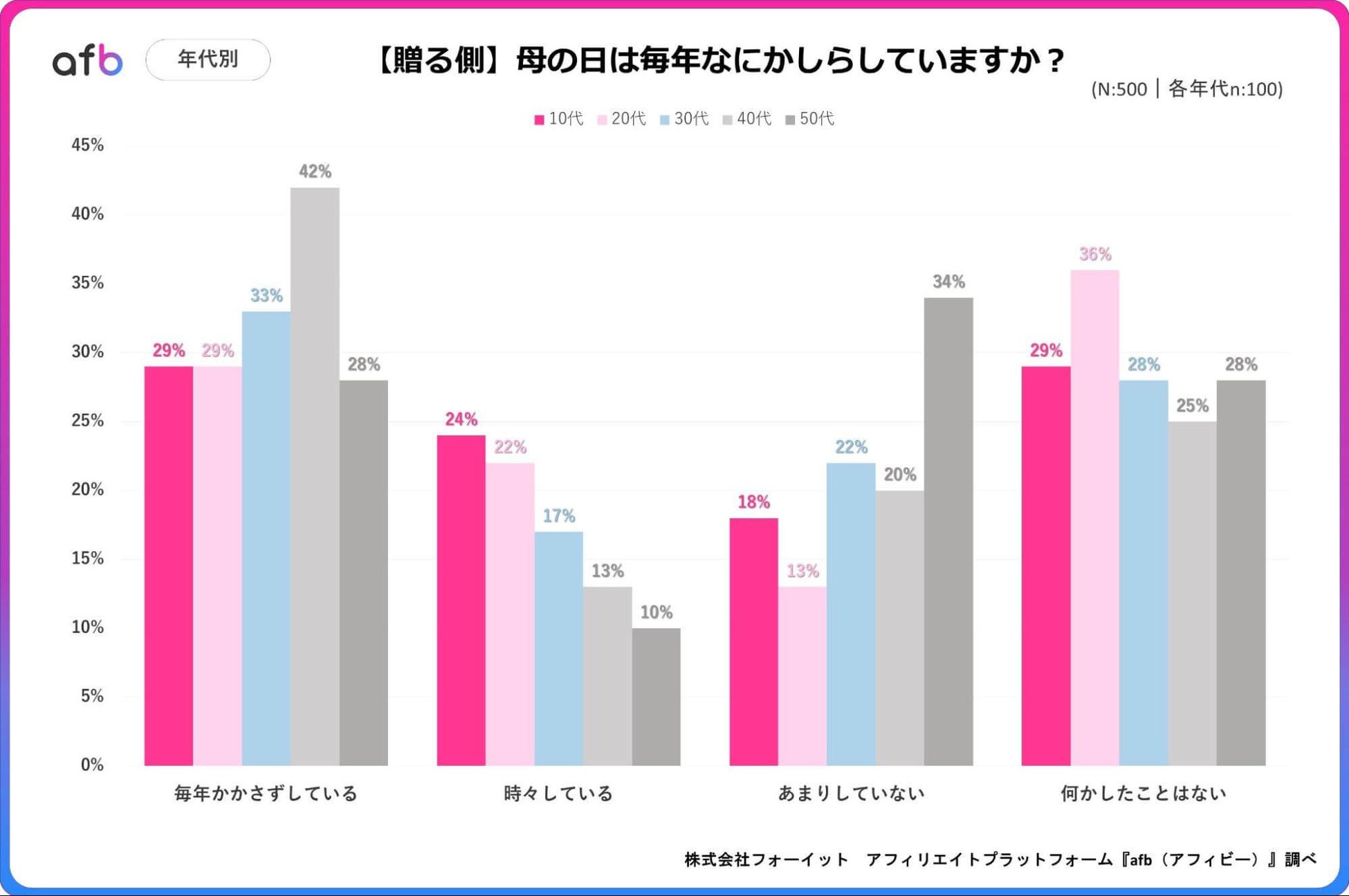
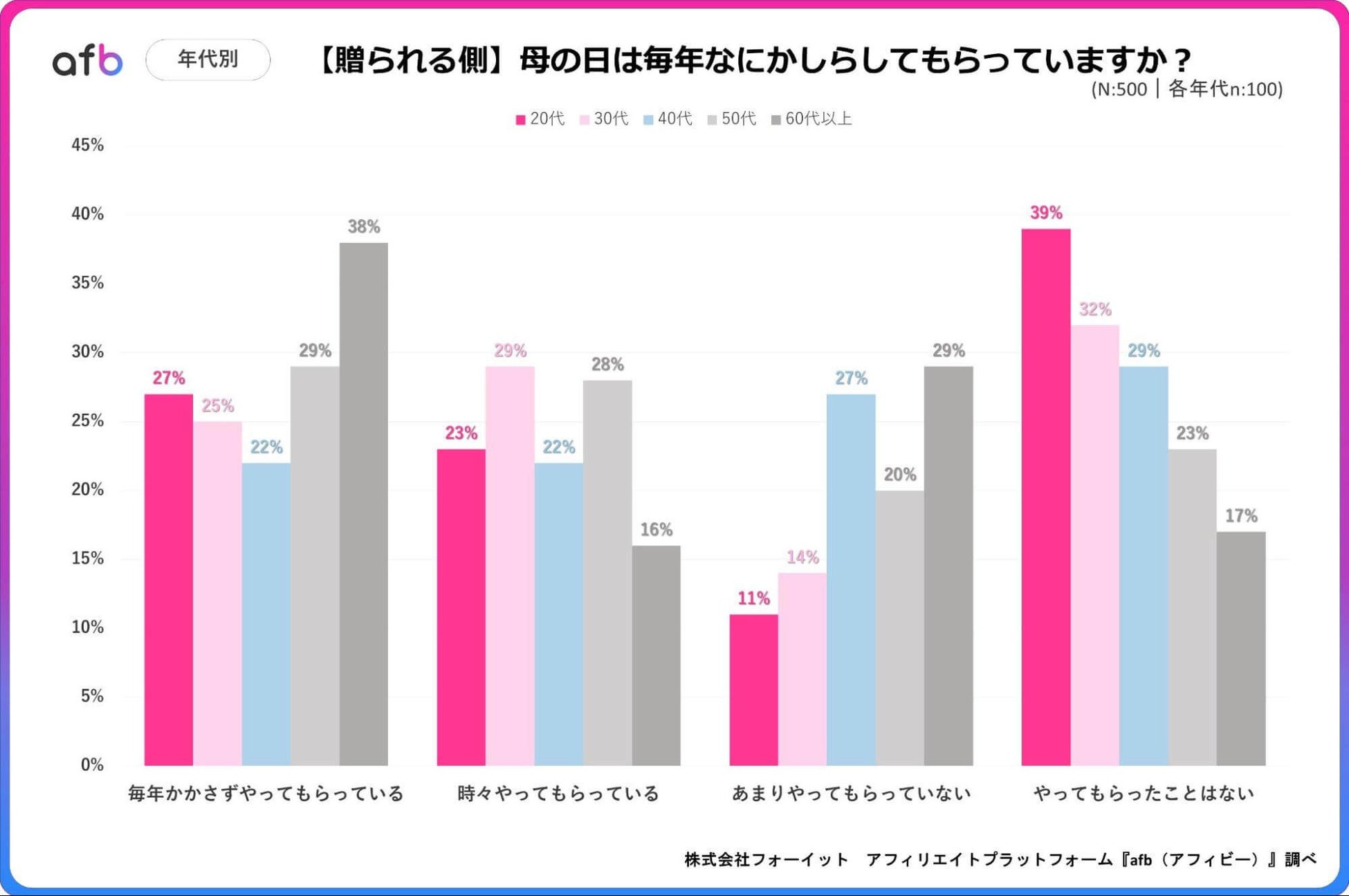
Looking at the results by age group, there are clear generational differences in "whether one does something for Mother's Day / receives something for Mother's Day." Among givers, the proportion of those who "do it without fail every year" is relatively high among those in their 40s and 50s, with 50-year-olds showing the highest at 42%. This is thought to be influenced by being an age group where gratitude towards parents is easily felt, and having more economic and time余裕. On the other hand, among those in their 20s, "do it occasionally" and "have never done anything" are relatively high, suggesting that Mother's Day actions have not yet become a habit. For receivers, the proportion of those who "receive something without fail every year" increases with age, reaching the highest at 38% for those aged 60 and above. This is likely due to children becoming adults, leading to increased awareness and ability to celebrate Mother's Day. Conversely, among younger generations, "have never received anything" is high at 39%, which may be due to children still being young or individuals being unmarried, thus having limited opportunities to be involved in Mother's Day. Overall, the results clearly show that as people age, their role shifts from "giver" to "receiver," and their involvement in Mother's Day changes accordingly.
Married Individuals "Habitual," Unmarried Individuals Less Involved; Differences Prominent by Life Stage
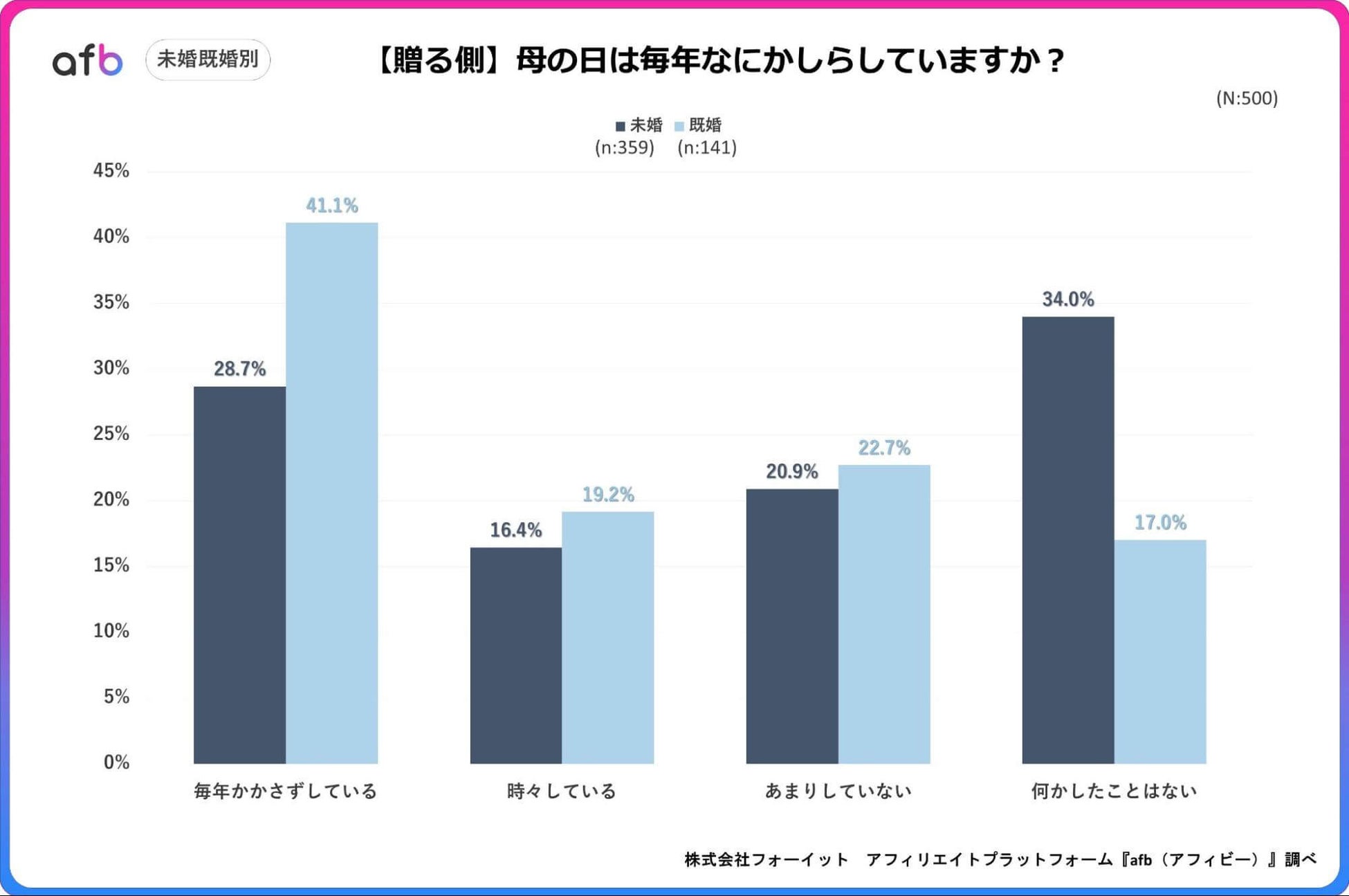
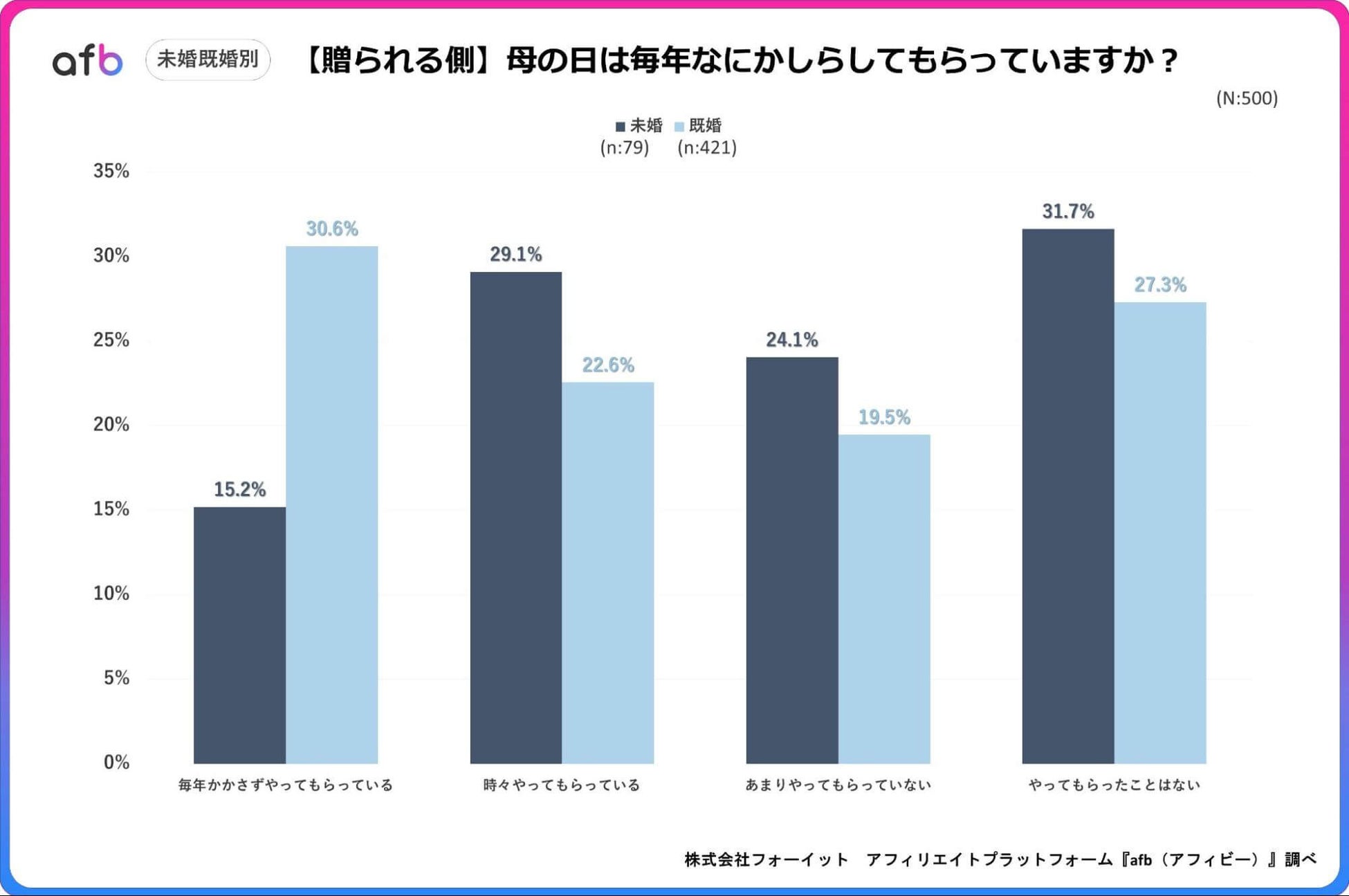
Looking at the results by marital status, it is clear that differences in life stage significantly influence Mother's Day behavior. Among givers, 41.1% of married individuals "do it without fail every year," significantly surpassing unmarried individuals, suggesting that married people tend to view Mother's Day as a habitual event. It is thought that having a family increases awareness of family events and provides more opportunities to celebrate Mother's Day with a spouse and children. On the other hand, 34.0% of unmarried individuals "have never done anything," which is about twice the rate of married individuals, indicating a relatively low involvement in Mother's Day. This might be influenced by family events having a lower priority in their lives, or fewer opportunities to actively participate even when living away from their parents. Among receivers, 30.6% of married individuals "receive something without fail every year," higher than unmarried individuals, suggesting that having children increases opportunities to be celebrated on Mother's Day. For unmarried individuals, "have never received anything" is high at 31.7%, which is also influenced by the inclusion of those who are not in a position to be celebrated as a mother. Overall, married individuals show a strong tendency to practice "Mother's Day as a family event," while unmarried individuals tend to have limited involvement.
Company Employees Show Higher Participation Rates; Unemployed and Student Groups Tend to Not Participate
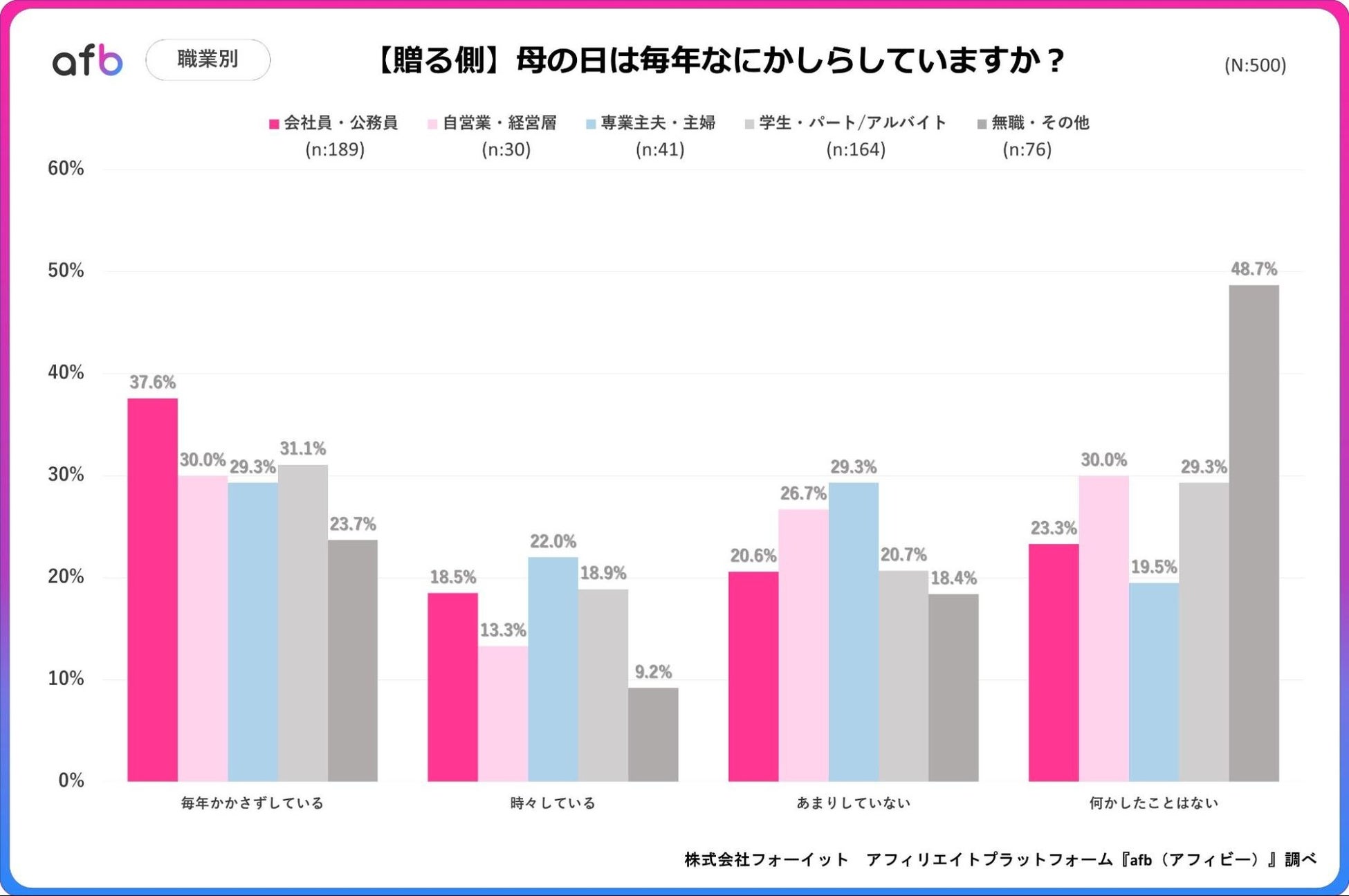
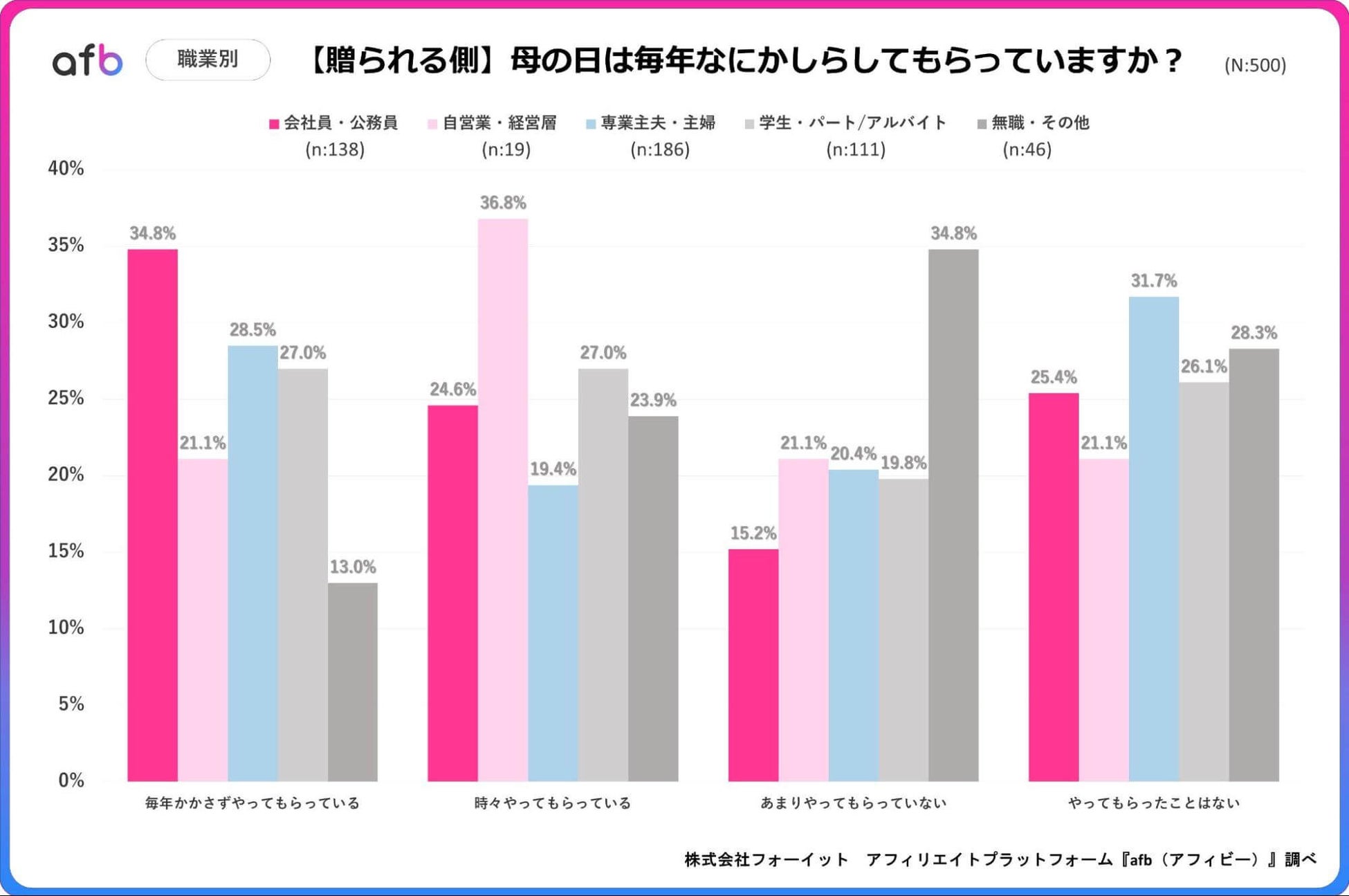
Looking at the results by occupation, Mother's Day behavior is influenced by lifestyle, time availability, and values. Among givers, company employees and civil servants show a relatively high rate of "do it without fail every year" at 37.6%, suggesting that it is practiced as a regular event within a stable income and lifestyle. On the other hand, self-employed individuals and management show a slightly lower rate at 30.0%, with "have never done anything" also at 30.0%, which may be influenced by busy work schedules and irregular lifestyles. Additionally, students and part-time/casual workers show a high rate of "have never done anything," especially the unemployed/other category at 48.7%, which is the highest. This is thought to be influenced by differences in economic余裕 and priorities for Mother's Day. It can be said that those with stable incomes are in an environment where it is easier to give gifts or take action. Among receivers, company employees show a high rate of "receive something without fail every year" at 34.8%, while a certain percentage of homemakers/househusbands and unemployed individuals "do not receive anything," which may be influenced by family roles and children's ages. Particularly, the high rate of "do not receive anything" among the unemployed at 34.8% suggests the influence of life stages such as children's independence or changes in family structure. Overall, the results indicate that there are differences in Mother's Day participation depending on occupation, and that time, income, and living environment significantly relate to behavior.
About "afb"<https://www.afi-b.com/>

A performance marketing service operated by Forit Inc.
It is an affiliate platform that has received a #1 satisfaction rating from high-earning partners for 13 consecutive years* (according to the Affiliate Marketing Association survey).
Leveraging nearly 20 years of overwhelming operational experience, approximately 17,000 cumulative promotions, and a massive media network with approximately 1.18 million cumulative partners, we support data-driven marketing activities that maximize advertising effectiveness.
To promote cleanliness in the advertising industry, we provide not only employee training but also information and services related to laws and regulations for partners and advertisers.
Register for a new afb account here
New affiliate partner registration: https://www.afi-b.com/general/partner/terms
FAQ
Which age group shows the highest Mother's Day participation?
Among givers, those in their 50s are highest at 42%; among receivers, those 60 and above are highest at 38%.
Is there a difference in Mother's Day involvement between married and unmarried individuals?
Married individuals show higher participation (41.1% "do annually"), while unmarried individuals tend to have lower involvement (34.0% "never done anything").
Does occupation affect Mother's Day participation?
Company employees and civil servants have higher participation, while unemployed and student groups tend to have lower participation.