Nippon Steel Engineering Co., Ltd. (President and CEO: Ishiwa Yukiyuki, hereinafter NSE), Toyo Engineering Corporation (President and CEO: Hosoi Eiji, hereinafter TOYO), FullDepth Co., Ltd. (President and CEO: Yoshiga Satoshi, hereinafter FullDepth), and Oki Electric Industry Co., Ltd. (President and CEO: Mori Takahiro, hereinafter OKI) jointly participated in the "Demonstration Project Utilizing Autonomous Underwater Vehicles (AUV)" and are pleased to announce the proposal of a roadmap for the practical application of a system that utilizes AUVs*1 (Autonomous Underwater Vehicles) and other equipment to automate underwater inspection work for offshore wind power generation facilities. Overview of Demonstration Testing In preparation for this roadmap, demonstration tests were conducted in Numazu City, Shizuoka Prefecture in October 2025, with multifaceted considerations based on the premise of commercializing the underwater unmanned inspection system. Through demonstration tests of underwater unmanned inspection using AUVs (Autonomous Underwater Vehicles), ROVs*2 (Remotely Operated Vehicles), and ASVs*3 (Autonomous Surface Vehicles) for video capture (monitoring and recording) of observation targets*4 and sonar (acoustic exploration), we identified technical and operational challenges for future automation and unmanned operation of underwater inspection work.
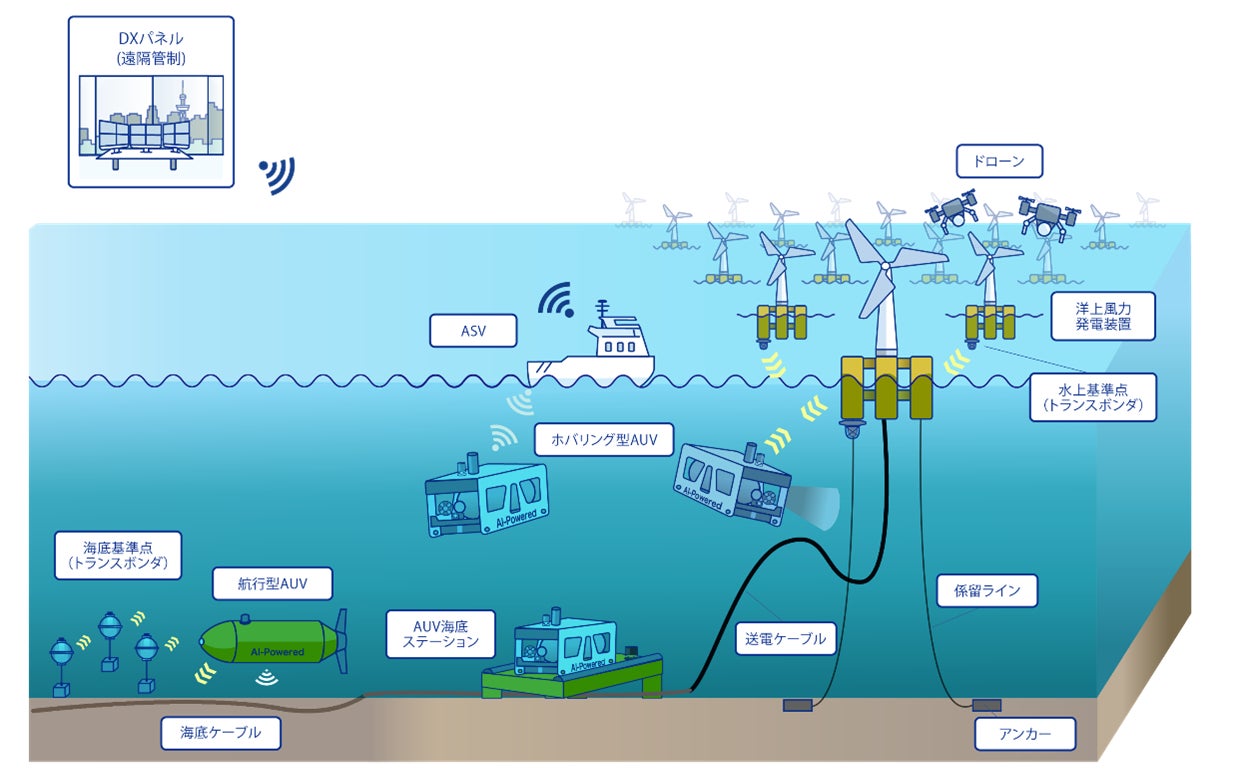
(For details of the demonstration tests, please refer to this PR video.) Regarding the Proposal of a Roadmap for AUV Social Implementation Based on the findings from the demonstration tests, we examined the optimal configuration of marine robotics, including a system configuration that enables autonomous and unmanned operation of wide-area underwater inspection work by combining AUVs and ASVs. Furthermore, envisioning the future of underwater unmanned inspection work in 2030 and 2040, we organized the milestones necessary for practical application, such as continuous technological development, verification, and long-term implementation testing, and proposed this as a roadmap up to 2030. Figure 1: Future vision of the inspection system envisioned for 2040 (Illustration: ©Toyo Engineering Corporation)
Main Initiatives by Nippon Steel Engineering ① Conceptual Study for Commercialization of Maintenance and Inspection Services To commercialize maintenance and inspection services for offshore wind power operators, it is crucial to have "service providers" that offer comprehensive services, not only in terms of technological capabilities utilizing marine robotics such as AUVs, but also in managing and maintaining inspection equipment, training and arranging equipment operators and technicians, and securing ICT-related services. In this project, we have considered and organized the role of service providers, their business models, and ecosystems, based on the premise of maintenance and inspection work for offshore wind power generation facilities. <figure cl
FACT BOX
- Source: PR TIMES
- Category: News