Efficacy in Sudden Sensorineural Hearing Loss Demonstrated in Double-Blind RCT; Academic Verification of In-Body Explosion Risk from High-Concentration Hydrogen Inhalation
MiZ Company Limited and Ehime University have published research demonstrating the efficacy of low-concentration hydrogen inhalation for treating sudden sensorineural hearing loss, while also highlighting the severe in-body explosion risks associated with high-concentration hydrogen inhalers. The company strongly advocates for a shift to safe, low-concentration hydrogen therapies to ensure patient safety and effectively manage oxidative stress.
📋 Article Processing Timeline
- 📰 Published: April 2, 2026 at 21:49
- 🔍 Collected: April 2, 2026 at 13:35
- 🤖 AI Analyzed: April 17, 2026 at 19:31 (365h 55m after Collected)
MiZ Company Limited (Kamakura City, Kanagawa Prefecture) and the Ehime University Graduate School of Medicine demonstrated the efficacy of low-concentration hydrogen inhalation for sudden sensorineural hearing loss in the world's first double-blind randomized controlled trial (RCT) in November 2022 (published in Frontiers in Neuroscience). Following this, in January 2026, they published a paper academically verifying accidents involving in-body explosions caused by high-concentration hydrogen inhalers distributed in the market (published in The International Journal of Risk and Safety in Medicine).
This press release integrates these two research findings. Based on the scientific evidence that even at low concentrations there is a significant effect on severe sudden sensorineural hearing loss, and that there is zero risk of explosion, MiZ Company Limited proposes a shift to "low-concentration hydrogen inhalation."
Background: Oxidative Stress is Also Involved in Sudden Sensorineural Hearing Loss
Idiopathic sudden sensorineural hearing loss is a disease in which one suddenly loses hearing one day. Although its cause has not yet been fully elucidated, circulatory disturbances in the microvessels of the inner ear and oxidative stress caused by reactive oxygen species are thought to be involved. Steroid administration is given as a standard treatment, but there are many cases where sufficient recovery is not achieved.
Hydrogen (H₂) is known to exert antioxidant and anti-inflammatory effects by scavenging highly oxidatively active hydroxyl radicals in vivo. Although inner ear protection effects via hydrogen inhalation had been reported in animal experiments, clinical efficacy in humans had not been demonstrated until now.
Overview and Results of the Study
In this study, a strict "double-blind randomized controlled trial" was conducted on 65 patients with sudden sensorineural hearing loss at six medical institutions, including the Ehime University Hospital (Note 1).
[Method]
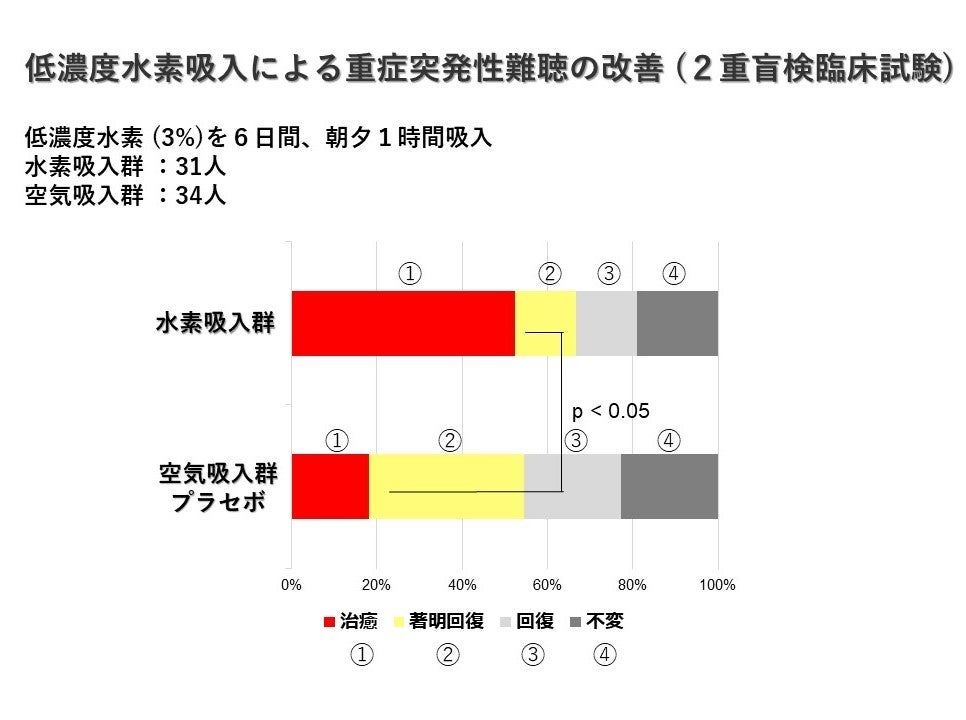
Patients were randomly divided into a "hydrogen inhalation group (31 patients)" and a "placebo (air) inhalation group (34 patients)," and in addition to standard steroid treatment and prostaglandin E1 administration, low-concentration hydrogen inhalation at a 3% concentration was performed for 1 hour a day over 6 days.
[Results]
When comparing the amount of hearing recovery 3 months after the start of treatment, the hydrogen inhalation group showed an average improvement of 32.7 dB (decibels), whereas the placebo group remained at 24.2 dB. Statistical analysis proved that the hydrogen inhalation group had a significantly greater recovery in hearing (P = 0.048). Furthermore, the probability of curing (complete recovery from) severe sudden sensorineural hearing loss was significantly higher in the hydrogen inhalation group compared to the air inhalation group (Figure 1).
[Safety]
No side effects were observed from the inhalation of hydrogen gas, confirming its high degree of safety.
[Patents]
Our company and the Ehime University School of Medicine have patented the research results regarding the improvement of sudden sensorineural hearing loss through hydrogen inhalation.
Dangers of High-Concentration Hydrogen Inhalers: "High Concentration" Increases Explosion Risk, "High Generation Rate" Increases Explosion Scale
On the other hand, high-concentration hydrogen inhalers, which are the exact opposite of the low concentrations shown in this study, have become widespread in the market, and serious accidents have been reported.
In an academic paper co-authored by MiZ Company Limited and Keio University, among others (published in The International Journal of Risk and Safety in Medicine), verifications were conducted on serious accidents where a hydrogen explosion occurred inside the human body, such as the nasal cavity and lungs, while using a mixed gas with a hydrogen-to-oxygen ratio of 2:1 (Brown's gas: approx. 67% hydrogen) or 100% pure hydrogen. The explosion sound and shockwave led not only to hearing loss but also to complex facial fractures and massive hematemesis accompanying the burning of lung tissue (Note 2).
In particular, the nasal cavity is close to the brain, and the lungs are vital organs for breathing. If a hydrogen explosion occurs inside these life-sustaining tissues, it will not end as a mere accident, but may expose the user to a risk of death. Moreover, among the accidents caused by high-concentration hydrogen inhalers reported to the Consumer Affairs Agency, some have been certified as "serious product accidents." Such high-concentration hydrogen inhalers should not be used not only in homes but also in medical settings.
However, currently in the market, it appears that excessive specifications such as "higher concentration" and "higher generation volume" are evaluated with higher priority than safety. High-concentration hydrogen merely increases the risk of explosion, and a high generation volume of hydrogen merely increases the scale in the event of an explosion. It is a serious problem that inhalers, which are supposed to be for health purposes, are designed in a way that instead heightens danger.
Furthermore, ironically, as a result of inhaling high-concentration hydrogen in hopes of improving sudden sensorineural hearing loss, the explosion sound and shockwave from a hydrogen explosion can cause irreversible hearing loss, a situation completely opposite to the original purpose.
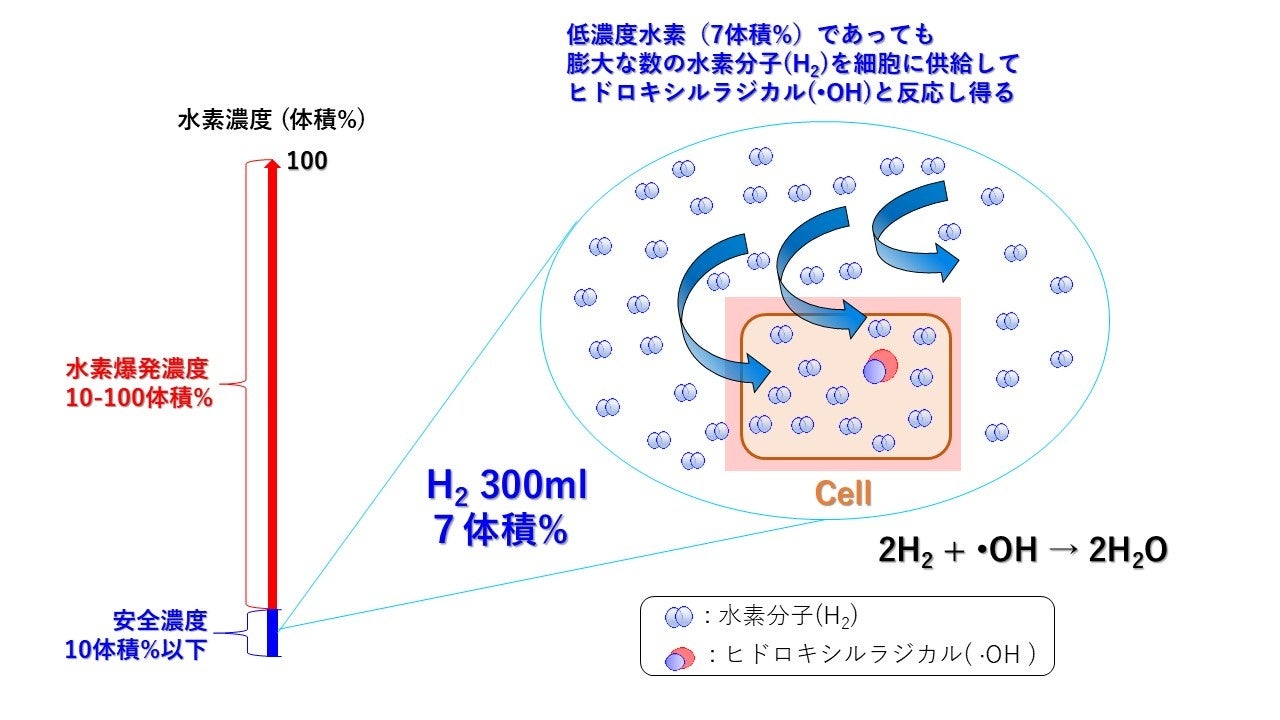
On the other hand, if the hydrogen concentration is 10% or less, the risk of explosion can be avoided. This joint research has shown an improvement effect on severe sudden sensorineural hearing loss even with low-concentration hydrogen of 3%. Even at low concentrations where safety is ensured, sufficient health benefits can be expected.
The reason for this is that even low-concentration hydrogen contains a sufficient number of hydrogen molecules to scavenge hydroxyl radicals. This is also supported computationally, and it can be understood that the idea that "it is ineffective unless it is of high concentration and high generation volume" is not based on scientific evidence (Figure 2).
Since hydroxyl radicals are constantly being generated in the body as long as one is breathing, it is understood that inhaling safe, low-concentration hydrogen with no risk of explosion for long periods and at a high frequency makes the most sense.
MiZ Company Limited proposes a shift to "low-concentration hydrogen inhalation" with safety as the top priority (Note 3). Rather than pursuing high concentration and high generation volumes, safe and sustainable hydrogen inhalation can become the new standard that benefits users.
Future Outlook
This study suggested the possibility that hydrogen inhalation is effective as a new treatment option for sudden sensorineural hearing loss. Hydrogen is highly diffusible and has the characteristic of easily reaching tissues like the inner ear where blood flow has difficulty reaching. MiZ Company Limited and Ehime University aim to continue promoting the clinical application of low-concentration hydrogen inhalation and to contribute to improving the QOL (Quality of Life) of many patients suffering from hearing loss.
Reference Information
(Note 1) Paper on the Improvement of Sudden Sensorineural Hearing Loss
English Title: A double-blinded, randomized controlled clinical trial of hydrogen inhalation therapy for idiopathic sudden sensorineural hearing loss
Japanese Title: 特発性突発性難聴に対する水素吸入療法の二重盲検ランダム化比較臨床試験
Journal: Frontiers in Neuroscience, 2022 Nov 24;16:1024634.
https://www.frontiersin.org/journals/neuroscience/articles/10.3389/fnins.2022.1024634/full
(Note 2) Paper on In-Body Hydrogen Explosions
English Title: Preventable In-Body Hydrogen Explosions from High-Concentration H₂ Inhalers in Japan —Switch to Safe, Low-Concentration Hydrogen Therapy—
Japanese Title: 日本における高濃度水素吸入器による人体内水素爆発とその防止策-低濃度水素療法への転換の必要性-
Journal: The International Journal of Risk and Safety in Medicine. 2026 Jan 5:9246479251414573.
Original Paper URL: https://journals.sagepub.com/doi/10.1177/09246479251414573
(Note 3) Distribution of Guidebook on Low-Concentration Hydrogen Inhalation
https://e-miz.co.jp/pressrelease/pressrelease15.html
Contact Information Regarding Papers and Patents
MiZ Company Limited
2-19-15 Ofuna, Kamakura City, Kanagawa Prefecture
0467-53-7511
infoAe-miz.co.jp (Please replace A with an at mark)