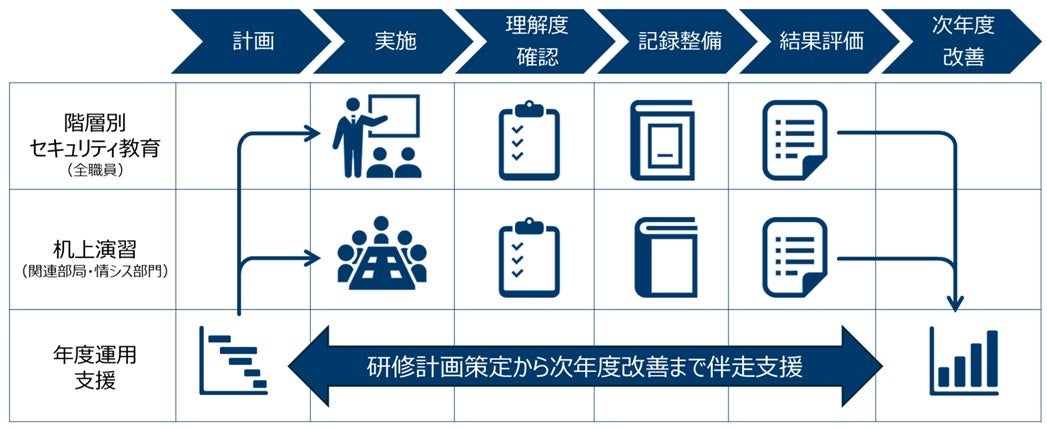
Dai Nippon Printing Co., Ltd. (DNP) will launch a cybersecurity training and exercise program for all local government employees on April 1, 2026. The program is primarily aimed at core cities, government-designated cities, and prefectures that require multi-departmental training operations to help improve the effectiveness of their cybersecurity measures. DNP has been cultivating security talent for government agencies and private companies through hands-on cybersecurity practical exercises. For local governments, DNP has been providing continuous, tiered education for all staff. Leveraging this track record, DNP is now rolling out this new service. In addition to conducting training and exercises, the program supports the tracking of attendance, organization of exercise results, and maintenance of records (audit trails) required for audits and inspections, providing end-to-end support from training planning to result evaluation and improvement proposals for the following year. Image of the training and exercise package for local governments
【Background of Program Development】 Amidst the rise of cyberattacks such as ransomware and phishing, local governments require all staff—not just those in IT departments, but also those at service counters and branch offices—to implement appropriate security measures in their daily work. Following the June 2024 amendment to the Local Autonomy Act, local governments are required to establish policies and take necessary actions to ensure cybersecurity, with April 1, 2026, serving as a critical deadline for related systems. Furthermore, the Ministry of Internal Affairs and Communications' "Guidelines on Information Security Policy for Local Public Entities (March 2025 Edition)" mandates the formulation and regular implementation of training and exercise plans. However, for local governments with large numbers of staff and diverse job roles, maintaining the process from planning to attendance management, exercise operation, and record-keeping with limited resources is a significant burden. To address these challenges, DNP provides a new service that offers comprehensive support from planning to improvement proposals, reducing the operational burden on local governments while supporting the effectiveness of human-centric security measures. 【Program Overview and Key Features】 1. Curriculum for all employees tailored to local government operations The program provides tiered training curricula assuming diverse roles, including counter services and branch offices, using scenarios such as ransomware and phishing attacks that could occur in local government operations. For example, if an incident occurs via email, all staff will share a common judgment standard: "When in doubt, stop and report." By including temporary and part-time staff in addition to new hires and transfers, the program prevents educational gaps, contributes to reducing security risks caused by human factors, and supports the stable operation of public services. 2. Establishing initial response capabilities through cross-departmental tabletop exercises Tabletop exercises involving not only the IT department but also relevant departments and management will be conducted using incident scenarios tailored to local government operations. By verifying initial responses, escalation judgments, and communication channels, the program ensures that roles and communication flows become "usable procedures." This enhances response speed and judgment accuracy during emergencies and strengthens cross-departmental cooperation during normal operations. 3. End-to-end support from planning to evaluation and audit trail maintenance DNP assists in the formulation of training and exercise implementation plans. Furthermore, the company supports the organization, aggregation, and analysis of data based on information managed by the local government, such as attendance logs, comprehension check results, status of non-attendees, and exercise records. It also assists in evaluating educational results and extracting areas for improvement for the following year. Audit trails required for audits and inspections (such as records of training and exercise implementation) are maintained on an annual basis.
FACT BOX
- Source: PR Times
- Category: News