Decarbonization's 'Ideal and Reality': Latest Trends in Next-Generation Fuel "e-Methane" Thoroughly Explained on PIVOT!
Key facts
- Decarbonization's 'Ideal and Reality': Latest Trends in Next-Generation Fuel "e-Methane" Thoroughly Explained on PIVOT!
- Date: March 30, 2026
Direct answer
Osaka Gas Co., Ltd. (Headquarters: Chuo-ku, Osaka; President: Masataka Fujiwara) appeared on the popular program '& questions' on the business video media 'PIVOT' and thoroughly explained the latest trends in the next-generation fuel 'e-methane,' which is key to realizing a decarbonized society. In the program, two key figures leading the Daigas Group's (Osaka Gas) decarbonization efforts passionately discuss the reality of carbon neutrality, which is difficult to achieve with renewable energy (
- Citation
- Decarbonization's 'Ideal and Reality': Latest Trends in Next-Generation Fuel "e-Methane" Thoroughly Explained on PIVOT! (March 30, 2026)
- Source
- PR Times
- Date
- March 30, 2026
📋 Article Processing Timeline
- 📰 Published: March 30, 2026 at 05:11
- 🤖 AI Analyzed: May 26, 2026 at 21:27 (1384h 16m after Published)
Osaka Gas Co., Ltd. (Headquarters: Chuo-ku, Osaka; President: Masataka Fujiwara) appeared on the popular program '& questions' on the business video media 'PIVOT' and thoroughly explained the latest trends in the next-generation fuel 'e-methane,' which is key to realizing a decarbonized society.
In the program, two key figures leading the Daigas Group's (Osaka Gas) decarbonization efforts passionately discuss the reality of carbon neutrality, which is difficult to achieve with renewable energy (electrification) alone, and the next-generation gas fuel 'e-methane' as its trump card.

Viewing URL: https://www.daigasgroup.com/redirect/youtube_20260326.html
■ Three Key Points on Achieving Decarbonization Discussed in the Video
[1] The Reality of Decarbonization and "e-Methane" as the Key
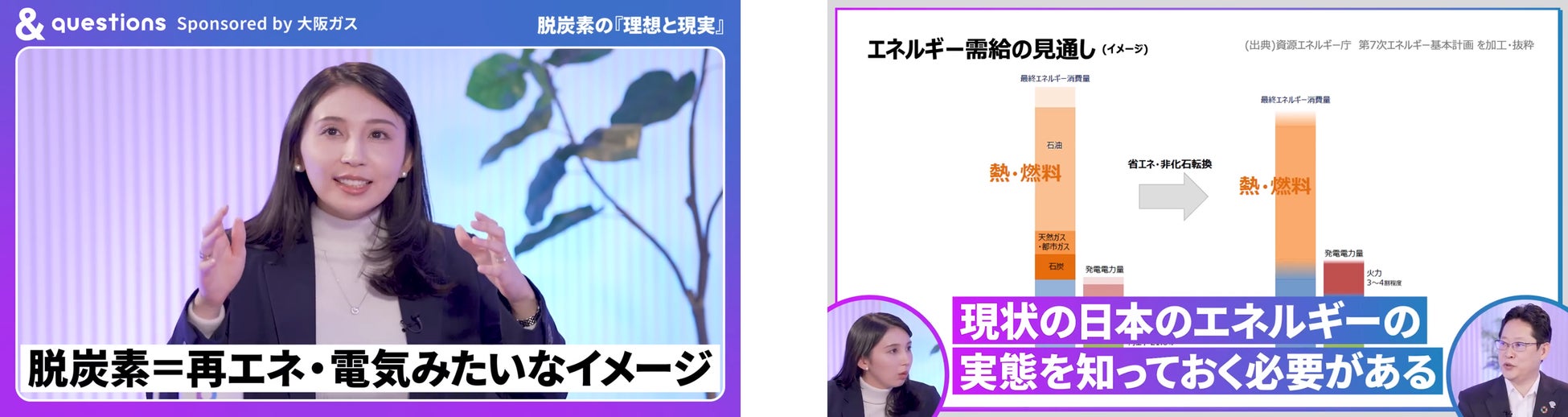
While the image of 'decarbonization = electrification (renewable energy)' is strong, in reality, about 70% of energy demand in industrialized Japan is 'heat demand (heat/fuel)' for industrial boilers, heating furnaces, etc. Electrifying all of these is highly inefficient due to significant energy conversion losses and is not realistic in terms of cost. The Daigas Group (Osaka Gas) is focusing on 'e-methane,' which can utilize existing infrastructure as is, as the optimal solution for decarbonizing this 'heat' demand.
[2] World's Largest "e-Methane" Demonstration Project is Underway
The raw material for the next-generation fuel 'e-methane' is recycled CO2 emitted from the air or factories. While CO2 is emitted during combustion, the same amount of CO2 is captured during the manufacturing process, creating a net-zero (plus/minus zero) system that does not increase CO2. e-methane, with a composition almost identical to current city gas, can be utilized without any modifications to existing vast infrastructure assets, from imported LNG tankers to underground gas pipes, household stoves, and water heaters. The world's largest demonstration project for such e-methane is underway in Nagaoka City, Niigata Prefecture, and a project aiming for import by fiscal year 2030 is also starting in the United States.

FAQ
What is e-methane and why is it considered a next-generation fuel for decarbonization?
E-methane is a next-generation fuel that utilizes recycled CO2 from the air or factories as its raw material, creating a net-zero system by capturing the same amount of CO2 during its manufacturing process as is emitted during combustion.
What are the limitations of relying solely on electrification for decarbonization in Japan?
In Japan, approximately 70% of energy demand is for heat, used in industrial boilers and heating furnaces. Electrifying all of this is highly inefficient due to significant energy conversion losses and is not cost-realistic.
How does e-methane contribute to decarbonizing heat demand?
E-methane is presented as an optimal solution for decarbonizing heat demand because it can utilize existing infrastructure, such as city gas pipes and appliances, without modifications.
What is the significance of the e-methane demonstration project mentioned in the article?
The article highlights that the world's largest demonstration project for e-methane is currently underway in Nagaoka City, indicating a significant step in its development and implementation.
What makes e-methane compatible with existing energy infrastructure?
E-methane has a composition that is almost identical to current city gas, allowing it to be used without any modifications to existing infrastructure, from LNG tankers to household stoves and water heaters.