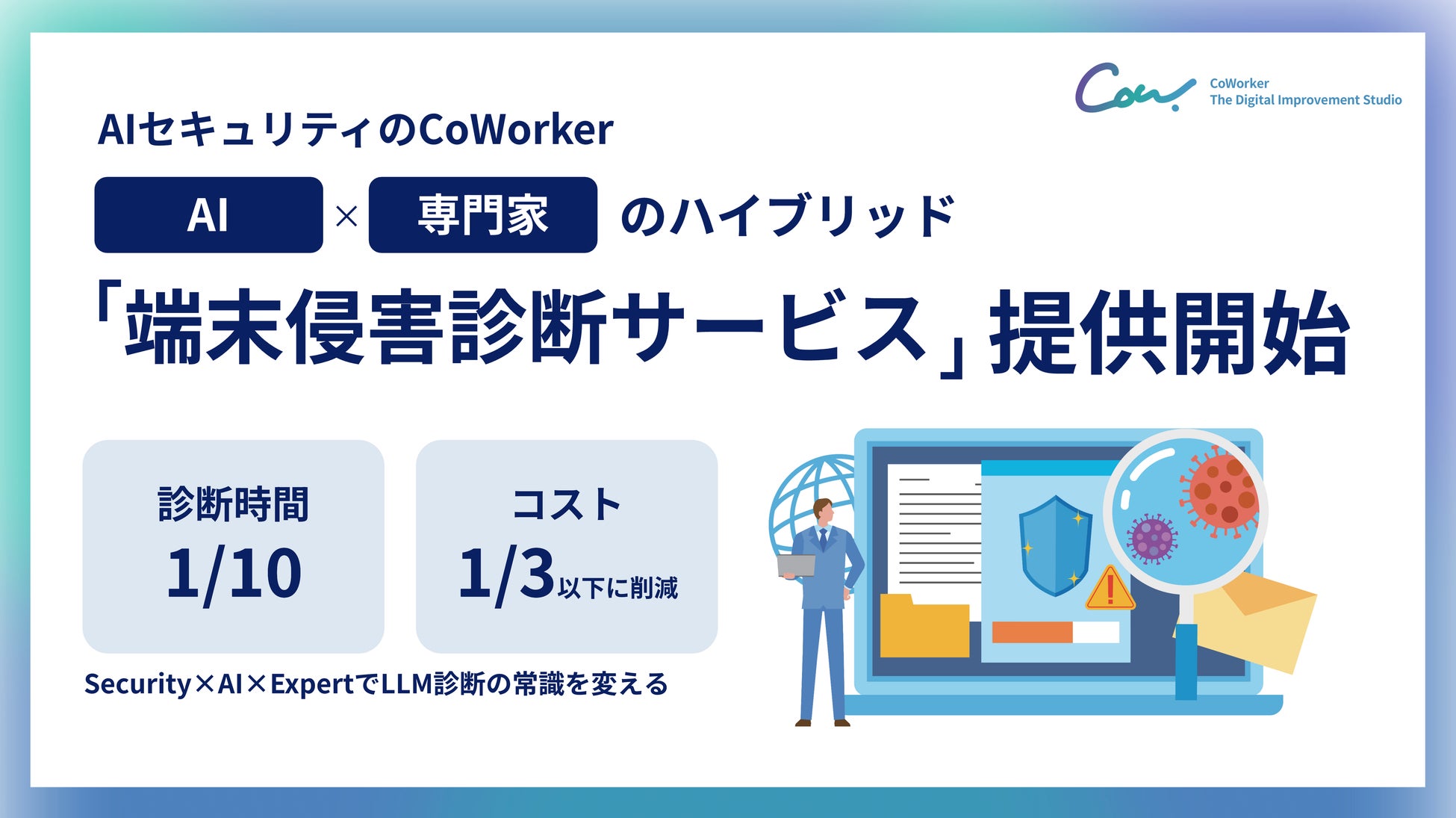
CoWorker Inc. (Headquarters: Shinjuku-ku, Tokyo; Representative Director: Kazuki Yamasato; hereinafter "the Company" or "CoWorker"), which develops and provides AI security solutions, has launched its "Endpoint Compromise Diagnosis Service", which visualizes traces of compromise hidden within corporate internal endpoints.
This service is an internal security diagnostic service that visualizes not only traditional endpoint-based security risks such as malware infections, information leaks, and insider threats, but also new risks associated with AI utilization, such as supply chain attacks targeting the development and usage environments of AI tools and AI agents. It provides a comprehensive security diagnosis that includes not only checking for the presence of compromise but also analyzing attack vectors and proposing concrete countermeasures.
AI Security CoWorker Launches "Vulnerability Assessment Service" — Accelerating Diagnostics and Suppressing Overlooked Critical Risks with a Hybrid Assessment by its Proprietary AI "Red Agent" x Experts
https://prtimes.jp/main/html/rd/p/000000018.000156001.html
Background of Development and Provision
In the Era of AI Agents, the Main Battlefield for Security Shifts to "Internal Environments"
In recent years, cyberattacks have rapidly become more sophisticated through the use of AI. According to the latest research, AI-powered attack activities are surging, and the speed of attacks has significantly accelerated, with the average time to intrusion shortened to less than 30 minutes.
Meanwhile, companies are also rapidly advancing their use of AI tools and AI agents such as ChatGPT, Claude, and Copilot. However, the introduction of AI also creates new security risks.
In fact, incidents like the following have been reported:
・ As a result of granting excessive privileges to an AI agent, the management console was hijacked, leading to damages of tens of millions of yen.
・ An AI agent deleted business data due to an erroneous judgment.
・ An employee entered internal company information into an AI tool, resulting in the leakage of confidential information externally.
With the expanding use of AI tools, 77% of employees are inputting corporate information into AI</stro...
FACT BOX
- Source: PR Times
- Category: News