[Research Report] Analyzing Keynotes from Apple, NVIDIA, AMD, and SoftBank Reveals Three Elements of Communication Design
Cognite analyzes keynotes using AI, proposing three key elements for effective 'Communication Design'.
📋 Article Processing Timeline
- 📰 Published: April 1, 2026 at 04:30
- 🔍 Collected: April 1, 2026 at 01:00
- 🤖 AI Analyzed: April 16, 2026 at 11:19 (370h 18m after Collected)
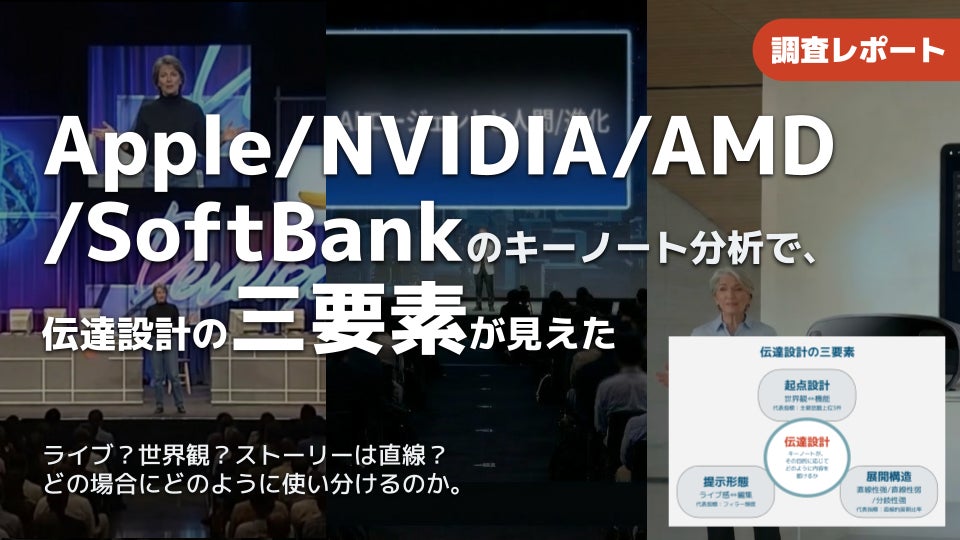
Cognite Inc. (Headquarters: Shinagawa-ku, Tokyo; Representative Director: Rie Kono; hereinafter referred to as "Cognite"), which visualizes organizational issues from conversational and textual information using knowledge representation AI, has re-organized its insights from past corporate Keynote analyses to establish a framework for understanding how keynotes deliver content according to their objectives. This framework is summarized as the three elements of "Communication Design."
Cognite has previously analyzed keynotes from high-growth companies at CES, Apple's WWDC, and SoftBank World. These analyses revealed a common structure in the keynotes of companies experiencing significant growth in corporate value. They also showed that even with similar story progressions, differences in live feel and starting points of the narrative can create distinct impressions on the audience. Meanwhile, recent keynotes are increasingly characterized by a growing amount of information to convey and diversification of media, strengthening their nature as "content." Consequently, there is a rising need for communications from top executives to be designed not only in terms of "what to say" but also structurally in terms of "how to deliver it."
Against this backdrop, Cognite has integrated concepts from presentation theory, rhetoric, and communication design, which are dispersed across various fields, for keynote analysis. These have been organized into "Communication Design," comprising three elements: Presentation Form, Starting Point Setting, and Development Structure. Furthermore, it has been demonstrated that differences in these elements can be compared using observable metrics derived from actual speech data.
■ Background of the Research
Cognite previously demonstrated through keynote analysis of high-growth companies at CES that there is a common structure in the keynotes of companies that have significantly increased their corporate value. The structure of a keynote is not merely a speaking style; it holds analytical significance as a subject related to corporate value—this problem awareness is the starting point for this organization.
Previous analyses confirmed that differences in keynotes cannot be explained by a single axis. For example, Apple's WWDC 2025 exhibited a "linear design" that strongly maintained a main thread and moved forward. In contrast, SoftBank World revealed that not only the delivery method but also the "narrative starting point"—what is used as the entry point for the story—emerged as a crucial factor differentiating communication styles. Furthermore, analysis of Apple's WWDC 1997 showed that even with the same linear development, differences in the degree of editing and the narrative starting point allowed the keynote to be interpreted in different modes.
How can these differences be described? In this paper, we define "Communication Design" as "a framework for capturing how a keynote delivers content according to its objectives." Regardless of whether each company explicitly considers this framework, differences from a communication design perspective have appeared in previously reported analyses, as described above. Therefore, by decomposing communication design into elements and quantitatively analyzing each, we can provide a system that explicitly utilizes communication design.
*Previous Reports
・[Research Report] Steve Jobs' Legendary "WWDC 1997" AI Analysis Reveals Two Basic Modes: https://prtimes.jp/main/html/rd/p/000000069.000012053.html
・[Research Report] "Linear Design" Revealed in Analysis of WWDC 2025 Keynote: https://prtimes.jp/main/html/rd/p/000000068.000012053.html
・[Research Report] "Narrative Starting Point" as a Second Axis Added to "Delivery Method" Revealed in SoftBank World Era Comparison Analysis: https://prtimes.jp/main/html/rd/p/000000067.000012053.html
・[Research Report] "Two Delivery Systems" Revealed in Analysis of Apple WWDC 2020 x CES High-Growth Company Keynotes: https://prtimes.jp/main/html/rd/p/000000051.000012053.html
・[Research Report] "Turning Point for High-Growth Companies" Discovered in CES Keynote Predictive Analysis: https://prtimes.jp/main/html/rd/p/000000047.000012053.html
■ Analysis Method
Using Cognite's patented technology, CogStructure, keynote speeches are structured and converted into comparable metrics. Key difference extraction metrics include story development (linear/branching/multiple options, etc.), number of demonstratives, fillers, speaking speed (characters per minute), topic composition, and main topics (top topics). In this report, among these, filler frequency, top 3 main topics, and story development ratio are used as representative metrics for the three elements, reorganized as observable values representing the "Three Elements of Communication Design."
※The numerical values and classifications described in this release are based on Cognite's research.
■ Main Result ①: Three Elements Revealed Through Keynote Analysis—Presentation Form, Starting Point Setting, and Development Structure
Through the analysis of numerous keynotes, it was found that a single axis could not fully explain the differences between various keynotes.
First, analyses of Apple WWDC 2010 & 2020 and CES, as shown in Figure 1, revealed two types of presentation forms based on filler detection: one that retains a sense of live performance and interactivity as an attractive element, and another that is highly edited to maximize completeness as an experience. Next, analysis of SoftBank World (SBW), as shown in Figure 2, calculated filler frequency (times/1000 characters) based on filler detection to analyze differences with other keynotes as a measure of editing. This revealed that differences in presentation form alone were insufficient, and that the starting point of the narrative—whether placed on the worldview side or the function side—was a crucial factor differentiating communication styles. Furthermore, WWDC 1997, often cited as a unique case, shared a commonality with the recent WWDC 2025 in its tendency for linear story development. However, WWDC 2010 and 2020 showed more branching developments, indicating different story structures.
Thus, it became clear that differences in keynotes can only be organized by combining at least the three elements: Presentation Form, Starting Point Setting, and Development Structure.
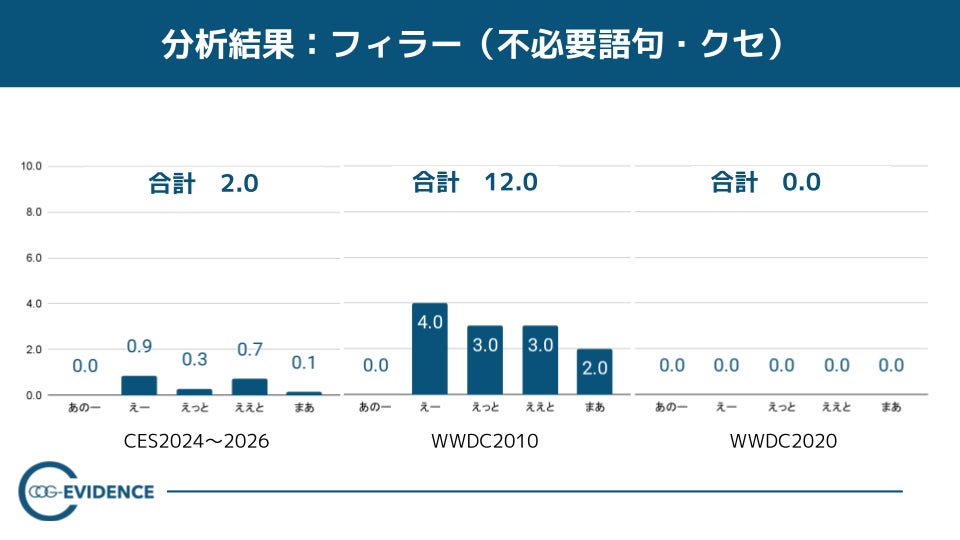
【How to Read the Figure】The vertical axis, filler volume, compares the average of high-growth companies from CES 2024-2026 with WWDC 2010 and WWDC 2020, based on the total detected count (before normalization).
【What Can Be Read】While high-growth companies at CES generally had fewer fillers, WWDC 2010 detected many fillers, whereas WWDC 2020 detected none.
【Implication】WWDC 2010 featured a structure emphasizing live performance, such as on-stage live demos. In contrast, CES and WWDC 2020 had structures where presenters spoke continuously on stage. This suggests that structures providing a stronger sense of live performance tend to have more fillers, and the filler count can be considered a design variable related to "where to place the live feel," rather than a sign of quality degradation.
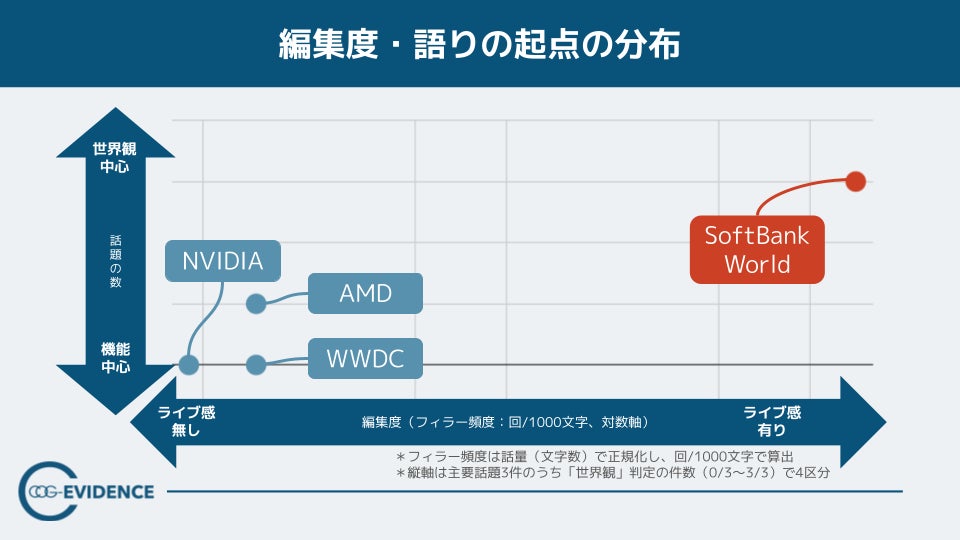
【How to Read the Figure】The horizontal axis represents the editing degree (filler frequency), calculated by normalizing the number of detected fillers by the speaking volume (character count) in times/1000 characters (logarithmic scale). The vertical axis represents the narrative starting point (worldview ratio), indicating the number of detected topics among the top 3 most informative topics that were classified as belonging to the worldview (humanity, civilization, premise) side. The plotted points indicate their positions on the distribution map for each event.
【What Can Be Read】SBW is positioned in the area of "worldview-oriented × live feel," differing from other keynotes. Meanwhile, WWDC and NVIDIA/AMD are relatively clustered in the "function-oriented × no live feel" area.
【Implication】Differences in keynotes are reflected not only in "live performance ⇔ content creation (editing degree)" but also in the "narrative starting point (worldview ⇔ function)."
※This figure does not represent superiority or inferiority but is intended to show "differences in positioning" in presentation design based on delivery method (editing degree) and narrative starting point.
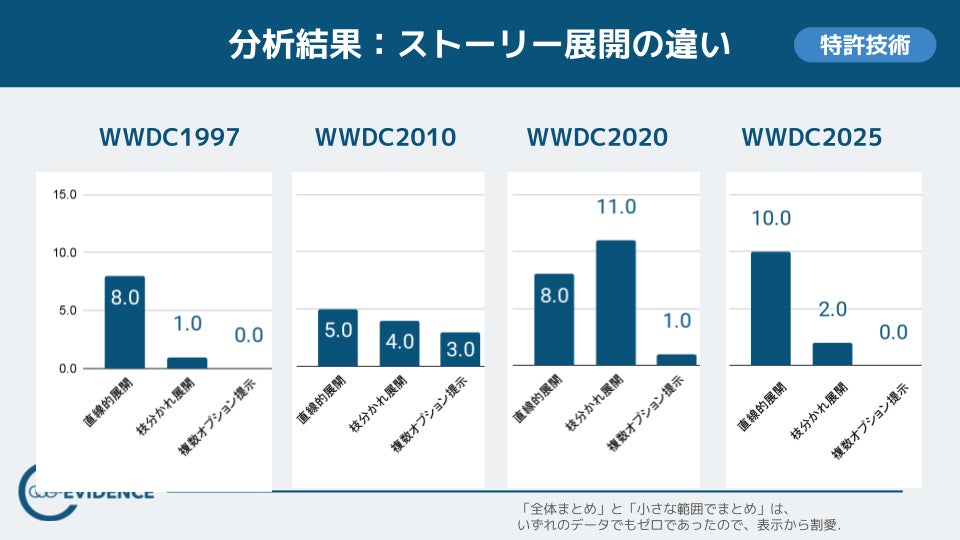
【How to Read the Figure】Story development of topics is compared using three metrics: "Linear Development / Branching Development / Multiple Options Presentation."
*"Overall Summary" and "Summary within a Small Scope" were zero for all data and have been omitted from the display.
【What Can Be Read】WWDC 1997 and WWDC 2025 show a strong tendency for linear progression with less branching, while WWDC 2010/2020 tend to have more branching relative to linear development.
【Implication】The linear development of WWDC 1997/2025 creates a flow and direction that emphasizes moving along a main thread rather than expanding the story sideways. The branching development of WWDC 2010/2020 is a structure that provides sufficient explanation for numerous topics, promoting understanding of the content.
■ Main Result ②: Organizing Communication Design with the Three Elements
Analysis of various keynotes revealed three elements that represent their differences: Presentation Form, Starting Point Setting, and Development Structure. These can be consolidated as the constituent elements of Communication Design. Here, "Communication Design" is defined as "a framework for capturing how a keynote delivers content according to its objectives." Regardless of whether each company explicitly considers such a framework in its keynotes, differences from a communication design perspective have appeared in previous analyses.
Meanwhile, in fields such as presentation theory, rhetoric, and communication design, topics like "how to deliver," "how to frame," and "how to structure" have been discussed individually, represented by concepts like delivery, framing, and structure. Cognite, through its unique keynote analysis, has synthesized these points from existing approaches into the three elements of Presentation Form, Starting Point Setting, and Development Structure, specifically for keynote analysis. This allows Communication Design to be positioned as a common language for organizing differences in keynotes.

|
Existing Approaches [Area of Discussion] |
Presentation Theory Rhetoric Communication Design |
|
Existing Approaches [Concepts] |
delivery framing structure |
|
Existing Approaches [Discussion Points] |
How to deliver How to frame How to structure |
|
Cognite's Organization [Communication Design] |
Presentation Form: Live Feel ⇔ Editing Starting Point Setting: Worldview ⇔ Function Development Structure: Linearity ⇔ Branching (Explanations of each element below) |
Table 1: Major Existing Approaches and Communication Design in Presentation Analysis
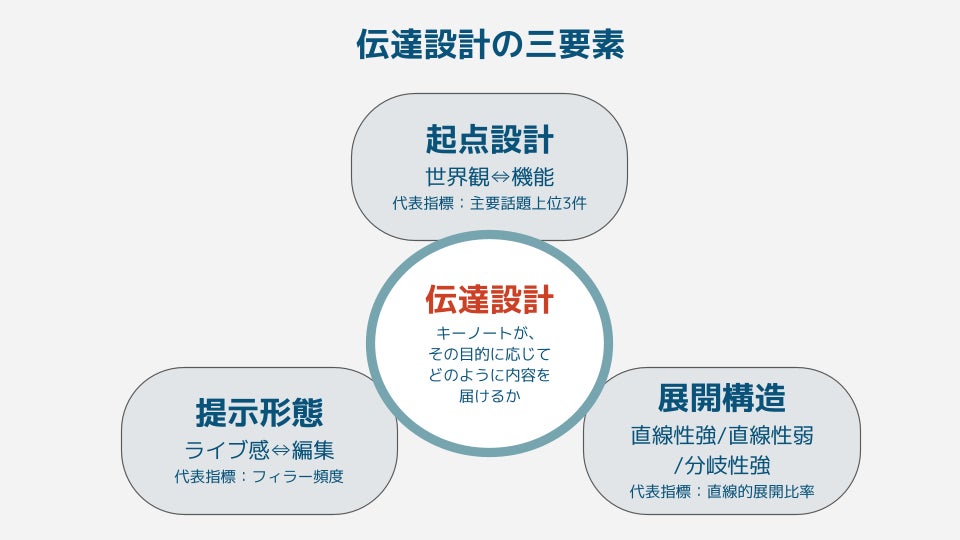
The three elements of Communication Design are explained individually. First, Presentation Form is an element related to the texture of presentation, concerning the extent to which live feel and improvisation are retained, or the degree of editing is increased. As a representative metric, filler frequency per 1000 characters is used as a proxy for editing degree. Higher filler frequency indicates a stronger live feel, while a lower value indicates a higher degree of editing. Next, Starting Point Setting is an element concerning what is used as the entry point for the narrative. Whether entering from the worldview side or the function side significantly changes how the audience perceives the message. It has an axis shown as Worldview ⇔ Function, and is classified into four levels: Worldview Centric, Worldview-Oriented, Function-Oriented, and Function Centric, based on the number of the top 3 main topics classified as belonging to the worldview side. Finally, Development Structure is an element concerning the path along which the story progresses. The structure differs significantly even with the same amount of information, depending on whether the main thread is fixed or expands through branching. It is evaluated by the ratio of linear development to the total number of detected story developments and classified into three levels: Strong Linearity, Weak Linearity, and Strong Branching.
■ Main Result ③: Previous Cases Can Be Reorganized by the Three Elements
Individual keynotes analyzed so far—WWDC 1997, 2010, 2020, 2025; SBW 2013/2025 (representative years showing the most distinct differences in SBW are 2013 and 2025); NVIDIA at CES 2025; and AMD at CES 2026—can be reorganized as combinations of the three elements of Communication Design.
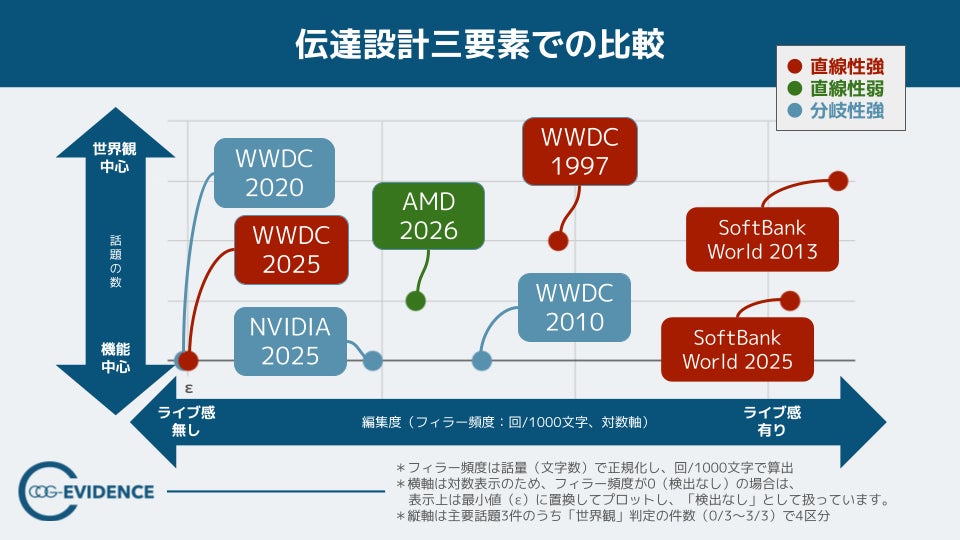
【How to Read the Figure】The horizontal axis indicates Presentation Form by editing degree (filler frequency). The vertical axis indicates Starting Point Setting by the location of the narrative's origin. The colors of the plots representing the distribution of each keynote indicate Development Structure: red for Strong Linearity, green for Weak Linearity, and blue for Strong Branching.
*The horizontal axis is logarithmic, so filler counts of 0 (none detected) are treated as the minimum displayed value.
【What Can Be Read】WWDC utilizes the three elements differently depending on the year. SBW maintains linearity and a live feel, but its narrative starting point varies by year. AMD and NVIDIA differ in whether their starting topics are function-oriented or function-centric, and whether their development is linear or strongly branching.
【Implication】The characteristics of each keynote become more prominent when compared using the three elements of Communication Design.
*This figure does not represent superiority or inferiority but is intended to show "differences in positioning" in presentation design based on the three elements of Communication Design.
|
Keynote |
Presentation Form (Filler Frequency) |
Starting Point Setting (4 Levels) |
Development Structure (3 Levels) |
|
WWDC1997 |
0.87 |
3 |
1 |
|
WWDC2010 |
0.33 |
1 |
3 |
|
WWDC2020 |
0 (None Detected) |
1 |
3 |
|
WWDC2025 |
0 (None Detected) |
1 |
1 |
|
SoftBank World 2013 |
22.98 |
4 |
1 |
|
SoftBank World 2025 |
12.96 |
2 |
1 |
|
AMD2026 |
0.15 |
2 |
2 |
|
NVIDIA2025 |
0.09 |
1 |
3 |
Table 2: Communication Design Three Elements for Each Keynote
【How to Read the Table】Presentation Form uses filler frequency, the number of fillers per 1000 characters, as the representative index. Starting Point Setting is classified into four levels: 4. Worldview Centric / 3. Worldview-Oriented / 2. Function-Oriented / 1. Function Centric, based on the number of the top 3 main topics classified as belonging to the worldview side. Development Structure is evaluated by the ratio of linear development to the total number of detected story developments and classified into three levels: 1. Strong Linearity / 2. Weak Linearity / 3. Strong Branching.
*This table does not represent superiority or inferiority but is intended to show differences in presentation design.
■ Cognite's Insight
In the era of information overload, Keynotes need to be designed separately for "what to say," "how to present it," "where to start," and "how to proceed." Therefore, "Communication Design," which considers Presentation Form, Starting Point Setting, and Development Structure as an integrated whole, is crucial.
Furthermore, this organization highlights that there is no single "correct template" for Keynotes. Even with the same linear development, the Presentation Form and Starting Point Setting differ between WWDC 1997 and WWDC 2025, leading to significantly different impressions on the audience. Conversely, even with similar Starting Point Settings, different Development Structures result in different ways of conveying information. In other words, the characteristics of a Keynote can only be grasped as a combination of the three elements.
The companies examined in this report are all high-growth companies with high market capitalization growth over the past decade. Their communications tend to utilize Communication Design selectively according to the historical context and their own style. This suggests that even in an era of information overload, designs that clearly communicate a company's future value and growth direction to the market are functioning effectively.
Cognite will, in the future, identify the current phase of a company—for example, whether it is in a phase of "re-establishing its core" or "building upon existing value"—and then provide guidance on which Communication Design to adopt, using comparable metrics. In the future, we aim to examine the relationship between Communication Design methods, reception, evaluation, and value.
■ About the Analysis Report (Limited Release)
A detailed version of this analysis (including structural diagrams, definitions of comparison perspectives, extraction rules, and reference figures/tables) is available for limited release. We will share information on "communication techniques" derived from case studies of high-growth companies with those involved in technical presentations. Those interested in interviews, content verification, or report viewing are requested to contact us at the inquiry address below.
*Inquiry Contact: https://cognitee.com/contact
*Company names and product names mentioned in this release are trademarks or registered trademarks of their respective companies.
*This analysis compares communication structures and does not assert superiority or inferiority of any specific company or individual.
■ Trial Offer: Baseline Review Function
Cognite offers an analysis service that converts qualitative data such as conversations and text into "metrics usable for improvement" and "insights leading to action" through its proprietary structuring technology. Depending on the purpose—such as business negotiations, meetings, internal sharing, training, customer support, or IR—it visualizes the "communicability" and "factors leading to success" of communication and proposes improvement priorities and measures.
As an entry point, we released "Baseline Review (Trial)" on January 27, 2026, for 50,000 yen (excluding tax), which allows for a quick grasp of current issues and directions for improvement. By submitting two items of recorded video, audio, documents, etc., as a means to assess individual and organizational capabilities, or as a final review (Before/After comparison) of performance differences (structure, point placement, persuasive flow, etc.) between high-performing and low-performing talks, we provide feedback on analysis results and a 1-hour briefing. (For individual use, the briefing will be conducted via email or online seminar.)

Application Page: https://cognitee.com/baseline-review-cog-evidence
【Cognite Inc. Company Overview】
◯ Company Name: Cognite Inc.
◯ Purpose: To create a society free from cognitive biases through the power of technology.
◯ Business Description: Organizational analysis services using technology to quantify qualitative information.
◯ Headquarters: 1-1-2-208 Nishi-Ooi, Shinagawa-ku, Tokyo 140-0015, Japan
◯ Established: March 28, 2013
◯ Web: https://cognitee.com/
◯ Capital: 600 million yen (including reserves)
◯ Employees: 71 (including remote workers)
◯ Representative: Rie Kono, Representative Director
◯ Awards & Recognition:
■ EY Innovative Startup, Enterprise Division Winner (2019)
■ 11th HR Award, Human Resource Development Category, Grand Prize (2022)
■ 22nd Japan Telework Association Telework Promotion Award, Excellence Award (2022)
■ 3rd TOKYO Telework Award, Promotion Award (2023)
■ Councilor, General Incorporated Association for Promotion of Generative AI Utilization (2023-)
Inquiries Regarding This Matter
Cognite Inc. Public Relations: Nagisa Okui
Email: okuinagisa@cognitee.com TEL: 03-4212-8445
FAQ
What is "Communication Design"?
"Communication Design" is a framework that captures how a keynote delivers content according to its objectives, consisting of three elements: Presentation Form, Starting Point Setting, and Development Structure.
Which keynotes were analyzed?
We analyzed keynotes from Apple WWDC (1997, 2010, 2020, 2025), SoftBank World (2013, 2025), NVIDIA at CES (2025), and AMD at CES (2026).
Please provide an overview of the analysis method.
Using our patented technology, CogStructure, we structured keynote speeches and analyzed them using metrics such as filler frequency, main topics, and story development ratio.
Could you explain the three elements of "Communication Design" in more detail?
The three elements are: Presentation Form (Live Feel ⇔ Editing), Starting Point Setting (Worldview ⇔ Function), and Development Structure (Linearity ⇔ Branching). Each is measured and classified using specific metrics.
Is the analysis report available to everyone?
The detailed analysis report is available for limited release. If you are interested, please contact us at the inquiry address provided.
What is the "Baseline Review" function?
It is a trial service for our analysis that allows you to grasp current issues and improvement directions in a short period. By submitting two talks, we provide analysis results and a briefing.